Last updated: August 8, 2026
You bought the post, you carried it home, you put it together, and your cat has used it exactly zero times. Meanwhile the couch keeps taking damage. If you are wondering how to get a cat to use a scratching post, the good news is that this is almost never a stubborn cat problem. It is usually a placement problem, a height problem, or an introduction problem, and all three are fixable in an afternoon.
Below is an eight step routine you can start today, in the order that tends to work best: get the post into the right spot first, make it worth using second, and only then make the couch less appealing. There is also a troubleshooting table for the “it still is not working” cases, plus an honest look at what catnip does and does not do.
Quick Answer
Move the post to the spot your cat already scratches, then reward the behavior when it happens.
- Placement first: put the post directly beside the couch arm or door frame your cat is using, not in a spare room.
- Make it inviting: tall enough for a full stretch, heavy enough not to wobble, and introduced through wand play rather than pressure.
- Never take your cat’s paws and drag them down the post. It reliably teaches cats to avoid the post entirely.
Top Picks on Amazon
Prices and availability may change. Check the current listing on Amazon.



The 8 Step Routine to Get Your Cat Using the Post
Work through these in order and give each step a few days. Most cats respond somewhere in the first four steps, and the later ones are for holdouts.
- Move the post to the scene of the crime. This single change fixes more cases than everything else combined. Put the post right next to the couch arm, door frame, or chair your cat is already scratching, close enough that they could reach either one. A post in the guest room is competing with furniture in the middle of the household, and it loses. Once it is being used consistently for a few weeks, you can inch it toward where you would prefer it to live.
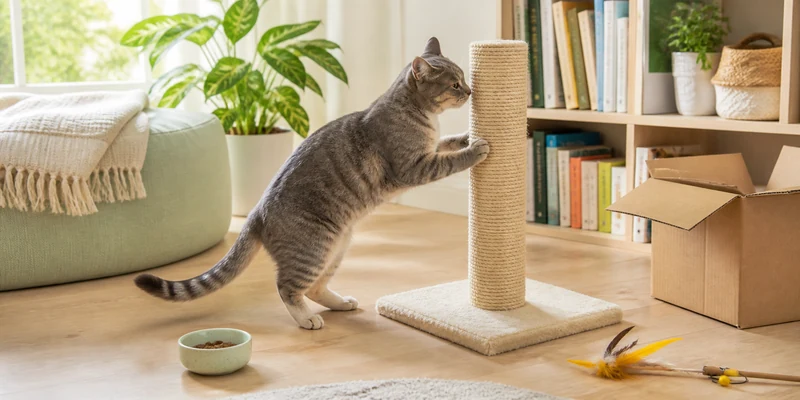
- Check that the post can do its job. Three specs decide whether a post gets adopted: taller than your cat’s full standing reach with the front paws extended, a base heavy or wide enough that it does not shift when pulled, and a coarse surface such as sisal rope, sisal fabric, or corrugated cardboard. If your post fails any of those, no amount of coaxing will fix it. Our guide to what matters in a cat scratching post covers height, base weight, and material.
- Do nothing for a day or two. New objects are suspicious objects. Set the post in place, then ignore it and let your cat investigate on their own schedule. Many cats will sniff it, rub their face on it, and try a tentative pull within a couple of days with no help at all.
- Introduce it through play, never through paws. Drag a wand toy up the side of the post so your cat chases it and their claws catch the surface on the way, which gives them the texture without any pressure. This is also where the most common mistake happens: do not pick up your cat, carry them over, and move their paws down the post. Cats associate that with being restrained, and the usual result is a cat who avoids the post on sight.
- Reward the moment it happens. When your cat scratches the post, even briefly, mark it right away with quiet praise and a treat, ideally within a couple of seconds. Timing matters more than the size of the reward, since a treat delivered a minute later is unrelated as far as the cat is concerned. Keep treats near the post for the first week.
- Add scent, with realistic expectations. Catnip is worth trying, but it is not a switch. A meaningful share of cats do not respond to it at all, and kittens usually do not react until they are several months old. If yours is a responder, rub dried catnip into the sisal or sprinkle it at the base and refresh it every few days, since the effect fades as the oils dry out. Silvervine and valerian are alternatives that some non responders react to, and attractant sprays get mixed reports from owners, so treat both as optional extras rather than the plan.
- Tie it to your cat’s natural scratching moments. Cats scratch most after waking up, when you come home, and around play. Lead a play session to the post, or start one next to it right when your cat stretches after a nap. Attaching the post to a routine your cat already has beats trying to create interest at a random moment.
- Only now make the old spot less rewarding. Once the post is getting real use, discourage the couch with double sided tape, a slipcover, or a piece of cardboard over the corner. Doing this earlier usually just moves the scratching somewhere new. Add first, redirect second, and never remove the old option until the new one is winning.
One thing worth being clear about: the goal is not to stop your cat from scratching. Scratching is normal maintenance and communication behavior that a cat cannot choose to give up, so the entire exercise is about relocating it. If the reasoning behind that is new to you, why cats scratch covers what the behavior actually accomplishes.
Why Placement Does Most of the Work
People tend to buy a post based on how it looks, then place it wherever it is least in the way. Cats choose scratching spots on almost the opposite logic. The marks are meant to be seen and smelled by others, so cats favor prominent, high traffic locations: the corner of the sofa facing the door, the hallway junction, the spot next to where their people sit. A post in a quiet corner asks your cat to give up everything they picked that location for.
Timing is the other half of it. Much of what looks like scratching is a stretch, which is why so many sessions happen right after a nap, so a post near a favorite sleeping spot catches that moment and a post across the house does not. If your cat sleeps in three places, that argues for more than one scratching surface rather than one perfectly chosen post. In multi cat homes, plan for separate stations: two cats sharing one post often means the lower ranking cat quietly stops using it and finds furniture instead.
Troubleshooting: When Your Cat Still Ignores It
If you have run the routine for two weeks with nothing to show for it, match what you are seeing to the row below.
| What you are seeing | Likely cause | What to change |
|---|---|---|
| Sniffs it once, then ignores it | Wrong location, or the post is still an unfamiliar object | Move it beside the spot being scratched now and give it two more weeks before judging |
| Uses the post, then goes back to the couch anyway | Normal during the transition; the couch is still available and rewarding | Keep both, reward every post session, and add a cover or tape to the couch corner |
| Scratches the rug or carpet instead | Horizontal preference, which a vertical post cannot satisfy | Add a flat cardboard or sisal mat scratcher in the same room |
| Starts to scratch, then stops abruptly | The post shifts or tips under a real pull | Weight the base, brace it against a wall, or replace it with a heavier model |
| No reaction to catnip at all | Your cat is likely a non responder, which is common | Skip the catnip and lean on wand play and treat timing instead, or try silvervine |
| Used it as a kitten, quit as an adult | Outgrew the height, so it no longer delivers a full stretch | Move up to a taller post and keep the old one as a secondary station |
If a cat who used a post happily for years suddenly stops, especially alongside hiding, appetite shifts, or litter box trouble, mention the pattern to your veterinarian rather than treating it as a furniture question. Sore joints can make stretching upward uncomfortable.
Common Mistakes That Set the Process Back
Most stalled cases involve one of these, and several of them actively make things worse rather than simply not helping.
- Taking the paws and forcing the motion. The most common well meant mistake. Being held and manipulated is unpleasant for most cats, and the post is what gets blamed. Once a cat has learned to avoid the post, you may need to move it to a new spot and start over.
- Punishing the couch scratching. Yelling, spray bottles, or a swat teach a cat to scratch when you are out of the room, not to stop. They also make the reward step harder by souring the association with you.
- Blocking the couch before the post is established. Covering the old spot first usually relocates the problem to a third piece of furniture instead of to the post.
- Giving up after three days. Two to four weeks is a realistic window for a new habit, and cats who ignore an object initially often adopt it once it stops being new.
- Offering one texture and calling it settled. Vertical sisal, flat cardboard, and rough wood are genuinely different experiences, and putting out two options for a week settles the question quickly.
What to Do Next
Where you go from here depends on what is still going wrong. If the furniture is taking damage while you work through the routine, the deterrent and redirection tactics in how to stop a cat from scratching furniture pair well with these steps. If you are still unsure why your cat picked the spot they picked, why cats scratch explains what each location tells you. And if vertical space is thin in your home, the placement logic in where to place a cat tree follows the same principles.
Frequently Asked Questions
How long does it take for a cat to start using a scratching post? Many cats try a well placed post within a few days, but two to four weeks is a fair window before you conclude something is off. If nothing has happened by then, the cause is usually location, height, or stability rather than motivation.
Should I put my cat’s paws on the post to show them? No. Holding a cat and moving their paws down the post is the single fastest way to teach avoidance. Use a wand toy dragged up the post instead, so your cat comes to it under their own power.
Does catnip really work for this? Sometimes. A significant share of cats do not respond to catnip at all, and kittens generally do not react until several months old. Silvervine works for some non responders, and play plus well timed treats works regardless.
My cat uses the post but still scratches the couch. What now? That is normal progress rather than failure. Keep rewarding the post, and now make the couch corner less pleasant with double sided tape or a cover, since the post is established enough to absorb the redirected behavior.
Do I need more than one scratching post? Usually yes in homes with multiple cats or multiple floors, and often yes for a single cat with several sleeping spots. Cats scratch where they wake up and where they socialize, so one post rarely covers every trigger point.
The Bottom Line
Move the post next to the furniture your cat is already scratching, make sure it is tall enough for a full stretch and heavy enough not to wobble, and introduce it with wand play rather than by handling your cat’s paws. Reward each session within a couple of seconds, treat catnip as an optional extra rather than the plan, and only make the old spot less appealing once the post is getting regular use. Give the whole routine two to four weeks before you decide it is not working.