Last updated: August 8, 2026
You walk into the living room and there it is again: fresh vertical lines down the arm of the couch, right next to a scratching post your cat has apparently never noticed. So why do cats scratch, and why that spot, and why now? It can feel personal, especially at two in the morning on the side of the mattress. It is not.
Scratching is a normal, hardwired behavior that does several jobs at once, from claw care to leaving a message for other cats. Working out which job your cat is doing in a given spot turns “my cat is destroying the furniture” into a solvable setup problem. Below: what the behavior accomplishes, how to read the locations your cat picks, and what genuinely helps.
Quick Answer
Cats scratch for five overlapping reasons, and none of them are spite.
- The physical jobs: shedding the outer claw sheath and stretching the back, shoulders, and toes.
- The communication jobs: leaving scent from the paw pads and leaving visible marks that other cats can read.
- The emotional job: an outlet for excitement, frustration, or stress, which is why it spikes at greetings, after naps, and during household changes.
Top Picks on Amazon
Prices and availability may change. Check the current listing on Amazon.



The Five Reasons Cats Scratch, at a Glance
Most scratching sessions are a mix of these, but one usually dominates. Match what you are seeing to the row that fits, since the reason points straight at the fix.
| Reason | What it looks like | What it tells you |
|---|---|---|
| Claw maintenance | Repetitive pulling on a rough surface, small crescent shaped shells left behind | Your cat needs a coarse, shreddable texture, not a smooth one |
| Stretching | Long reach upward, body extended, often right after waking up | The surface has to be tall enough for a full stretch and it must not move |
| Scent marking | Kneading and dragging paws down, often in doorways and walkways | Location matters more than the object; this spot is socially important |
| Visual territory marking | Deep, obvious marks on prominent furniture in the busiest room | Your cat wants the mark seen; hiding the post in a spare room will not work |
| Emotional outlet | Bursts at your arrival home, before play, or during household stress | The trigger is arousal, so timing and placement matter more than the texture |
Worth saying plainly: none of these are misbehavior, and a cat cannot decide to stop having them. The goal is never to eliminate scratching but to give it somewhere better to happen.
A Closer Look at What Scratching Does
Each reason changes what a scratching surface needs to be, so it helps to take them one at a time.
1. Claw maintenance
Cat claws grow in layers. As a claw grows, the worn outer sheath loosens, and scratching against a coarse surface helps pull it away to reveal the sharper claw underneath. Those little curved husks at the base of a post are shed sheaths, not broken claws. This is why texture decides everything: sisal rope, sisal fabric, and corrugated cardboard give claws something to catch on, while smooth wood or slick fabric does not. It is also why the couch keeps winning, since woven upholstery grabs claws about as well as sisal does.
2. Stretching
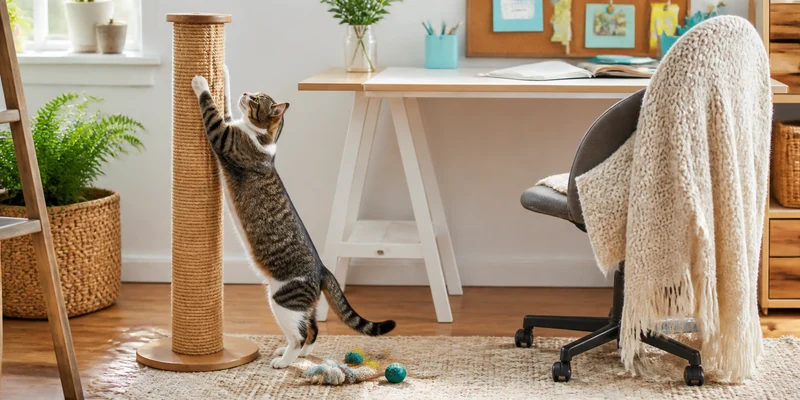
Watch a cat scratch after a nap and you are mostly watching a stretch: front paws reaching up, shoulders and back extending, toes spreading. That is why post height comes up constantly in owner reviews. A post shorter than your cat’s full standing reach does not deliver the stretch, so it gets used once and abandoned. Measure your cat standing on the hind legs with the front paws extended, then add a few inches. A wobbly post fails the same way, since a cat pulling backward against something unstable gets no resistance.
3. Scent marking
Cats have scent glands between the pads of their paws, so scratching deposits scent along with the marks. That is invisible to us and obvious to another cat, and it explains the seemingly random locations: entryways, the corner where the hallway meets the living room, the side of the sofa facing the door. Those are traffic points, and in multi-cat homes the marking often increases where two cats share tight quarters.
4. Visual territory signals
The shredded marks are themselves a message. A conspicuous set of claw lines at cat height says someone lives here, and cats place them where they will be seen rather than tucked away. The practical consequence: a post banished to a back bedroom is competing with a couch in the middle of the household, and the couch wins on location before texture is even a factor.
5. Emotion and arousal
Scratching also works as an outlet for a surge of feeling: when you come home, right before a play session, when another cat appears at the window, or during a change such as a move or a new pet. Owners frequently report that it increases during unsettled stretches and settles again afterward. If it escalates suddenly alongside other changes such as hiding, litter box trouble, or altered appetite, raise that pattern with your veterinarian rather than treating it as a furniture problem.
What Your Cat’s Chosen Spot Tells You
The location and angle your cat picks is the most useful information you have, and it is free. Spend a few days noting where the marks appear.
- Couch arms and door frames. Vertical scratching with a full stretch. Your cat wants a tall, rock solid post, and it needs to go near the spot being used now, not across the house.
- Rugs, carpet, or a doormat. Horizontal preference. A vertical post will not satisfy this; a flat cardboard or sisal mat scratcher is the match.
- Right by the front door or a hallway. Strong scent and territory component. Placement beats product here, and a post in that walkway will usually get adopted quickly.
- Multiple spots around one room. Often a multi-cat signal. Two cats sharing a space typically need separate scratching stations rather than one shared post.
- The bed or your chair specifically. These carry your scent, and cats often scratch where their people spend time. It is a social behavior, not defiance.
Once you know which type you are dealing with, choosing the surface becomes straightforward. Our guide to what matters in a cat scratching post covers height, base weight, and material, which are the three specs that decide whether a post gets used at all.
Nail Trims, Posts, and the Declawing Question
Because scratching is normal and self-maintaining, the workable approach is to manage it rather than suppress it. Two things do most of the work.
Give the behavior a better target. That means the right texture, enough height for a full stretch, a base heavy enough that the post does not shift, and placement in the room your cat actually uses. Sisal posts tend to hold up longer than carpeted ones, which also blur the message that rugs are off limits, and a flat scratcher is worth adding if your cat works on the carpet.
Keep the claws trimmed. Trimming the sharp tips reduces snagging and furniture damage without taking anything away from the cat. Many owners find it easiest to do one or two paws at a time while a cat is sleepy, and your veterinarian or a groomer can demonstrate the technique and how far to stay from the quick.
Declawing is a different matter entirely. It is not a nail trim: it is a surgical procedure that removes part of each toe, it is banned or restricted in a number of places, and many veterinary organizations discourage it. If someone has suggested it to you, treat it as a conversation to have with your veterinarian about your specific cat rather than a routine option, and ask about alternatives first. For nearly every household, appropriate posts plus routine nail trims address the problem that declawing is meant to solve.
Common Mistakes When You Read Scratching Behavior
Most frustrating scratching situations trace back to one of these misreadings rather than to a difficult cat.
- Treating it as a discipline issue. Punishment tends to teach a cat to scratch when you are not in the room, not to stop. The behavior itself is not optional for the cat.
- Buying short and light. A post that tips or that stops below a full stretch fails at two of the five jobs at once. Stability and height come before looks or the number of levels.
- Hiding the post. Putting a scratching post in a corner nobody visits is asking your cat to give up the territory value of the spot they chose. Prominence is part of the point.
- Offering one texture only. Cats have individual preferences, and vertical sisal, flat cardboard, and rough wood are not interchangeable. Trying two surfaces settles the question fast.
- Removing the old option too soon. Covering the couch corner before the new post is established just moves the scratching to a third location. Add first, then redirect.
What to Do With This
Understanding the why is step one; the follow through depends on which problem you are solving. If your furniture is already taking damage, the redirection sequence, deterrents, and placement fixes are laid out in how to stop a cat from scratching furniture. If you own a post and your cat ignores it, the issue is usually location, height, or introduction, and how to get a cat to use a scratching post walks through that. If your cat has nowhere to climb or perch at all, scratching is often the visible symptom, and vertical space from a cat tree or wall shelves takes pressure off the furniture. Renters who cannot drill will find options in cat furniture for renters.
Frequently Asked Questions
Why does my cat scratch the couch instead of the post? Usually because the couch beats the post on texture, height, stability, or location. Woven upholstery grips claws well and sits in the middle of the household, so a post has to match on all four points to compete.
Why do cats scratch right after waking up? That session is mostly a stretch. The pulling motion extends the back, shoulders, and toes, which is why a full height surface matters more than a wide one.
Does scratching mean my cat is stressed? Not by itself, since it is normal daily behavior. A noticeable increase alongside hiding, appetite changes, or litter box problems is worth discussing with your veterinarian.
Do cats scratch to sharpen their claws? Partly. It removes the worn outer sheath and exposes the sharper claw underneath, which is closer to grooming than to filing.
Will trimming my cat’s nails stop the scratching? No, and it is not meant to. Trimming reduces the damage and the snagging, but the stretching, scent marking, and territory functions remain, so your cat still needs somewhere appropriate to scratch.
Why does my cat scratch me or the bed? Both carry your scent and are socially significant spots. Scratching there is affiliative behavior rather than aggression, though redirecting it to a post placed nearby is reasonable.
The Bottom Line
Cats scratch to shed claw sheaths, to stretch, to leave scent, to leave a visible territory mark, and to release excitement or tension, which means the behavior is normal and not something to train away. Where and how your cat scratches tells you exactly what kind of surface is missing, whether that is a tall stable post in the living room or a flat scratcher by the rug. Give the behavior a better target, keep the claws trimmed, and treat any surgical option as a veterinarian conversation rather than a first step.