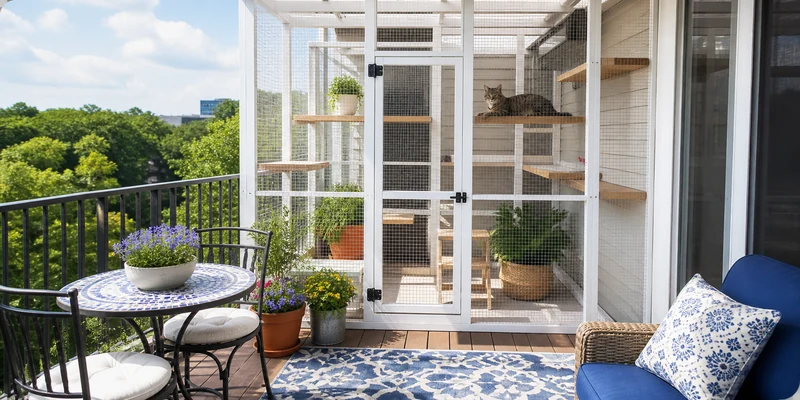
Last updated: August 8, 2026
You have probably seen the photos by now: a screened box bolted to a kitchen window with a tabby stretched out inside, or a walk-in enclosure off a back door with ramps, shelves, and a cat asleep in a sunbeam. So what is a catio? The name is a mash-up of “cat” and “patio”, and that is close to the literal truth. A catio is an enclosed outdoor space that lets your cat sit in real air, watch real birds, and feel real sun, without being able to wander off and without much of anything being able to get in.
The word covers a wide range of structures. On one end is a window box roughly the size of a large aquarium that a renter can put up in an afternoon. On the other is a screened room off the patio you can walk into with a cup of coffee. Below: the main types, why owners build them, and how to think about a kit versus a build of your own.
Quick Answer
A catio is a secure outdoor enclosure that gives an indoor cat safe access to the outside.
- It is a fenced or screened space, not a cage: window box, balcony enclosure, walk-in room, or freestanding structure in the yard.
- The point is outdoor stimulation without the outdoor risks, meaning cars, other animals, and the pressure free-roaming cats put on local birds.
- You do not need a yard. Window and balcony versions work in apartments, and some mount without permanent damage.
Top Picks on Amazon
Prices and availability may change. Check the current listing on Amazon.

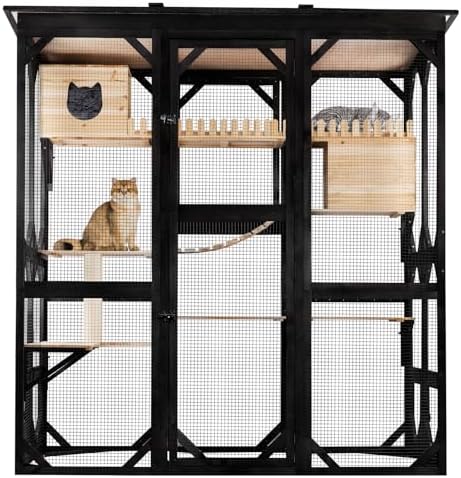

The Main Types of Catio, Side by Side
Almost every catio you will come across is a variation on one of these five formats. Find the row that matches the space you actually have before you start looking at products.
| Type | What it is | Works well when | Main limitation |
|---|---|---|---|
| Window box catio | A screened box mounted in or against a window opening, so the cat steps straight out | You rent, have no outdoor space, or want the smallest possible project | Room to lounge, not to run; window type and sill strength decide what fits |
| Balcony enclosure | Mesh or screen panels closing off an existing balcony, often floor to ceiling | Apartment living with a balcony you already use | Landlord or HOA rules usually apply, and wind matters higher up |
| Walk-in catio | A screened structure tall enough for a person, usually attached to the house with a cat door | You have a patio, deck, or side yard and want room for shelves and ramps | The largest build, and the one most likely to touch permit rules |
| Freestanding catio | A self-contained enclosure that sits in the yard on its own | You would rather not attach anything to the house | The cat has to be carried out, or you add a tunnel to connect it |
| Tunnel or catwalk | A narrow mesh run linking two points, such as a window to a garden enclosure | Connecting a house to a freestanding catio, or adding length in a side yard | Movement rather than lounging, so it is a connector, not the whole plan |
Scale is flexible in every one of these categories. Plenty of owners start with a window box, discover their cat lives in it, and build something bigger the following spring.
Why People Build Them in the First Place
A catio is usually the answer to a specific tension: the cat clearly wants outside, and outside is clearly not safe. Rather than picking a side, the enclosure splits the difference.
Traffic and territory disputes. The two things that most often end a free-roaming cat’s life early are cars and encounters with other animals, including other cats. An enclosure removes both without removing the outdoors.
Real stimulation, not simulated. Indoor enrichment is mostly what we provide: toys, towers, a view through glass. A catio adds moving air, changing temperature, rustling leaves, insects, and smells that shift by the hour. Owners often report the same thing afterward, that a cat who used to yowl at the door now sleeps outside for hours and comes in calm.
Local wildlife. Cats hunt because they are cats, and outdoor cats do meaningfully affect local bird and small mammal populations. A catio lets a cat watch the feeder without emptying it, which also keeps the peace with the neighbors.
Cats who cannot roam anyway. Deaf cats, cats missing a limb, declawed cats, and elderly cats all lose the option of unsupervised outdoor time, and an enclosure gives that back at a level they can handle. If your cat has a health condition, ask your veterinarian what outdoor access makes sense, and confirm that parasite prevention and vaccinations are current first.
How Much Space Does a Catio Actually Need?
Less than most people assume, as long as the space goes upward. Cats do not need a track to run laps on. They need somewhere to lie flat in the sun, somewhere shaded to retreat to, and a couple of levels to move between.
This is why a narrow, tall enclosure with three staggered shelves often gets more use than a wide, empty one with a bare floor. The same logic that drives indoor cat wall shelves applies outside: vertical layers multiply the usable area without adding a square foot to the footprint. A window box that holds one cat comfortably can still be the highlight of that cat’s day.
Two practical notes. Two cats in a space where neither can get away from the other creates friction rather than relaxation, so add a second level or a second exit before adding cats. And think about your own access, because anything you cannot reach into is something you will not clean.
Catio Kits Versus Building Your Own
This is the fork in the road for most people, and there is no universally right answer. It comes down to whether your constraint is time or flexibility.
| Consideration | Buying a kit | Building it yourself |
|---|---|---|
| Time to done | An afternoon to a weekend, with pre-cut parts and instructions | Several weekends for walk-in sizes, plus planning and material runs |
| Fit to your space | Fixed dimensions, so you fit the space to the kit | Built to your exact wall, window height, and awkward corner |
| Skills needed | Basic tools and the ability to follow a manual | Framing, cutting mesh, and squaring a structure |
| Materials | Chosen for you, and generally consistent | Your call, which matters for weatherproofing and mesh gauge |
| Later changes | Some kits are modular and expandable, many are not | Extend, add a tunnel, or move a shelf whenever you want |
A middle path suits a lot of households: start with a window unit or a small kit, live with it for a season, then use what you learn to plan something larger. If you are leaning toward buying, our roundup of what to look for in a catio kit covers mesh, framing, and door design. If you are leaning toward building, how to build a catio walks through the construction sequence, and window catio boxes is the place to start if a window is your only opening.
What Separates a Catio That Gets Used From One That Does Not
Structures fail for boring reasons. These are the details that decide whether your cat treats the enclosure as a favorite room or a place it visits once.
- Sun and shade in the same space. A fully exposed enclosure gets uncomfortable on a hot afternoon, and a fully shaded one never offers the warm patch cats are actually after. A solid roof panel over part of it gives you both.
- Weather protection. A roof that sheds rain and a wind-sheltered corner extend the usable season considerably.
- Levels, not just floor. Shelves, a ramp, and one high perch with a view over the fence line.
- Independent access. A cat door or window insert means the cat comes and goes without you. Enclosures that need a human to open a latch get used far less.
- A closure you cannot leave open. Self-closing hinges or a latch you have to actively undo. This is the failure point that turns a safe enclosure into an escape route.
- Surfaces you can hose down. Outdoor spaces get dirty in a way indoor furniture does not.
Common Mistakes Worth Avoiding
- Using chicken wire. It rusts, the gaps let smaller wildlife through, and cut edges are sharp. Coated welded wire or purpose-made pet mesh holds up far better.
- Forgetting the ground. On bare soil a cat can dig out and other animals can dig in. A buried skirt of mesh, a paver base, or a solid floor solves it.
- Skipping the rules check. Renters need landlord approval, condos usually need HOA sign-off, and some municipalities treat a large attached structure as a build that needs a permit.
- Building it where nobody goes. A catio behind the garage sees a fraction of the use of one attached to the room where the household spends its evenings.
- Wobbly shelves. A perch that shifts underfoot gets abandoned quickly, and outdoor fasteners have to handle weather as well as weight. Our notes on cat furniture safety cover the stability side in more detail.
- Assuming instant enthusiasm. Some cats stroll straight out. Others need a week of propped-open doors, a familiar blanket, and a few treats before they commit.
Where to Go From Here
Your next step depends on which row of that first table sounded like your home. With a yard or a deck, you are choosing between a kit and a build. With a window and a lease, you are looking at a window unit. If neither is possible right now, the fallback is worth naming: a well-placed cat window perch gives a cat the view and the sun without the air, which is not the same thing but beats nothing. Renters juggling what is allowed will find more workarounds in cat furniture for renters.
Frequently Asked Questions
Is a catio worth it for one indoor cat? For a cat who lingers at the door or the window, usually yes. Even a small window enclosure changes the day from watching the outdoors to being in it.
Do you need a backyard? No. Window boxes and balcony enclosures were designed exactly for apartments, and a window catio box is the smallest version of the idea.
Can my cat use it in winter? In milder weather, often yes, if there is a roof, a wind-sheltered corner, and a way back inside whenever the cat wants. In hard cold, most cats make short visits rather than long stays.
Do I need a permit? It depends entirely on where you live and how large and permanent the structure is. Small window units rarely raise questions, while a large attached room might. Check locally before building.
Will it stop my cat from asking to go out? Often it reduces the door-scratching a lot, because the request is usually about access to air and stimulation. Cats who have already roamed freely may still push for more.
Is a catio safe from predators? A well-built one is, which means proper mesh, a covered top, and a secure base that nothing can dig under. Leaving a cat out overnight is a different question and depends on where you live.
The Bottom Line
A catio is simply an enclosed outdoor space for a cat, ranging from a window box to a walk-in screened room, and it exists to give an indoor cat genuine outdoor time without traffic, fights, or a hunted songbird. Size matters less than height, shelter, and a door the cat can use alone. Start with the format your home allows, and expand once you see how your cat uses it.