Last updated: August 8, 2026
Almost every good idea in cat furniture seems to start with a drill. Shelves anchored into studs, a perch screwed to the window frame, a scratching panel bolted to the hallway wall. That is fine if you own the place. If you rent, every one of those photos comes with a quiet question attached: how much of my security deposit is this going to cost me? Cat furniture for renters is really the same design problem with one extra rule, which is that nothing permanent may stay behind when you hand back the keys.
The rule is less limiting than it looks. Almost every wall-mounted solution has a freestanding twin that does the same job for the cat. Below is a swap-by-swap map: what renters usually cannot install, what to use instead, what each substitute costs you, and how to protect the floors, walls, and window frames you do not own.
Quick Answer
Can you give a cat real vertical space in a rental without drilling?
- Yes. A tall freestanding tree or a floor-to-ceiling tension pole replaces wall shelves, a suction cup perch replaces a screwed-in window seat, and a heavy-based post replaces a wall scratching panel.
- Your deposit is usually at more risk from carpet dents, claw marks on frames, and litter odor than from the furniture itself, so plan the protection first.
- Buy for the move: light, flat-packable, and neutral pieces survive several apartments; bulky towers rarely do.
Top Picks on Amazon
Prices and availability may change. Check the current listing on Amazon.


The No-Drill Swap Chart
Find the setup you wanted, then read across. The third column is the honest trade-off, because most of these substitutes cost you something, usually floor space.
| What you cannot install | Freestanding swap | What it costs you |
|---|---|---|
| Cat shelves anchored into studs | A tall freestanding tree, or a floor-to-ceiling tension pole with platforms | Floor footprint, and the piece has to be stable entirely on its own |
| Window perch screwed to the sill or frame | A suction cup perch on the glass, or a sill perch that rests and braces itself | Weight limits, and the glass has to be smooth and clean |
| Wall-mounted scratching panel | A tall post with a wide, heavy base, or a door-hanging scratcher | Takes floor space; a light base will rock and get abandoned |
| Cat flap cut into an interior door | A pet gate with a small opening, or a stopper that holds the door ajar | Less control over which rooms stay closed |
| Catio bolted to the exterior wall | A window box catio that sits in the opening, or a freestanding enclosure on a balcony | Still needs landlord permission in most leases |
| Litter area built into a closet | Standalone litter box furniture, bench or cabinet style | Bulkier in the room, but it moves out with you |
One note before you use this chart: ask rather than assume. Plenty of landlords approve small drywall anchors if you agree in writing to patch and paint, and if you do get permission, a wall route is the stronger answer in a small apartment. Our guide to a wall-mounted climbing route covers how to build one that comes down cleanly.
What Your Lease Is Actually Protecting Against
It helps to separate two worries, because renters tend to spend all their caution on the wrong one.
Holes are the visible risk, and usually the smaller one. A handful of screw holes in drywall counts as normal wear in many leases, and patching is a short job. What landlords object to is a grid of large anchors, damage to studs or plaster, or paint that no longer matches. Older buildings with plaster walls are less forgiving than newer drywall, which alone is a reason for renters in older places to stay freestanding.
Cat-specific damage is the quieter risk, and usually the expensive one. Shredded carpet at a doorway, claw marks along a wooden window frame, a stained subfloor near the litter box. None of that comes from furniture you installed; it comes from furniture you did not provide. That is the real argument for buying decent cat furniture as a renter: the post and the tree keep your cat off the parts of the apartment you are responsible for. If scratching is already happening on the wrong surfaces, work through how to stop a cat from scratching furniture first.
Height Without the Wall
Vertical space is the one thing renters most often give up, and it is the one thing indoor cats benefit from most. There are three ways to get it back without a single screw.
- A tall, narrow freestanding tree. Current towers are much slimmer than the old carpeted pyramids, so you can get real height against a wall with a modest footprint. Stability is the whole ballgame: a narrow tree on a light base will sway when a cat lands up top. Look for a wide or weighted base, thick board, and ideally a strap point; see cat furniture safety if tip-over risk is new to you.
- A floor-to-ceiling tension pole. These brace between floor and ceiling and carry platforms up the shaft, which makes them the closest thing to a wall route without a wall. Two cautions: they need a solid ceiling, not a suspended one, and the pressure plate can leave a mark, so add a felt pad or thin board at each end to spread the load.
- Stacked furniture you already own. A bookshelf beside a dresser beside a windowsill is a climbing route if the gaps are jumpable and nothing shifts. Secure the top-heavy pieces, clear the landing surfaces, and you have a free vertical corridor.
If your floor plan really cannot spare the footprint, a compact tower is a fair compromise; the models that manage height in a small base are covered in our guide to a small cat tree.
Windows Without Screws
A window seat is the highest-value spot in most rentals, and it is where renters get nervous, because the standard mounts attach to the frame or the sill. The no-drill options split into two types.
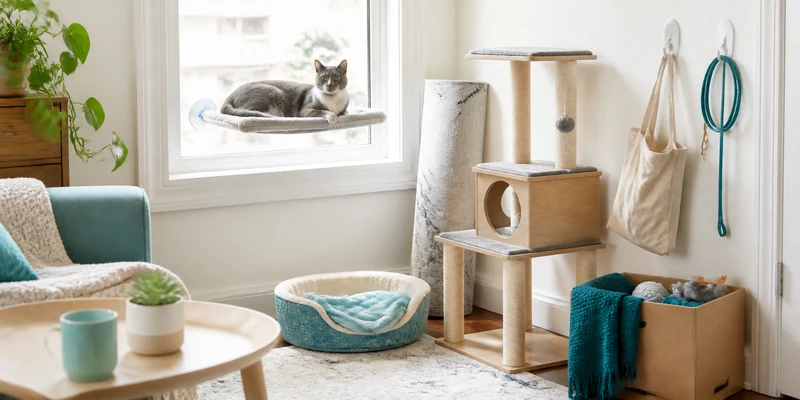
Suction cup perches attach directly to the glass and leave nothing behind. The limits are real: the glass has to be smooth, clean, and in good condition, the cups need re-seating every so often, and there is a stated weight capacity you should respect rather than test. Owners consistently report that the mounting surface matters more than the brand, so textured, frosted, or leaded glass rules them out. Details are in our guide to the suction cup cat window perch.
Sill-resting and braced perches take their support from the frame’s geometry rather than fasteners. They carry more weight than suction, but they need a sill deep enough to work with, which older buildings tend to have and newer ones often do not. Either way, put a felt or silicone pad between any hard edge and painted wood.
Protecting the Surfaces You Do Not Own
This is the part that actually decides how much of your deposit comes back. Handle it on move-in day rather than move-out week.
- Put something under every heavy piece. Furniture coasters or a low-pile rug under a tree or litter cabinet prevent the deep carpet dents and hardwood scuffs that get itemized. Dents from a few months usually recover; dents from two years often do not.
- Guard the doorways and corners first. Door frames and outside wall corners are the classic targets. A post placed at the exact corner your cat uses redirects the behavior far more reliably than one placed where it looks tidy.
- Keep the litter setup off the floor finish. A waterproof mat under the box, and a cabinet style enclosure if odor and scatter are an issue in a small apartment; litter box furniture exists mostly for this situation.
- Photograph everything at move-in. Baseboards, carpet, window frames, sills. Ten minutes now settles arguments later.
- Mind the blinds and screens. Both are a common charge, and both usually break because a cat wanted the view. A legitimate perch at that window is the fix.
Buying for the Next Apartment Too
Renters move. That should change what you buy, not just where you put it, and it is a filter most cat furniture advice skips.
- Can it come apart? Flat-pack pieces with bolted joints survive a move. Glued one-piece towers often do not, and stapled carpet towers rarely look the same on the other end.
- Can one person carry it? A tree that took two people to position is a tree you will be tempted to leave on the curb.
- Is it neutral enough for a different room? Your next place has a different window, wall color, and corner. Neutral wood and fabric adapt; bright plush shapes tend not to.
- Are replacement parts available? Sisal wears out. A post you can re-wrap outlasts several apartments.
Compact, decent materials, quiet colors: that is roughly the definition of the design-led end of this market. If you want pieces that read as furniture rather than pet gear, start with modern cat furniture and filter for freestanding.
Common Renter Mistakes
These come up again and again in apartment setups, and all of them are avoidable.
- Adhesive mounts as a drilling workaround. Removable adhesive strips are rated for picture frames, not for a cat launching off a shelf. When they fail they often take a patch of paint with them, which is the exact outcome you were avoiding.
- Buying tall before buying stable. In a small apartment the tree gets bumped constantly, by you, by the vacuum, by the door. A wobbly tower is both a safety issue and a piece your cat quietly stops using.
- Ignoring the neighbors below. A cat landing on a bare floor from a high perch at three in the morning carries. A rug under the landing zone solves a complaint before it starts.
- Waiting to ask permission. Requests for a window box catio or a few shelf anchors land much better before you move in, or at renewal, than after installation.
- Treating a suction perch as a replacement for height. It is a lookout, not a climbing route. Most apartments need one floor-standing vertical piece as well.
Where to Start in a Small Rental
If you are furnishing from scratch and the apartment is tight, the order that tends to work is simple: one window spot, one scratching surface at the problem corner, one vertical piece as tall as your ceiling allows. Add from there once you see which one your cat actually uses. These reads cover the next decision in each direction:
- Cat window perches: what mounts where, and what holds
- Scratching posts: height, base weight, and material
- Window box catios for apartments and rentals
Frequently Asked Questions
Can my landlord charge me for screw holes? It depends entirely on the lease and local norms; small drywall anchors are often treated as normal wear, while plaster damage rarely is. Ask in writing before you drill, and get the answer in writing too.
Do suction cup window perches damage the glass? They do not damage sound glass, since nothing penetrates anything. The risk is the perch letting go, so respect the weight limit, clean the glass properly, and re-seat the cups periodically. See the suction cup perch guide for the details.
Will a floor-to-ceiling tension pole damage the ceiling? It can leave a pressure mark on paint, and it is not suitable for suspended or drop ceilings at all. A felt pad or thin board at each end spreads the load and usually prevents a visible mark.
Are carpet dents from a cat tree permanent? Usually not, if the piece sat there for months rather than years. Coasters or a rug underneath prevent most of it, and steam plus a stiff brush lifts much of what remains.
Is a cat tree or a wall route better for a rental? A freestanding tree, unless you have written permission to mount. Shelves give more usable height per square foot, so if permission is possible it is worth asking for.
The Bottom Line
Renting removes the drill, not the options: a tall freestanding tree or tension pole covers what shelves would have done, a suction cup or sill perch covers the window, and a heavy-based post covers the scratching. Protect the surfaces you do not own from day one, because carpet dents and clawed frames cost far more of a deposit than any furniture decision. And buy for the next apartment as well as this one, since flat-packable, neutral, one-person-portable pieces are the ones that survive a move.