Last updated: August 8, 2026
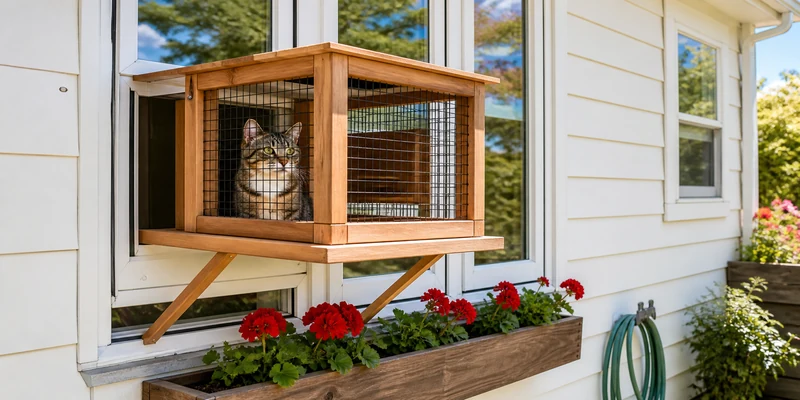
A catio window box is the smallest version of an outdoor enclosure for cats: a screened box that sits in or against a window opening so your cat can step out of the house, sit in real air, and come back in whenever it wants. It is the answer for people who have no yard, no deck, and no permission to build anything permanent, which describes a large share of apartment and rental households. Done right, it turns one ordinary window into the most popular spot your cat has.
It is also the catio format that goes wrong most often, because it looks simple. A box hanging off the side of a building has to carry weight without anything under it, survive rain and sun year round, and close in a way that a determined cat cannot defeat. This guide covers the four things that decide whether yours works: whether it fits your window type at all, what actually carries the load, how it handles weather, and how the opening seals when the cat is inside. If you are still deciding between formats, our hub guide to catio kits compares window units against balcony and walk-in enclosures.
This article contains affiliate links. If you buy through them, we may earn a commission at no extra cost to you. Learn more.
Quick Answer
What should you check before buying a catio window box?
- Your window type decides everything. Double-hung and horizontal sliders open into a clear rectangle a box can occupy. Casement and awning windows swing into that same space, so they usually need a different approach.
- The window frame is not a mounting point. Load should reach the wall framing through brackets, or reach the ground through legs. Sill trim, screen tracks, and glass carry nothing.
- Plan the closure before the box. A gap around the sash, an unlocked window, or a latch a cat can nudge undoes the whole point.
The Four Window Catio Formats, Compared
Nearly everything sold as a window catio, window box, or cat window enclosure is one of these four. They differ less in looks than in how they are held up, which is the part that should drive your choice.
| Format | How it attaches | Works well when | Main limitation |
|---|---|---|---|
| In-sash insert box | Sits inside the open window like a window air conditioner, with the sash closed down onto it and brackets or braces taking the weight | You have a double-hung or slider window and want the cat to step straight out | Sized to a specific opening range, so measure before anything else |
| Bracket-mounted exterior box | Lag-fixed to the exterior wall framing below or beside the window, with the window or a pet door as the entry | You own the home, the wall is sound, and you want a larger box | Permanent holes through the wall envelope, so flashing and sealing matter |
| Leg-supported box | Rests on adjustable legs or a frame standing on a balcony, deck, porch roof, or the ground on a lower floor | Ground-floor windows, balconies, and anywhere drilling is not allowed | Needs a solid surface directly below at the right height |
| Tunnel-connected pod | A small window collar or cat door feeding a short mesh tunnel into a freestanding enclosure | You want more space than a box and have somewhere to put it | More of a small catio than a window unit, and more to assemble |
One product is deliberately not in this table. A cat window perch stays on the inside of the glass and gives your cat height and a view, not air. The two are often confused because both live at the window, but a perch is furniture and a window catio is an enclosure with a hole in your building behind it. If you are not sure you want the second thing yet, our overview of what a catio is is the gentler starting point.
Will It Fit Your Window? Start Here
This is where most purchases fail, and it costs nothing to check. What matters is not the size of the window but the shape of the opening when it is open, and whether the sash stays out of the way once the box is in.
- Double-hung and single-hung. The friendliest case. Raise the lower sash, the box occupies the opening, and the sash comes back down onto the top of the box. Confirm the sash actually holds its position, because tired balances that let a sash creep down will slowly close the route.
- Horizontal sliders. Also workable, but the clear opening is tall and narrow rather than wide and short. You are looking for a box designed to fill a vertical gap, often with a filler panel above or beside it.
- Casement and awning windows. These crank outward into exactly the space the box wants to occupy. In practice the box goes on the wall next to or below the window and the cat gets in through a pet door in the wall, or you use a different window entirely.
- Fixed and picture windows. No opening at all, so there is no route out without cutting one. Not a starting point for a first project.
- Tilt-and-turn and hopper windows. The sash swings inward, which conflicts with an in-opening box and can leave gaps a cat will find. Treat these as a bracket-mounted or pet-door job.
Measure the clear opening width and height with the window fully open, then measure the wall thickness, because a box that has to clear deep trim or a thick masonry reveal sits further out than the pictures suggest. Check what is directly outside too: a downspout, an exterior light, or a neighbor’s window three feet away can rule out an otherwise perfect wall.
Finally, check the rules before you check the products. Renters need the landlord’s agreement in writing, condo and HOA residents usually need approval for anything visible from outside, and a box projecting over a shared walkway can raise questions no product page will warn you about. Our guide to cat furniture for renters covers the reversible setups worth proposing.
Weight and Support: What Is Really Holding It Up
A window box is a cantilever. Everything it weighs, plus the cat, plus whatever rain and snow collect on top, hangs off the building with nothing underneath. That is a fundamentally different loading situation from a shelf or a perch, and the further the box projects, the more leverage it applies to whatever holds it.
Judge support by following the load path down to something structural. In typical US framing, the wall around a window is built from a header, king and jack studs at the sides, and a rough sill below, and that timber is what a bracket should reach. The parts a box must never depend on are the ones closest to hand: the glass, the sash, the screen track, the vinyl or aluminum window frame, and the interior stool and apron, which are trim rather than structure. Siding alone is not a fixing point either, since it is a cladding layer.
- Support from below beats pure cantilever. Angled braces, corbels, or legs standing on a deck or the ground change the geometry completely and take strain off the fixings. Where a lower-floor window allows it, this is the most forgiving arrangement.
- Fixings into framing, with exterior-rated hardware. Stainless or hot-dip galvanized lag screws, sized to bite properly into solid wood. Anything that rusts will be the weak point in two winters.
- Seal every penetration. Holes through the exterior wall are holes through your weather barrier. Sealant, and flashing where a bracket sits under siding, keeps water out of the wall cavity.
- Read published capacities as an upper bound. A stated figure assumes correct installation and a static load. A cat launching itself into the box delivers considerably more force than a cat lying in it, so leave real margin, particularly for a heavy breed or two cats sharing.
- Think about the floor height. On a ground-floor or first-floor window a failure is a mess. Several stories up it is something else, and many owners sensibly restrict window boxes to low floors or add redundant support up high.
The stability logic is the same one we cover for indoor climbing furniture in cat furniture safety, with the outdoor version simply being less forgiving of a shortcut.
Our Top Picks at a Glance
How we chose: we compared widely available window catio units on how they carry load, mesh and frame material, weather protection, and how securely the window opening closes off. Selections reflect manufacturer specifications and patterns that come up repeatedly in owner reviews, not on hands-on assessment.
Two expectations worth setting. Almost every unit in this category arrives flat and needs assembly plus a careful fit to your specific opening, so budget an afternoon rather than an hour. And most cats do not walk straight out on day one, so plan on a week of a propped door, a familiar blanket, and some patience.
🏆 Best Overall
A wooden-framed window enclosure with a metal mesh screen, sized to sit in a standard window opening with the sash closed onto it. The format that suits the most homes, provided you fix the brackets into framing rather than trim.

💛 Best Value
A compact mesh window pod for a single cat, light enough that the support job stays manageable. A reasonable way to find out whether your cat takes to the idea before committing to a larger build.

⭐ Upgrade Pick
A larger multi-level window catio with jump platforms and a waterproof roof, so the cat gets both a sunny ledge and somewhere dry to retreat to. Worth it if the window faces a view your cat will use all day.

If none of these fit your opening, a custom build is genuinely easier than it sounds at this scale, and how to build a catio walks through the sequence.
Weatherproofing: Rain, Sun, Wind, and Winter
An indoor product has to survive a cat. An outdoor one has to survive a cat and the climate, and the second job is what separates a box that lasts a decade from one that looks tired after a season.
Mesh is the first decision. Coated welded wire or purpose-made pet mesh is what you want. Chicken wire is the classic mistake: it rusts, the openings let smaller wildlife in, and cut ends stay sharp. Check how the mesh is fastened too, because staples alone pull loose over time, while staples plus a batten strip holding the edge down do not.
A roof, and shade under it. A solid sloped top sheds rain and gives the cat somewhere out of the sun. A box in full afternoon sun with mesh on five sides can get uncomfortably warm, and the most important safeguard is simply that your cat can always walk back into the house. If your cat has a health condition or you have any concern about heat tolerance, ask your veterinarian what outdoor time makes sense.
Water has to leave. A flat solid floor that traps rain becomes a puddle and then a stain on your wall. Look for a floor that drains or slopes slightly outward, and materials that tolerate getting wet repeatedly: exterior-grade plywood, treated or naturally durable timber, a UV-stable finish, and rust-resistant fasteners throughout.
Wind and snow are real loads. A box is a sail as well as a shelf. Higher floors see more wind, and in snow country the roof carries weight the brochure photo never shows. Both are arguments for over-specifying the support rather than meeting the minimum.
Secure Closure: The Detail That Decides Everything
An enclosure is only as good as its weakest opening, and a window catio has more openings than most: the gap between the box and the window frame, the sash above it, the service door you clean through, and the mesh joints. Cats find all of them.
- Seal the perimeter gap. Where the box meets the opening there is usually a gap on one or both sides. Filler panels, foam strip, or a trim board close it. A cat can get through a smaller space than you would guess, and can push at a soft gap for as long as it takes.
- Lock the sash. A sash resting on the box can often still be raised. A sash stop, a pin, or a bracket that fixes the position stops both the cat pushing it up and the sash sliding down and shutting the route while your cat is outside.
- The insect screen is not a barrier. Screen mesh and its spline are designed to stop bugs, and a cat leaning on one can pop it out of the track. If the screen stays in place anywhere in the setup, treat it as decoration rather than containment.
- Latches a cat cannot work. Any access door needs a latch you have to deliberately undo, ideally self-closing. Magnetic catches and gravity hooks are the ones that eventually let go.
- A way to close the box off. A sliding panel or a lockable pet door lets you keep the cat inside overnight, during a storm, or when contractors are outside. Units without one leave you closing the window on the box, which is awkward at best.
- Check it seasonally. Wood moves, fasteners loosen, and mesh sags. A two-minute push test on every panel each spring and fall is the whole maintenance routine.
Picks for Renters, Big Cats, and Exposed Windows
The general recommendations above suit most homes. These three cover the situations that change the answer: a lease that forbids drilling, a cat at the heavy end of the range, and a window with nothing sheltering it.
🏠 Best for Renters
A leg-supported enclosure that stands on a balcony, porch, or ground-level surface and braces against the opening, so nothing goes through the exterior wall. Still needs landlord sign-off, but it comes down without a trace.

🐈 Best for Large Cats
A taller, deeper enclosure standing on a sturdy full-height base rather than brackets alone. The extra room matters as much as the strength, since a long-bodied cat needs space to stretch out rather than curl.

🌦️ Best for Exposed Windows
An enclosure with a weatherproof roof and a sealed PVC door, so wind and driving rain do not reach the whole interior. Sensible on upper floors and on any wall that catches the weather.

Whichever route you take, the inside of the box deserves a moment of planning too. A single flat floor gets used far less than two staggered levels, for the same reason cat wall shelves outperform a single big platform indoors.
Installation and Upkeep, Realistically
Plan the job in this order and it goes smoothly. Measure the clear opening and the wall thickness first. Locate the framing around the window with a stud finder and mark it, since that is where brackets have to land. Dry-fit the box in the opening before any fixing goes in, so you can see the gaps you will need to close. Then fix, seal, and only afterward fit the mesh and any interior shelving. Two people make this far easier than one, because someone has to hold a box in an open window while someone else drives a lag screw. If you have never fixed anything into framing, our walkthrough of installing cat wall shelves covers stud finding and fastener choice in more detail.
For upkeep, think about reach before you buy. Outdoor boxes collect pollen, leaves, dust, and fur, and anything you cannot get a hand and a cloth into is something you will stop cleaning. A removable floor tray, a full-width access door, or hose-friendly surfaces turn that from a chore into a two-minute job.
Common Mistakes Worth Avoiding
- Fixing to the window rather than the wall. The frame, the sill trim, and the screen track are not structural. Brackets belong in framing, or the box belongs on legs.
- Buying before measuring the open opening. Window sizes are nominal and trim eats the rest. Measure with the sash raised.
- Leaving a gap at the side. The number one escape route, and the easiest thing in the whole project to fix.
- Chicken wire and interior-grade hardware. Both fail outdoors, and both fail in ways that put sharp edges or a loose panel near a cat.
- No shade and no exit. A fully mesh box in full sun needs somewhere shaded and an unobstructed way back inside at all times.
- Skipping the lease or HOA question. Far cheaper to ask before the holes exist than to argue afterward.
- Expecting instant enthusiasm. Some cats stroll out immediately. Others need days of a propped opening and a familiar-smelling blanket before they commit.
Where to Go From Here
If a window box is clearly right for your home, compare it against the larger formats in our roundup of catio kits before ordering, since a balcony enclosure sometimes costs less effort than a well-supported box and gives the cat far more room. If you have a yard or a deck and a weekend, how to build a catio covers a build sized to your actual wall rather than to a product range. And if the honest answer is that your building will not allow an enclosure at all, the fallback is worth naming: a suction cup window perch gives your cat the sun and the view on the inside of the glass, which is not the same experience but is available to almost everyone.
Frequently Asked Questions
Can I install a catio window box in a rental? Often yes, if you choose a leg-supported or no-drill design and get the landlord’s agreement in writing. Anything that fixes through the exterior wall is a different conversation.
Does it work with a casement window? Rarely as an in-opening box, because the sash swings outward into the same space. The usual solution is a bracket-mounted box entered through a pet door, or a different window.
How much weight does a window box need to hold? More than your cat weighs, because a cat jumping in loads the structure far harder than one lying still, and rain, snow, and the box itself all add up. Treat any published figure as a ceiling, not a target.
Can two cats share one? Only if there are two levels or enough length that neither is cornered. In a single small box, two cats tend to take turns rather than share.
Is it safe to leave the cat out unsupervised? During the day, in a properly closed and well-supported box, most owners do. Overnight is a local question, and a lockable panel that closes the box off is the feature that makes the choice yours.
What is the difference between this and a window perch? A perch is indoor furniture on the inside of the glass. A window catio is an enclosure outside the glass, with real air, and it has to be mounted and sealed accordingly. Our cat window perch guide covers the indoor option.
The Bottom Line
A catio window box gives an indoor cat genuine outdoor time in the smallest possible footprint, which makes it the obvious catio for apartments and rentals. Choose it on fit and support first, because the window type decides what is even possible and the load has to reach framing or the ground rather than the sash. Then judge weather protection and how tightly the opening closes, since those two details are what turn a box into a safe one.