Last updated: August 8, 2026
Almost everyone who goes looking for sturdy cat wall shelves is doing it for the same reason: something already moved. A perch that ticks when the cat lands, a step that has developed a slight lean, a bracket that leaves a dark smudge on the paint because it has been rocking against the wall for months. Wobble is the one complaint that runs through this entire product category, and it is rarely about the cat being too heavy. It is about how the shelf is built and how it grips the wall.
So this guide leaves the cat out of it. Whether you have a slim seven pound tabby or a long-bodied Maine Coon, the same four things decide whether a shelf stays rock solid for years: the bracket design, the thickness and material of the platform itself, the number and type of fixings, and how the joint between bracket and shelf is made. Get those right and weight becomes a secondary question. Get them wrong and even a light cat will loosen the installation within a season. If you are still choosing which components to buy at all, start with our hub roundup of cat wall shelves; this article is the deep dive on build quality.
This article contains affiliate links. If you buy through them, we may earn a commission at no extra cost to you. Learn more.
Quick Answer
What makes a cat wall shelf sturdy rather than just strong on paper?
- Bracket geometry first. A bracket with two vertically separated fixings resists the tipping force of a landing cat; a single keyhole slot or one hidden rod does not.
- Solid wood or thick plywood at least three quarters of an inch deep, screwed through rather than dowelled into particleboard.
- A shelf is only as rigid as what it is anchored to. A stud fixing turns a good bracket into a solid one and a drywall plug undoes it.
Bracket Types Compared: What Holds and What Works Loose
Manufacturers use a handful of mounting systems, and they behave very differently under the load pattern a cat produces. That pattern matters: a cat does not lower itself onto a shelf, it arrives at speed and pushes off hard, which loads the bracket downward and outward at the same time. The table below is the short version of why some shelves stay tight and others start ticking.
| Bracket type | How it works | Behavior under a landing cat | Verdict |
|---|---|---|---|
| L-bracket, two fixings stacked vertically | Steel angle screwed to the wall at two heights, shelf sits on the horizontal arm | The vertical separation converts leverage into a push and pull pair the wall absorbs well | The most reliable arrangement in the category |
| Full-height back plate | A wide steel or wood plate spreads several fixings across the wall | Load is distributed over a larger area, so no single screw carries the tipping moment | Excellent, especially on deep platforms |
| Triangular gusset bracket | Diagonal brace between wall plate and shelf underside | Very rigid vertically, though the whole assembly still depends on the wall fixings | Strong, slightly more visible |
| Single keyhole slot | One screw head hooks into a slot routed into the shelf back | The shelf pivots around one point, so the front edge dips and the slot enlarges over time | Fine for a picture frame, weak for a cat |
| Floating rod or hidden pin | Steel rods driven into the wall, shelf slides over them | Rod flex plus a loose fit produces the classic front to back bounce | Looks clean, needs a heavy duty version to work |
| Rope or chain suspension | Shelf hangs from anchors above rather than resting on a bracket | Swings by design; motion is normal rather than a fault | Only for hammocks and lounging spots, not steps |
Notice what this table is not about. It says nothing about how heavy your cat is, because bracket geometry is what decides whether the load is carried or levered. If your concern is specifically a big cat needing a deeper, wider platform, our roundup of cat wall shelves for large cats covers sizing for body length and weight. This guide stays on construction, which applies whatever is standing on it.
Materials and Thickness: Where Shelves Quietly Fail
The platform itself is the second variable, and it is easy to check before you buy because the material is almost always in the listing. What you want is solid wood or a good multi-ply plywood, ideally three quarters of an inch thick or more. Solid pine, poplar, and birch ply all tolerate repeated impact, hold a screw thread properly, and stay flat over the years.
The material that causes trouble is particleboard with a laminate or melamine skin. It is cheap and looks fine in photographs, but it has two weaknesses that matter here. It does not grip a screw thread well, so the fixing between shelf and bracket loosens under repeated shock, and it sags under sustained load on wider spans. That is why a two year old budget shelf often has a visible dip in the middle even though nothing ever broke.
A few construction details worth checking in listings and photographs:
- Thickness stated in the specs. Anything under half an inch is thin for a cat platform regardless of material, and a thin shelf on a hidden rod system is where bounce comes from.
- How the bracket meets the shelf. Screws driven up through the bracket into the underside of the platform beat dowels, glue, or a simple rest. Threaded inserts are better still.
- Screw count per bracket. Two fixings into the shelf and two into the wall is a meaningful step up from one of each.
- Surface covering. Carpet and sisal add grip, which reduces the scrabbling that puts sideways force on the bracket in the first place. A slick lacquered top on a step is a construction issue, not a taste question.
Fixings and Wall Type: The Part Sold Separately
Here is the uncomfortable truth about the whole category: a good bracket is useless if it is held to the wall by the small plastic plugs that came in the box. Those plugs are sized for light static loads. A cat landing delivers a short, sharp force in a direction the plug was never designed to resist, and it enlarges the hole a fraction each time. Months later the shelf is loose and the shelf gets blamed.
In typical US framing, studs sit at regular intervals behind the drywall, usually sixteen inches on center and sometimes twenty-four. Any shelf a cat lands on should ideally have at least one screw into solid timber, with a screw long enough to pass through the bracket and the drywall and still bite properly into the stud. When a shelf has to sit between studs, heavy duty hardware such as toggle bolts is the right answer, chosen deliberately rather than accepted because it was in the packet. Plaster, lath, and masonry walls change the hardware again.
Because the supplied hardware is so often the weak link, it is worth judging a product partly on whether the manufacturer talks about it honestly. Brands that specify stud mounting in their instructions and include long screws tend to have thought about the load. Brands that show a shelf held up by two plastic plugs in a marketing photo have not. For the practical sequence of stud finding, marking, and levelling, work through our step by step guide to installing cat wall shelves before you drill anything.
Our Top Picks at a Glance
How we chose: we compared widely available wall shelves on bracket geometry and the number of fixings per mounting point, platform material and stated thickness, how the bracket joins the shelf, and whether the manufacturer specifies stud mounting. Selections are based on published specifications and the patterns that come up repeatedly in owner reviews, not on hands-on assessment.
Two expectations worth setting. Sturdier shelves are usually heavier and more visible, because steel brackets and thick timber do not hide well. And almost every set benefits from better screws than the ones in the box, which is a small extra purchase rather than a flaw.
🏆 Best Overall
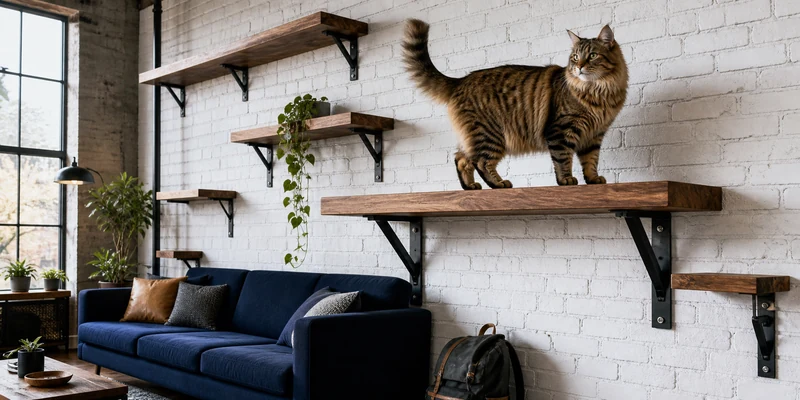
A solid wood wall perch from a modular range designed around stud mounting, sold as individual pieces that can be extended into a full route later. The construction is the selling point rather than the styling.

💛 Best Value
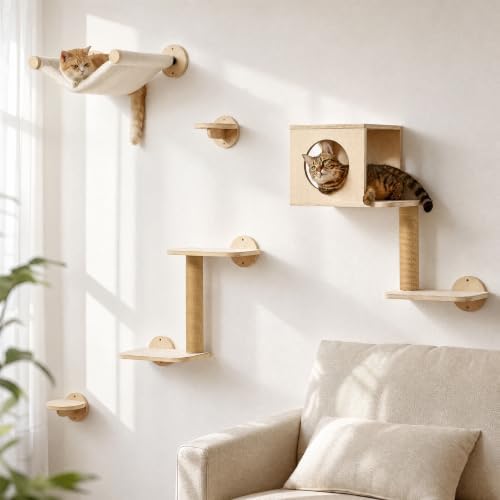
A multi-piece solid rubber wood wall shelf set, a sensible starting point for a first route as long as you swap in longer screws and land the load-bearing pieces on studs.
⭐ Upgrade Pick
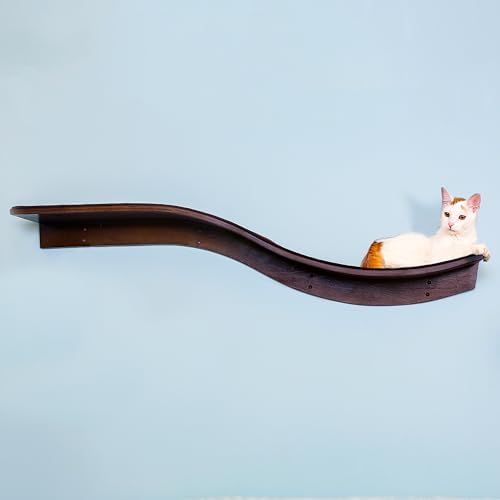
A design-led wall perch with a furniture-grade finish, fixed through multiple mounting points, for living rooms where the hardware has to look intentional and still hold properly.
If you would rather build the platforms yourself and buy only the brackets, our guide to DIY cat wall shelves covers timber choice, thickness, and bracket sourcing.
What Actually Causes Wobble, and How to Diagnose It
Wobble has four common causes and they need different fixes, so it pays to work out which one you have before ordering replacement parts. Press down on the front edge of the shelf, then push it side to side, and watch where the movement originates.
Movement at the wall plate, where the bracket itself shifts against the paint, means the fixings are the problem. Either they missed the stud, or the anchors are undersized, or the screws have worked loose. This is the most common failure and the most fixable. Movement between bracket and shelf, where the bracket stays put but the platform rocks on top of it, points to the joint: screws backing out of a particleboard underside, or a shelf simply resting on the bracket arm without being fastened down.
Flex in the platform itself, where the shelf visibly bends when weight is on the front edge, is a material and thickness issue that cannot be tightened away. A shorter shelf, a thicker one, or an extra bracket under the span is the answer. Movement in the wall is the rarest and most serious: if the drywall dishes around the fixing, the anchor is chewing out its hole and the shelf should come down and be remounted into a stud.
One contributor is easy to miss. A route with big gaps between shelves forces cats to arrive hard and scrabble for grip, which multiplies the sideways force on every bracket. Tighter spacing and a grippy surface reduce the load on the hardware more than any upgrade you can buy, which is why placement and construction are not separate topics; the same logic applies to floor furniture, as our guide to where to place a cat tree explains.
Sturdier Options for Awkward Walls and Busy Routes
Two situations put more strain on the hardware than a single shelf on a clear stud wall, and both have specific answers.
The first is a wall where the studs land in the wrong place, which happens constantly around windows and doorways. Rather than hanging a load-bearing platform between studs on anchors alone, choose a wider component with a long back plate that can still reach a stud even when it is not centered on one. The second is a busy route in a multi-cat home, where a narrow step becomes a passing place and takes repeated sideways knocks. A wide platform or a bridge anchored at both ends shares that traffic across two mounting points, and adding floor options relieves the pressure further, as our roundup of cat trees for multiple cats explains.
🐾 Best for Multi-Cat Routes
A wall-mounted bridge or wide double-width platform anchored at both ends, so the load is shared between two mounting points and two cats can pass without crowding a single step.

👍 Also Great
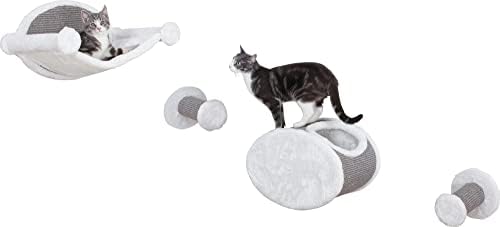
A wall-mounted lounge set with plush-covered condos and sisal-wrapped steps, useful where you want grip underfoot and several fixing points per piece rather than a single hidden slot.
Installing and Keeping It Tight
Sturdiness is half product and half installation, and the installation half is free. Mark your stud lines floor to ceiling with painter’s tape before you commit to a layout, drill pilot holes so the screw cuts rather than splits, and drive every fixing fully home so the bracket sits flush with no gap behind it. A level across the top is worth two minutes as well, since a platform that slopes slightly is unpleasant to settle on and encourages the scrabbling that loosens hardware.
Before the cat is anywhere near a new shelf, load it by hand. Lean on the front edge, push down and outward at the same time, and watch the bracket rather than the shelf. Anything that ticks, shifts, or leaves a mark on the paint comes off and gets remounted.
Then put a recurring check in your calendar. Repeated impact backs screws out slowly, so re-tighten every fixing a few weeks after installation and a couple of times a year after that. While you are up there, trim frayed sisal flush instead of pulling it and check that nothing breakable has migrated into the landing zone below. Our overview of cat furniture safety covers the tip-over and stability side across all formats.
Common Mistakes to Avoid
- Using the hardware in the box without checking it. The plastic plugs supplied with budget sets are the most common cause of a shelf that loosens. Longer screws into a stud cost very little and change the outcome.
- Buying on stated weight capacity alone. A published figure assumes correct installation and static load. Bracket geometry, material, and fixing count tell you more than the number does.
- Trusting a single keyhole slot. One pivot point means the front edge dips and the slot slowly enlarges. It is a picture-hanging system doing a job it was not designed for.
- Ignoring particleboard sag. Nothing breaks, the shelf just develops a permanent dip. Solid wood or thick plywood avoids the problem entirely.
- Spacing the route too far apart. Big gaps mean hard landings and scrabbling, and every hard landing works the fixings a little looser.
- Skipping the re-tighten. Fixings loosen. Twice a year with a screwdriver is the whole maintenance routine.
Where to Go From Here
If you are still assembling a shopping list, the hub guide to cat wall shelves compares component types and what each one is for. Owners of big cats should read cat wall shelves for large cats next, since platform depth and width are a separate question from bracket strength. When the boxes arrive, follow the sequence in how to install cat wall shelves. And if a wall route is meant to replace a tower rather than supplement one, our guide to a cat tree wall mount covers designing the full climbing path.
Frequently Asked Questions
What makes one cat wall shelf sturdier than another? Bracket geometry above all, specifically whether the mounting point has two vertically separated fixings rather than one. After that it is platform material and thickness, how the bracket is fastened to the shelf, and whether the supplied screws are long enough to reach a stud.
Do cat wall shelves have to be mounted into studs? Any shelf a cat lands on should have a fixing into solid timber wherever possible. Heavy duty anchors such as toggle bolts are the alternative when a piece must sit between studs, but the light plastic plugs included with many sets are not built for the impact a cat produces.
My shelf wobbles. Do I need a new one? Usually not. Check where the movement starts: at the wall plate it is a fixing problem, between bracket and shelf it is the joint, and only visible flex in the platform itself points to a material issue that hardware cannot fix. See the diagnosis section above.
Are floating shelves with hidden brackets strong enough for cats? Some are, but the heavy duty versions with thick steel rods and a snug fit are a different product from the decorative ones. Front to back bounce on a floating shelf usually means the rods are flexing or the shelf is loose on them.
How often should I re-tighten everything? A few weeks after installation, then roughly twice a year. Repeated landings back screws out gradually, and catching that early is easier than remounting a bracket that has chewed out its hole.
The Bottom Line
Sturdy cat wall shelves come down to four things that have nothing to do with your cat’s weight: a bracket with two separated fixing points, a platform in solid wood or thick plywood rather than laminated particleboard, screws that actually reach a stud, and a joint where the bracket is fastened to the shelf rather than resting under it. Upgrade the supplied hardware as a matter of course, re-tighten twice a year, and a well built shelf will outlast several cat trees.