Last updated: August 8, 2026
Buying a cat tree for multiple cats is not the same job as buying one for a single cat. With one cat, you are giving a pet somewhere pleasant to nap and scratch. With two, three, or four, you are handing out real estate, and cats are particular about real estate. The tower that works in a multi-cat home is the one that gives every cat a spot worth having, at a height worth having, without anyone having to walk past a housemate to get there.
That changes what you shop for. Instead of counting levels, you start counting good levels: perches wide enough for a full-grown cat, spread across different heights, with more than one way to climb up and back down. This guide walks through what to check, how many resting spots you actually need, and which widely available towers are built around those ideas rather than around a single top perch.
This article contains affiliate links. If you buy through them, we may earn a commission at no extra cost to you. Learn more.
Quick Answer
What makes a cat tree work for more than one cat?
- More than one desirable spot. Aim for at least one full-size perch per cat, placed at different heights rather than stacked in a single column.
- Two ways up and down. A tower with a single climbing route creates a bottleneck, and a cornered cat is a stressed cat.
- A base that handles chasing. Several cats moving at once puts far more sideways force on a tower than one cat napping, so footprint and weight matter more than height.
What to Check Before You Buy for a Multi-Cat Home
Use this as a shopping checklist. Every line is something you can verify from a product listing, a photo, or a tape measure before you spend anything.
| What to check | Why it matters with several cats | What to look for |
|---|---|---|
| Number of full-size perches | A tower can list eight levels and still have only one spot a grown cat wants to sit on | Count the platforms that could hold a curled-up adult cat, and ignore the tiny intermediate steps |
| Height spread | Cats sort themselves out partly by elevation, so identical heights create direct competition | Good perches at low, middle, and high positions rather than three levels clustered near the top |
| Two climbing routes | One route means one cat can hold the whole tower and the others have to negotiate past | Staggered levels that let a cat go up either side, or a second post or ramp on the opposite face |
| Base footprint and weight | Chasing puts sideways shock loads on the structure that a single napping cat never does | A base clearly wider than the top perch, heavy enough that the tower resists a shove |
| Number of scratching posts | Scratching is territorial as well as physical, and a shared single post gets guarded | Sisal on several posts at different levels, not just the two bottom uprights |
| Hideaways with two exits | A cubby with one opening can trap a cat that wants out | Condos with a second hole or an open-topped bed as an alternative to a fully enclosed box |
| Perch dimensions | Two cats sharing a small platform is where most squabbling starts | Measure your largest cat lying down, add a couple of inches, then check the stated platform size |
If you want the wider view of the category first, our hub guide to cat trees covers every style, height, and price tier. This page narrows it to one variable: how many cats have to share the thing.
Territory, Not Just Furniture
Cats living together are not a pack. They can be genuinely affectionate housemates, and many are, but they still keep track of who is where. Behaviorists describe a cat’s world in terms of resources: food, water, litter boxes, resting places, and vantage points. When any of those is scarce or concentrated in one place, the cats have to sort out access, and sorting out access is what looks to us like staring, blocking doorways, or the occasional swat on the stairs.
Vertical space is one of the easiest resources to add, which is why cat trees carry more weight in a multi-cat home than in a single-cat one. Height gives a cat somewhere to be that is out of the traffic, and it lets two cats occupy the same square footage of floor plan without being in each other’s space. The catch is that a tower only adds resources if it adds several of them. One tall tower with one great perch is a single prize, and a single prize is something to compete over.
The practical version of this is simple. Think in terms of one good resting spot per cat as a floor, then add one more if you can. Spread those spots across heights, and if you have the room, spread them across the house rather than concentrating everything in one corner. A tower in the living room plus a shorter one or a couple of cat wall shelves in another room does more for a tense household than one enormous structure ever will. Our overview of whether cats need a cat tree covers the underlying behavior in more depth.
Two Routes Up: The Detail Most Towers Miss
Look at a typical budget tower from the side and you will usually see one climbing path: floor, step, perch, step, top. That works fine for one cat. With several, it means the cat on the middle platform sits on the only road, and anyone who wants to come down has to go through. Most of the time nothing happens. Sometimes it turns into a standoff, and over months that standoff is the reason one cat stops using the tower at all.
A tower with two routes solves it quietly. That can be levels staggered on opposite faces so a cat can climb up either side, a ramp on one flank next to a post on the other, or simply enough overlap between platforms that a cat can hop sideways to bypass an occupied step. When you are looking at product photos, trace the path with your finger from the floor to the top perch, then try to trace a second, different path. If you cannot, expect a bottleneck.
The same thinking applies to enclosed cubbies. A condo with one entrance is a dead end, and a cat that gets cornered in one has no exit. Models with a second opening, or a mix of open beds and enclosed boxes, give the cats more options. This is one area where cat condos and cat trees diverge in a way worth understanding; our comparison of the cat condo versus the cat tree lays out where each format fits.
Our Top Picks at a Glance
How we chose: we compared widely available towers on the number of genuinely usable perches, how those perches are spread across heights, whether there is more than one climbing route, and how stable the base is under several cats at once. Selections rest on manufacturer specifications and recurring themes in owner reviews rather than any trial of our own.
Two things to know before the list. Multi-cat towers are big towers, so measure your wall space before ordering and plan on a serious assembly session. And a single tower is rarely the whole answer: two medium structures in different rooms usually beat one giant one, for the resource-spreading reasons above.
🏆 Best Overall
A very large multi-level tower with several full-size perches at different heights and posts on more than one face, which is the combination that keeps two or three cats out of each other’s way. A sensible default for most multi-cat homes.

💛 Best Value
A tall carpeted tower that gets you a lot of levels and a decent footprint without a premium price. The value benchmark other multi-cat towers get measured against.

⭐ Upgrade Pick
Solid wood posts wrapped in sisal, thicker platforms, and a base with real mass, so the whole structure stays calm when several cats move at once. Worth the step up if your cats chase.

Matching the Tower to Your Household
Two cats and four cats are different problems, and so are two calm seniors and two adolescents who treat the living room as a racetrack.
- Two adult cats who get along. A mid-size tower with three or four proper perches is usually enough, especially if one cat prefers height and the other prefers a covered spot near the floor. Watch which levels each cat claims, then add elsewhere if they both want the same one.
- Three or more cats. One tower stops being sufficient. Add a second structure in another room, or extend upward with wall shelves so there are more high spots than cats.
- A kitten joining an adult. Low steps matter as much as top perches, because a kitten needs to reach the tower without being cornered on the way. Closely spaced levels help both ends of the age range.
- Large or heavy cats. Perch dimensions and base weight become the limiting factors. Our guide to cat trees for large cats covers what to check when your cats overhang a standard platform.
- High-energy breeds. Athletic cats land hard and often, which is a structural question more than a comfort one. The picks and reasoning in our cat tree for Bengal cats guide apply to any household with a jumper in it.
- Small apartments. When floor space is the constraint, go up rather than out. A narrow tall tower plus wall-mounted spots can serve several cats in a footprint a single wide tower would not fit into.
The picks below cover the situations that come up most often once you go past two cats.
🐈⬛ Best for Three or More Cats
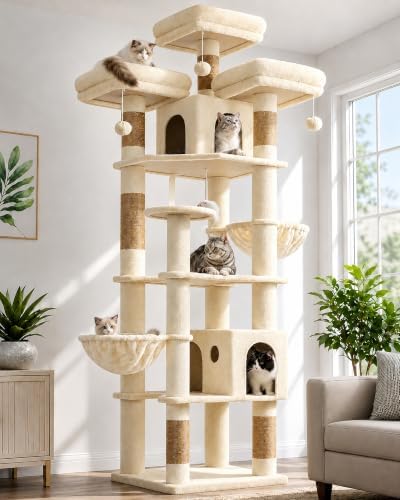
An extra-large tower with a high level count, several separate top perches, and more than one enclosed spot, so nobody is left with the leftovers. Check the platform count against how many cats you have.
🧱 Also Great: Wide-Base Pick
A stocky tower that trades some height for footprint, which is the right trade when several cats use it at speed and you cannot anchor into a stud. Suits renters and homes with hard floors.

Placement, Assembly, and Keeping It Solid
Placement does more for peace in a multi-cat home than the tower itself. Put it where the cats already want to be, usually overlooking a window or in the room the household actually uses, but avoid dead ends: a tower wedged into a narrow alcove has only one approach, which reproduces the bottleneck problem at floor level. Leave clear space on at least two sides so a cat can arrive and leave from different directions. Our guide on where to place a cat tree covers the trade-offs when the ideal spot for the cats is not the ideal spot for you.
Assembly is worth doing carefully on any tower that will carry several cats. Run every bolt in loosely first, get the frame square, then tighten in stages, working around the structure instead of fully seating one bolt at a time. That keeps the panels from racking. The supplied hex key is usually too short for proper leverage, so finish with a screwdriver or a socket that fits it, and use the wall strap if one is included. More on anchoring and tip-over risk in our overview of cat furniture safety.
Then keep an eye on it. Re-tighten the bolts after the first two weeks and every few months after that, since carpet and board compress under regular use. Vacuum the sisal with an upholstery attachment, trim frayed strands rather than pulling them, and re-wrap a post once it goes smooth, because a slick post gets ignored and the sofa gets used instead. In a multi-cat home this happens faster than owners expect, simply because several sets of claws are working the same rope.
Common Mistakes to Avoid
- Counting levels instead of usable perches. Eight levels can mean one real perch and seven steps. Count only the platforms an adult cat could curl up on.
- Putting all the good spots at the same height. Cats separate themselves partly by elevation, so three perches clustered at the top are three cats competing for the same tier.
- Buying one big tower instead of two medium ones. Spreading resources across rooms usually does more for a tense household than concentrating them in one structure.
- Ignoring the single climbing route. Trace the path from floor to top in the product photos, then try to trace a second one. If there is only one, expect standoffs.
- Choosing cubbies with one entrance only. A cat that gets cornered in a dead-end box will stop using it, and often stops using the tower around it too.
- Underestimating the chase load. Several cats moving at once puts sideways force on the base that a single cat never does. Compare shipping weights within a height class.
- Forgetting the floor. On hardwood or laminate a tower walks a little every time a cat launches. Felt pads or a rug under the base solve it.
Where to Go From Here
If floor space is your main constraint, a tall cat tree adds vertical range without widening the footprint, provided you can anchor it. If you would rather have a furniture-like block with enclosed spaces than an open climbing frame, start with our guide to the cat condo and the format comparison it links to. And if you are adding a second, smaller structure in another room, our small cat tree roundup covers what still works at a reduced size.
Frequently Asked Questions
How many cat trees do I need for two cats? One well-designed tower with several full-size perches at different heights is often enough for two cats who get along. If both consistently want the same spot, a second structure elsewhere in the home usually settles it faster than a bigger tower does.
Will two cats share the same perch? Some will, especially cats who grew up together, and others never do. Plan for at least one good spot per cat so sharing is a choice rather than a requirement, and make sure the platforms are deep enough for a grown cat to lie down without hanging over the edge.
Do I need a tree with a condo for each cat? Not necessarily. Cats vary in whether they like enclosed spaces at all, and an open perch high up is often more sought after than a box near the floor. A mix of both types of spot covers more preferences than doubling up on either one.
My cats squabble on the tower. What should I change? Look at bottlenecks first: a single climbing route, a single top perch, or a tower pushed into a corner with one approach. Adding a second route, a second high spot, or a set of cat wall shelves nearby usually reduces the friction. Sudden changes in behavior are worth raising with your veterinarian.
Is a taller tower better when you have several cats? Only up to a point. Extra height helps if it creates additional separate perches, but a tall tower with a narrow base and one good spot at the top is a competition trophy. Footprint and perch count matter more than total height.
What if one cat guards the whole tower? That is usually a sign the tower is the only resource of its kind in the home. Add vertical spots in other rooms so the guarded structure stops being the only place worth being, and keep food, water, and litter boxes spread out too.
The Bottom Line
For a multi-cat home, buy for the number of genuinely usable perches and how they are spread across heights, not for the level count on the box. Look for two climbing routes, hideaways that are not dead ends, and a base heavy enough to stay calm when the cats chase. Then spread the resources: two structures in different rooms almost always work better than one large tower in a corner.