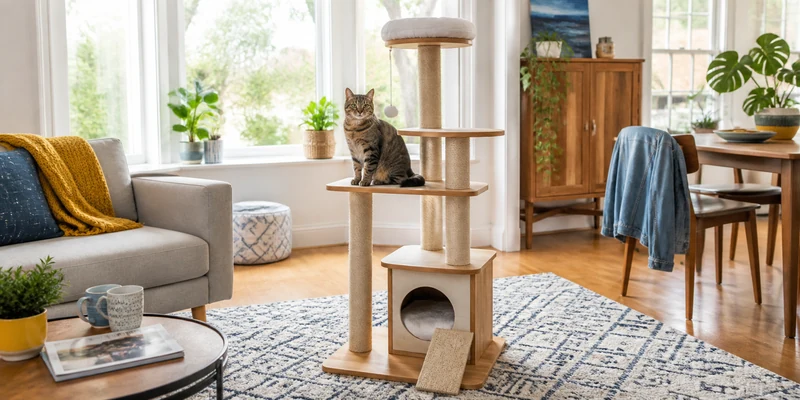
Last updated: August 8, 2026
Choosing the best cat tree for your home is less about height and features than most product listings suggest. A tower with seven levels, three hammocks and a dangling toy can still end up ignored in a corner, while a plain two level post next to a sunny window gets used every day. The difference comes down to a short list of things: how stable the base is, how tall the scratching surface is, whether a sleeping cat fits on the platforms, and where in the room it ends up.
This guide is the starting point for the whole cat tree category. It covers the types available, the specifications worth checking before you order, and picks for the situations most owners land in: a solid allrounder, a budget option, a design led upgrade, something built for a big cat, and a compact tower for a small apartment. Where a subject deserves more depth, you will find a link to the dedicated guide.
This article contains affiliate links. If you buy through them, we may earn a commission at no extra cost to you. Learn more.
Quick Answer
What makes a cat tree worth buying?
- Stability first. A wide, heavy base plate and thick posts matter more than total height, because a tower that wobbles under a landing cat stops getting used.
- At least one scratching post tall enough for your cat to reach up with front legs fully extended, wrapped in natural sisal rather than carpet.
- Platforms sized for a curled up cat, not a standing one, and a top perch with a view of a window or a doorway.
Cat Tree Types at a Glance
Cat trees are sold as one category, but they solve different problems. This overview shows what each type is good at and where it tends to fall short, so you can narrow things down before comparing individual models.
| Type | What it does well | Best suited to | Watch out for |
|---|---|---|---|
| Compact tower | Adds height and a scratching post in a small footprint | Studios, apartments, second trees in a bedroom | Short posts and small platforms; adult cats outgrow them fast |
| Mid height allrounder | Balances climbing, scratching, napping and price | Most single cat and two cat homes | Base plate is often the weak point on cheaper models |
| Tall tower | Real vertical territory and a high lookout perch | Confident climbers, homes with ceiling height to spare | Needs a wall anchor; more sway near the top |
| Large or heavy duty | Wide platforms and thicker posts for heavier cats | Maine Coons, Ragdolls, Bengals, multi cat households | Bulky in a small room and heavy to move once built |
| Modern or design led | Wood, felt and clean lines that suit a living room | Open plan spaces where the piece is always visible | Fewer levels and sometimes narrower bases |
| Wall mounted | Vertical routes without using any floor space | Small apartments, cats that like high shelves | Requires drilling into studs; harder for renters |
Most homes do well with one mid height or tall allrounder as the main piece, then a second smaller tower or a set of shelves in another room once you see where your cat actually settles.
Stability: The Specification Nobody Lists
If one factor decides whether a cat tree gets used, it is stability. Cats do not step onto a platform politely. They launch, land, twist and push off, and a tower that shifts under that load teaches a cat within a day or two that it is not a safe place to be. Owners who report abandoned cat trees almost always describe wobble first.
There is no wobble rating on any box, so you have to read it from the construction:
- Base plate footprint. A wide, thick base is what keeps a tall tower upright. Height on a narrow board is a tipping risk with a heavy cat.
- Total weight. Heavier is usually more stable. A tall tower that ships in a surprisingly light box tends to be built from thin particle board and hollow tubes.
- Post diameter. Thicker posts flex less. Slim posts on a tall unit produce the swaying that makes cats hesitate at the top perch.
- Anchoring hardware. Better tall models include a bracket to strap the top to the wall. If yours does not, an inexpensive furniture anti tip strap does the same job. Our cat furniture safety guide covers tip over risk in more detail.
Sisal Height, Platforms and Materials
Scratching height. Cats scratch to stretch, so a post has to let an adult cat reach up with front legs fully extended. Posts that are too short get skipped in favor of the sofa arm. Measure your cat from back paws to front paws while stretched against a door frame and use that as your minimum.
Sisal versus carpet. Natural sisal rope holds up to claws far better than carpet, which shreds, mats and then stops being satisfying to use. Sisal fabric is a reasonable middle ground and sheds less. If scratching is your main motivation for buying, the sisal cat tree roundup goes deeper on rope quality and rewrapping.
Platform size. A cat sleeping on a perch curls into a circle and spills over the edges of anything undersized. Compare the listed platform dimensions against your cat lying down, not standing, and add margin for a long coat.
Frame materials and extras. Most towers are particle board wrapped in fabric, which is fine when the panels are thick and the hardware is bolt through rather than stapled; solid wood and plywood frames cost more but survive moves and hold screws better, and the solid wood cat tree guide covers that route. Among the add ons, a hammock or cubby gives an anxious cat somewhere to hide and washable cushion covers are worth more over three years than any styling detail. Dangling toys bolted to the frame are the first thing most cats destroy.
Not sure a tower is necessary at all? This look at whether cats really need a cat tree works through the behavior side before you spend anything.
Our Top Picks at a Glance
How we chose: we compared widely available cat trees on base stability, post thickness, sisal height, platform size, materials and value, weighting the specifications that owner reviews consistently flag as deal breakers. Availability, colors and model numbers change often, so check the current listing before ordering.
Two things worth saying up front. A more expensive tower is not automatically a more stable one, and you do not need every feature: a heavy base, one tall sisal post and two well sized perches cover the daily routine of most cats.
🏆 Best Overall
A tall multi level tower with full height sisal posts, a hammock and several perches, sized for an average adult cat. A sensible default if you want one main piece that covers climbing, scratching and napping.

💛 Best Value
A straightforward multi level tower with sisal wrapped posts and a roomy enclosed condo, at an entry level price. A reasonable first cat tree, or a second one for a bedroom.

⭐ Upgrade Pick
A design led wooden tower with clean lines and a finish meant to live in a main room rather than a spare corner. Worth considering if the piece has to hold its own next to real furniture.

Want to compare within one lane rather than across them? The tall cat tree and modern cat tree roundups narrow the field, and there are brand level looks at the two mass market names above in our Feandrea cat tree review and Yaheetech cat tree review.
Matching a Cat Tree to Your Cat and Your Room
Big and heavy cats. Maine Coons, Ragdolls and larger mixed breeds need wider platforms, thicker posts and a much heavier base than a standard tower provides. Weight limits are rarely published, so read construction instead: solid panels, bolt through hardware and a base you struggle to lift on your own. Start with the cat tree for large cats guide, or go breed specific with the Maine Coon cat tree and Bengal cat tree roundups.
Small apartments and studios. Floor space is the constraint, so go vertical and slim rather than wide. A narrow tower in a corner plus a couple of wall steps gives more usable territory than one bulky unit. The small cat tree guide covers compact models, and wall mounted cat trees are the option when there is no floor to spare.
Two or more cats. Cats share vertically rather than horizontally, and problems start when one cat can block the only route down. Look for two separate paths to the top and perches at different heights, or split the budget across two mid height trees in different rooms, as the cat tree for multiple cats guide explains.
Kittens and senior cats. Kittens climb anything but land badly, so closely spaced levels near the floor are safer than big gaps. Older cats often stop using a tall tower because the first step is too high, and a ramp or a lower entry platform usually brings them back. If your cat suddenly avoids climbing, that is worth mentioning to your veterinarian.
Picks for Specific Situations
These cover the cases where a general purpose tower is the wrong answer. Each one solves a particular constraint rather than adding features.
🐾 Best for Large Cats
A heavy duty tower with oversized platforms, thick sisal posts and a substantial base, built for cats that land hard. Check the platform dimensions against your cat lying stretched out before ordering.
🏠 Best for Small Spaces
A compact tower with a small footprint that still includes a full height scratching post and a raised perch. A practical option for a studio, a hallway corner or a rented room.

🧶 Also Great
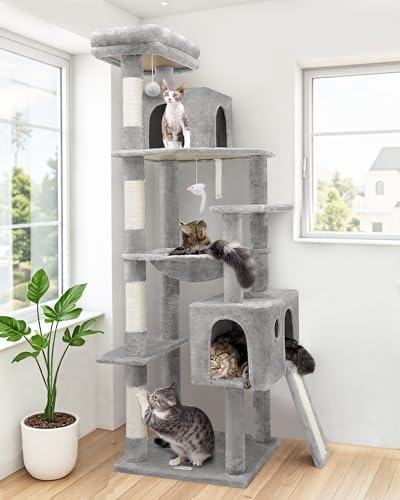
A tall multi perch tower with two enclosed condos and resting spots at several heights, which helps when two or more cats have to share one piece.

Prefer a boxier enclosed unit to an open climbing frame? That is a different category, and cat condo versus cat tree explains which one suits which cat, with the full cat condo guide alongside it.
Placement, Assembly and Upkeep
Placement. Put the tree where your cat already spends time, not where it looks tidiest. A tower at a window with a view of a bird feeder or a busy sidewalk gets used constantly, while the same tower in a spare room gathers dust. Our guide on where to place a cat tree covers the room by room logic.
Assembly. Work on a flat floor, keep every bolt loose until the frame is fully together, then tighten in stages so the panels seat squarely. A rocking base on an uneven floor is easy to fix with a felt pad and easy to ignore until the cat refuses the top perch. Anchor anything tall to the wall.
Introducing it. Do not lift your cat onto it. Put a familiar blanket on a platform, feed treats on the lower levels for a few days, and play near the base with a wand toy so the cat climbs on its own. Give it a week or two before deciding it was a mistake.
Upkeep. Vacuum the fabric with an upholstery attachment rather than a beater bar. When a sisal post frays past the point of being satisfying, a rewrapping kit costs a fraction of a new tower and takes an evening. Retighten the hardware every few months, especially on tall units.
Common Mistakes When Buying a Cat Tree
- Buying for height alone. A tall tower on a thin base is less useful than a shorter, heavier one. Stability and post thickness beat the number on the listing.
- Ignoring the platform dimensions. Levels sized for a kitten are the reason many towers end up used only as a scratching post.
- Choosing carpet posts to save money. Carpet stops appealing to claws once it mats, and a cat that gives up on the post goes back to the furniture.
- Putting it in the room nobody uses. Cats want to be where the household is. A tree tucked away in a guest room is the most common reason for an unused purchase.
- Expecting one tree to stop all scratching. Cats scratch where they already scratch, so you may also need a post right next to the targeted furniture. Our guide on how to stop a cat from scratching furniture walks through the fix, and the scratching post buying guide covers standalone options.
Where to Go Next
If size is the deciding factor, the large cat tree guide is the next stop. If the look is what is holding you back, the aesthetic cat tree roundup and our wider modern cat furniture hub cover design led options. And if you would rather build than buy, how to make a cat tree lays out a realistic first project.
Frequently Asked Questions
How tall should a cat tree be? Tall enough that your cat can climb above standing eye level and stretch fully against a post, which for most adult cats means a mid height or taller tower. Height only helps if the base is wide and heavy enough to stay planted.
Do cats prefer sisal or carpet? Most cats work harder on natural sisal, and it lasts far longer than carpet, which mats down and loses its texture. Carpet still has a place on platforms, just not on the scratching posts.
Why is my cat ignoring the new cat tree? Usually placement, wobble or size. Move it to a window or a room the household actually uses, check that nothing shifts under weight, and make sure the perches are big enough for a curled up cat.
How many cat trees does one cat need? One good tower is enough for many single cat homes, though a second smaller piece in another room gives a cat somewhere to retreat. In multi cat households, plan on more than one climbing option.
Are cat trees safe for large or elderly cats? They can be, provided the base is heavy, the unit is anchored and the steps between levels are not too far apart. For older cats, a lower entry point or a ramp makes a real difference.
The Bottom Line
A cat tree earns its space when the basics are right: a wide and heavy base, posts thick enough not to sway, natural sisal tall enough for a full stretch, and platforms sized for a sleeping cat rather than a standing one. Match the type to your cat and your room instead of chasing levels and features. Then put it where your cat already wants to be, and most of the work is done.