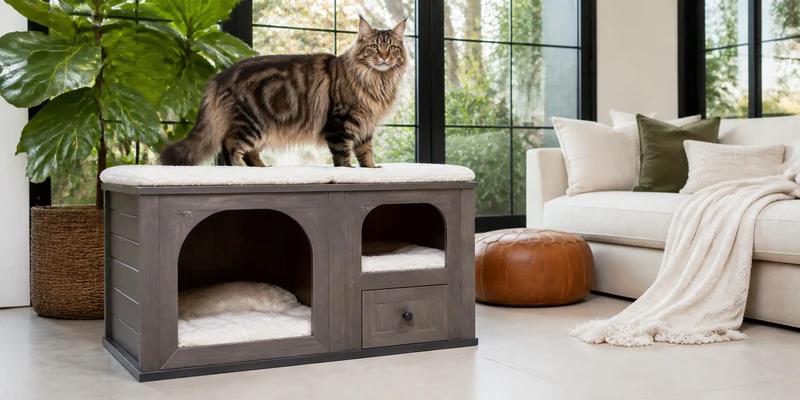
Last updated: August 8, 2026
Choosing a cat condo for a Maine Coon comes down to one number that almost no product listing puts up front: the size of the space inside. Exterior dimensions get all the attention, entry holes get a photo and nothing else, and the compartment itself is usually described with a word like “roomy” and left at that. For a cat that can weigh close to twenty pounds and measure more than three feet nose to tail tip, roomy is not a specification. It is a hope.
This guide is about the enclosed side of the category: cubbies, condo compartments, and furniture-style boxes your cat climbs into rather than onto. It covers the interior measurements that decide whether a big cat actually uses the hideaway, how to read an entry opening before you order, and which widely available units are built with enough room inside. If you are after an open tower with perches and posts instead, our guide to the Maine Coon cat tree covers that route, and the two solve different problems.
This article contains affiliate links. If you buy through them, we may earn a commission at no extra cost to you. Learn more.
Quick Answer
What makes a cat condo big enough for a Maine Coon?
- Interior floor space, not exterior size. Aim for a compartment your cat can curl up in and turn around in without touching two walls, which for most adult Coons means roughly sixteen inches across or more.
- An entry opening wide enough for the shoulders and hips, with a generous head height. Standard round holes are cut for an average cat and are the number one reason a big cat ignores the cubby.
- Interior height that lets him sit up without ducking, plus a floor and roof panel rated for a heavy cat landing on top.
Interior Measurements That Actually Matter
Save this table on your phone and hold every listing up against it. The left column is what to measure on your cat, the right column is what to look for in the product description or, more often, in the dimension diagram buried in the images.
| Measurement | How to check it on your cat | What to look for in a condo |
|---|---|---|
| Interior floor width | Measure him curled up in a favorite spot, from spine to knees, then add a few inches so he can shift position | Roughly sixteen inches across or more for a grown Coon; square compartments beat narrow rectangular ones |
| Interior depth | Nose to base of tail while he is loafing, not stretched out | Enough depth that he is fully inside with the tail tucked, rather than half in with the back end exposed |
| Interior height | Floor to ear tips while he sits upright | Room to sit up and groom without pressing his ears into the roof panel; low ceilings are a common complaint |
| Entry opening width | Widest point across the shoulders, then across the hips | Comfortably wider than his broadest point; openings on mass-market condos often land in the seven to nine inch range |
| Entry opening shape | Watch how he enters a cardboard box: head first and low, or stepping over a lip | Arched or open-sided entries are more forgiving than small round holes; a low threshold helps older cats |
| Roof and platform load | His weight plus the force of a landing, which is meaningfully more than standing weight | Capacity stated per level rather than for the whole unit, with thick panels and bolted joints |
| Overall stability | Not about the cat, but about how hard he launches himself off things | Wide base, low center of gravity, and an anti-tip strap for anything tall |
Two of these deserve more than a table row, because they are where the money gets wasted. The next two sections take the entry opening and the interior volume in turn.
The Entry Opening Is the Real Bottleneck
An enclosed cubby only works if getting in feels effortless. Cats are famously good at squeezing through gaps, but a Maine Coon that has to compress his shoulders to enter a box will usually decide, quietly and permanently, that the box is not for him. You will not get a complaint. You will just get an expensive empty compartment and a cat sleeping on the rug next to it.
Most mass-market condo compartments use a circular cutout sized for an average house cat of around ten pounds. Coons carry width through the shoulders and chest, and long-coated cats are effectively broader again once the winter coat fills in. That is why the same hole that looks generous in the product photo can be marginal in your living room. If you can find the opening dimension in the listing, compare it against your cat’s shoulder width with a couple of inches to spare. If you cannot find it, treat that as information in itself.
Shape matters as much as size. An arched or oval opening gives more usable width at shoulder height than a circle of the same nominal diameter, and an open-sided cubby, meaning a compartment with one whole face left open, removes the question entirely. Open-sided designs also make it far easier for a big cat to reverse out, which is the movement that tends to look awkward on video and feel worse in practice. A raised threshold, common on furniture-style units where the compartment sits above a base panel, is worth noticing too, since older or heavier Coons appreciate stepping in rather than hopping in. For the broader safety picture, including tip-over risk on taller units, see our guide to cat furniture safety.
Interior Volume: Why Exterior Dimensions Mislead
A condo advertised as extra large can still have a small compartment. Panel thickness, structural uprights, and the plush lining all eat into the interior, and a unit whose outer footprint sounds impressive may devote most of that to a base, a staircase, and a top perch. What your cat experiences is only the box he can get into.
Look for one of three signals. Some brands publish interior compartment dimensions directly, which is the easy case. Others include a labeled diagram in the image gallery, which is worth zooming into. Failing both, owner photos with a cat in frame tell you more than the marketing copy does, especially if you can find someone with a large breed. Reviews consistently mention fit for big cats when it is a problem, so the complaint pattern is usually easy to spot.
Volume also interacts with comfort in a way that is easy to miss. A compartment that is barely big enough forces your cat into one position, which for a heavy cat means one set of pressure points. A slightly oversized compartment lets him rotate, sprawl in warm weather, and curl tight in cold weather. That flexibility is a large part of why cats favor one hideaway over another. If your Coon is elderly and starts avoiding an enclosed space he used to like, or seems stiff getting in and out, that is worth raising with your veterinarian rather than assuming the furniture is the whole story.
Not sure whether an enclosed unit or an open tower fits your household better? Our comparison of a cat condo vs a cat tree works through the trade-offs in detail.
Our Top Picks at a Glance
How we chose: we compared widely available condo-style units on interior compartment size, entry opening width and shape, stated weight capacity per level, base construction, and the fit issues that come up repeatedly in owner reviews from people with large breeds. Selections are based on manufacturer specifications and reported owner experience rather than any hands-on assessment of our own.
One caveat before the list. Manufacturers change dimensions between model years while keeping the product name, so confirm the compartment figures on the listing you are actually buying. And if your Coon is still filling out, buy for the adult cat, because a cubby that suits an eighteen month old rarely still suits him at three years.
🏆 Best Overall
An extra-large condo tower with an oversized enclosed compartment, thick panels, and a wide base. A sensible default when you want one unit that covers hiding, lounging, and scratching for a full-grown Coon.

💛 Best Value
A large multi-level condo with a roomier than average cubby at a friendlier price. Board thickness and finish are a step down from the pick above, but the compartment and entry are in the right range.

⭐ Upgrade Pick
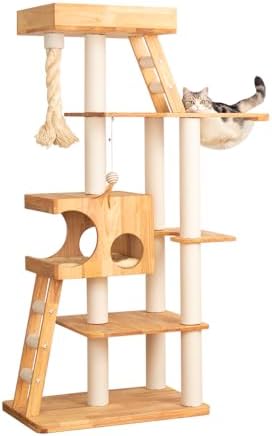
A furniture-grade wooden condo tower with an enclosed lounge compartment, built to sit in a living room without looking like pet gear. Worth it if you want the enclosed space and the room to still look like yours.
Matching the Condo to Your Household
Beyond raw size, three household situations change which unit makes sense. Work out which one describes you before you order, because the wrong answer here is harder to fix than a slightly small cubby.
Two or more big cats. One condo means one hiding spot, and a hiding spot is exactly the kind of resource cats guard. Either buy a unit with two separate compartments on different levels, or plan on a second smaller hideaway in another room. Compartments stacked directly on top of each other are less useful than compartments with some horizontal separation, since a cat in the lower one can feel cornered.
Older or heavier Coons. A ground-level compartment beats an elevated one once a cat starts jumping less. If the unit you like puts the condo on the second tier, check whether the route up is a short step or a real jump, and whether the entry sits above a lip he has to clear. Units with the enclosed space at floor level stay in use for years longer.
Apartments and shared living rooms. Footprint is the constraint, and a tall narrow condo is the least stable shape there is. In a small space, a lower and wider unit with one generous compartment usually beats a tower with three cramped ones. If the look of the piece matters as much as the function, our guide to mid century modern cat condos covers the design-led end of the category, and modern cat furniture is the wider view.
🐾 Best for Multi-Cat Homes
A tall unit with two separated condo compartments and several perches, so two large cats can settle in at the same time without negotiating over one box.

🪜 Best for Ground-Level Access
A large condo with the enclosed compartment at floor level and a low entry, so an older or heavy cat can walk straight in rather than climb and duck.

🌿 Also Great
A wooden two level cat house with a balcony, an escape door and a natural finish, for owners who want the enclosed space without carpet-covered particleboard in a main room.

Bear in mind that a condo and a tower are not mutually exclusive. Plenty of Coon households run a low condo for sleeping and hiding plus a tall structure for climbing and scratching, and that combination covers more behavior than either does alone. Our roundup of cat trees for large cats covers the climbing half.
Placement, Assembly, and Upkeep
Placement determines whether the compartment gets used at all. Cats choose hideaways that feel defensible, which in practice means a spot with a wall or corner behind it, a clear view of the room’s entrance, and enough distance from foot traffic that a passing person does not loom over the opening. A condo pushed into a busy hallway will lose to a cardboard box in a quiet corner every time. Our guide on where to place a cat tree applies here too, with one adjustment: enclosed units want a bit more shelter and a bit less exposure than an open perch does.
On assembly, big cats punish sloppy work. Tighten every fastener partway, square the frame up, then finish them off, and re-check the whole unit after two weeks once it has taken real load. If the compartment has a floor panel that drops in rather than bolts on, check how it is supported, since that is where sag shows up first under a heavy cat. Use the anti-tip strap if one is included, and add one if the unit is taller than it is wide.
Upkeep on enclosed compartments takes slightly more effort than on open perches, because hair and dander collect in a space with no airflow, and a long-coated breed produces plenty of both. A vacuum with a crevice tool once a week keeps it manageable. Removable and washable compartment pads are worth prioritizing where you can find them, and if a unit has a fabric lining glued to the interior, expect that to be the part that ages worst.
Common Mistakes to Avoid
- Shopping on exterior dimensions. An extra-large outer footprint tells you nothing about the compartment. Interior figures or a labeled diagram, or move on.
- Ignoring the entry opening. This is the single most common mismatch for the breed, and no amount of interior space fixes a hole your cat has to squeeze through.
- Trusting a whole-unit weight capacity. The number you need is per level, especially for the roof panel a big cat will treat as a perch.
- Buying tall in a small room. Height without a matching base is the least stable combination, and enclosed units carry more weight higher up than open frames do.
- Putting the condo where you want it rather than where he will use it. A quiet corner with sightlines beats a decorative placement in the middle of the floor.
- Expecting one unit to do everything. A condo is a hideaway. If your cat also needs to climb and scratch at full stretch, plan for that separately.
Where to Go From Here
Still narrowing things down? Start with the hub: our complete guide to the best cat condos explains how the formats differ and who each one suits. From there, cat condo vs cat tree settles the format question, the Maine Coon cat tree guide covers the open climbing route for the same cat, and cat trees for large cats broadens that to other big breeds. If the piece has to work as furniture as well, mid century modern cat condos is the design-led shortlist, and litter box furniture handles the other enclosed problem in most cat households.
Frequently Asked Questions
How big should a cat condo compartment be for a Maine Coon? Measure your cat curled up and add a few inches in each direction. For most adult Coons that lands somewhere around sixteen inches of interior width, with enough height to sit upright without ducking.
Why does my Maine Coon ignore his cubby? Nine times out of ten it is the entry opening rather than the interior. If he has to compress his shoulders to get in, or cannot back out comfortably, he will use the top of the unit instead and leave the compartment empty.
Is a condo better than a cat tree for a Maine Coon? They do different jobs. A condo gives enclosed, defensible resting space and blends into a room, while a tree gives height, sightlines, and full-stretch scratching. Our condo vs tree comparison lays out both sides.
How much weight should the roof panel hold? Look for a capacity stated per level, and give yourself headroom over your cat’s actual weight, since a landing loads a panel with considerably more force than a standing cat does.
Should the condo compartment be at floor level or up high? Floor level suits older, heavier, and more nervous cats and stays in use longer. Elevated compartments appeal to confident younger cats, provided the climb up is a step rather than a leap.
Do I need to anchor a cat condo to the wall? Anything taller than it is wide, yes. Enclosed units carry mass high in the structure, and a heavy cat launching off the top generates real sideways force.
The Bottom Line
A cat condo for a Maine Coon lives or dies on two numbers the listing usually hides: the interior floor space and the width of the entry opening. Measure your cat curled up and across the shoulders, then hold every candidate against those figures before you look at anything else. Put the compartment at floor level if he is older or heavy, anchor anything tall, and add an open tower separately if he also needs to climb.