Last updated: August 8, 2026
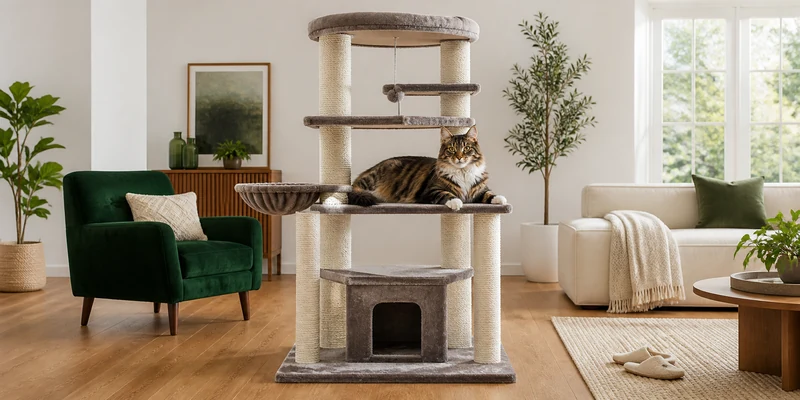
Shopping for the best cat tree for large cats is a different problem from shopping for a big cat tree. Plenty of towers are tall and impressive and still wobble the moment a 16-pound cat launches off the top perch. What a heavy cat needs is not extra inches of height, it is mass in the base, thickness in the posts, and platforms wide enough to hold a body that spills over the edges of an average perch.
This guide is about the cat, not the furniture dimensions. If your cat tips the scale past roughly 12 pounds, or is simply long and rangy rather than heavy, the specifications that matter shift. Below: what to check before you buy, why so many towers fail under weight, and picks from the mass-market brands that build sturdier than their size class suggests.
This article contains affiliate links. If you buy through them, we may earn a commission at no extra cost to you. Learn more.
Quick Answer
What should a cat tree have if your cat is big and heavy?
- A wide, heavy base. Weight low down is what stops a tower from rocking when a large cat jumps off, and it matters more than the height on the box.
- Thick posts and real board thickness. Thin cardboard-cored tubes and slim particleboard shelves are where towers loosen and sag first under a heavy cat.
- Perches your cat actually fits on. Measure your cat curled up and standing, then compare to the platform dimensions rather than trusting product photos.
What to Check When Your Cat Is Heavy
Use this as a shopping checklist. Every line is something you can verify from a product listing or a tape measure before you spend anything.
| What to check | Why it matters for a heavy cat | What to look for |
|---|---|---|
| Base footprint | A narrow base under a tall tower turns every landing into a rocking motion | A base clearly wider and deeper than the highest perch, and heavy enough that you notice it when you slide the tower |
| Total product weight | Shipping weight is the most honest clue about material thickness | Among towers of similar height, the heavier one almost always uses denser board and thicker posts |
| Post diameter | Thin posts flex, and flex works fasteners loose over months | Posts you cannot easily wrap one hand around, with a solid or thick-walled core rather than a light tube |
| Perch size | Large cats overhang standard perches, so they stop using them | Measure your cat curled up, add a couple of inches, then check the stated platform dimensions |
| Condo entry hole | Openings sized for an average cat are a squeeze for a broad-chested one | A generous round or arched opening, judged against the cube width if no measurement is listed |
| Level spacing | Heavy and older cats climb rather than leap | Steps close enough together to walk up, or an included ramp on taller models |
| Anti-tip hardware | The cheapest safety feature on a tall tower | An included wall strap, or a top plate you can anchor yourself |
If you want the wider view of the category first, our hub guide to cat trees covers every style and price tier. This page narrows it to one variable: your cat’s size and weight.
Weight, Not Height: Where Most Towers Fail
A cat tree carries two very different loads. The static load is your cat sitting on a perch, which almost any tower handles. The dynamic load is the shock of a large cat pushing off hard, several times the cat’s body weight arriving at one corner of one shelf. That is what separates a tower that lasts from one that starts creaking after a season.
Three weak points come up again and again in owner reviews of budget towers. The posts are hollow tubes with a thin wall, so they bow under a sideways push and the bowing gradually loosens the bolts at each end. The shelves are thin particleboard, which sags in the middle once a heavy cat has slept on the same spot for a few months. And the base is that same thin board, so there is no ballast at floor level to resist a cat leaping from four or five feet up.
So when you compare two towers of the same height, shipping weight and post thickness tell you more than the number of levels does. The heavier one is using denser board, thicker posts, or both.
Large Cat, Large Cat Tree, or Large Breed?
These three searches lead to different products, and mixing them up is how people end up disappointed.
- A large cat tree is about the furniture: overall height, footprint, and number of levels. A tall tower can still have small perches and slim posts. Our roundup of large cat trees compares options by size of the structure.
- A breed-specific tree is built around known proportions. Maine Coons, for example, are long as much as they are heavy, so length of the perch matters as much as its load rating. That is the angle in our Maine Coon cat tree guide.
- A tree for a large cat, which is what this page covers, starts from the animal on your floor. A stocky domestic shorthair at 18 pounds needs the same structural margin as a pedigree, and the same wide perches, even if the tower itself does not need to be enormous.
The practical takeaway: height is optional. A four-foot tower with thick posts, deep perches, and a weighted base serves a heavy cat better than a six-foot tower built to average-cat specifications. Go tall only if your cat still climbs enthusiastically and you can anchor the tower to a wall.
Our Top Picks at a Glance
How we chose: we compared widely available cat trees on base stability, post construction, perch dimensions, and how consistently owners of big cats report them holding up. Selections lean on manufacturer specifications and recurring themes in customer reviews rather than any hands-on trial of our own.
Two notes before the list. Sturdier towers for heavy cats are heavier towers, so plan for a bulky box and an assembly session with a real screwdriver rather than the folding hex key alone. And carpeted models remain the mainstream choice at this size; if you want a design-led look instead, a solid wood cat tree is the direction to explore.
🏆 Best Overall
Solid wood posts wrapped in sisal, thick perches, and a base with real mass, which is the combination heavy cats need most. A sensible default if you want one tower to last.

💛 Best Value
A tall, familiar carpeted tower that gets you a big footprint and several wide levels without a premium price. The value benchmark most other towers are measured against.

💪 Best Heavy-Duty
An extra-large heavy-duty tower with multiple rest levels, a substantial base and an anti-topple strap, built for cats that outgrow standard towers. Worth the step up if your cat is both heavy and long.

Multi-Cat Homes Where Everyone Is Big
Two heavy cats on one tower is not twice the load in a neat, predictable way. It is two cats using the same favorite perch at different moments, plus the occasional chase up and down the levels, which is the hardest thing you can ask of a base. Prioritize footprint over height, and look for towers with more than one top-tier perch so the cats are not competing for a single good spot.
Spreading vertical space around the room helps too. A second, shorter tower or a set of cat wall shelves rated for large cats reduces standoffs and takes load off any one structure. Our guide to cat trees for multiple cats goes deeper on layout and level counts.
Heavier Cats Who No Longer Leap
Weight and age often arrive together, and a cat carrying extra pounds tends to stop jumping long before it stops wanting height. The fix is not a shorter tower, it is a climbable one: levels that step up gradually rather than in big vertical gaps, an included ramp or staircase, and a bottom perch reachable from the floor in one easy step. Surface grip matters too, since a carpeted or sisal-covered step gives more traction than a smooth wood finish. If your cat is struggling with mobility or has gained weight quickly, that is a conversation for your veterinarian rather than a furniture purchase.
🐈 Best for Multi-Cat Homes
An extra-large multi-level tower with several roomy perches and a broad base, so two big cats are not fighting over the one good spot. Check the level count against how many cats you have.

🪜 Best for Less Agile Cats
A mid-height tower with a ramp and closely spaced steps, so a heavy or senior cat can walk up instead of jumping. Lower overall, but with the same wide platforms.
🧱 Also Great: Wide-Base Pick
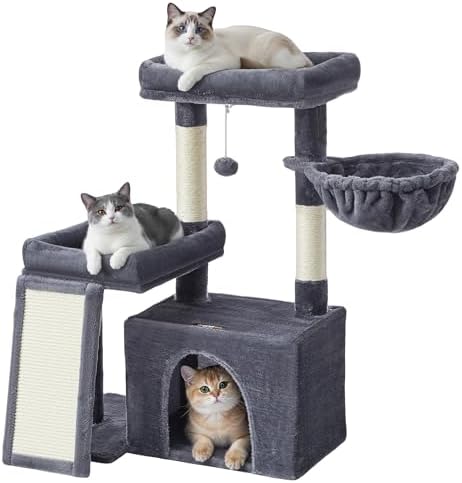
A stocky tower that trades height for footprint, which is the right trade if you cannot anchor to a wall. Suits renters and homes with hard floors.

Placement, Assembly, and Keeping It Solid
Placement does more for stability than most people expect. A tower with one side against a wall, or better still tucked into a corner, cannot rock in that direction at all. Put it where your cat wants to be, usually overlooking a window or the room the household actually uses. Our guide on where to place a cat tree covers the trade-offs when those two goals conflict.
Assembly is worth doing carefully on a heavy-duty tower. Run every bolt in loosely first, get the frame square, then tighten in stages, working around the structure rather than fully seating one bolt at a time. That keeps the panels from racking. The supplied hex key is usually too short for proper torque, so finish with a screwdriver or a socket that fits it.
Then keep an eye on it. Re-tighten the bolts after the first two weeks, since carpet and board compress under a heavy cat, and again every few months. Anchor tall towers to a wall or a nearby piece of furniture; more on that in our overview of cat furniture safety. For upkeep, vacuum the sisal with an upholstery attachment, trim frayed strands instead of pulling them, and re-wrap a post once it is worn smooth, because a slick post gets ignored and your sofa gets used instead.
Common Mistakes to Avoid
- Buying for height instead of mass. A tall, light tower is less stable under a heavy cat than a shorter, heavier one. Compare shipping weights within the same height class.
- Trusting the photo for perch size. Product images are often styled with a small cat. Measure your own cat and check the stated platform dimensions.
- Skipping the wall strap. It takes five minutes and removes the one failure mode that actually hurts a cat.
- Ignoring the condo entrance. Broad-chested cats will not use a hideaway they have to squeeze through, so the cube ends up as storage.
- Assuming sisal rope is all the same. Thin, loosely wound rope wears through quickly under a big cat, as covered in our sisal cat tree guide.
- Forgetting the floor. On hardwood or laminate, a tower walks a little every time a cat launches. Felt pads or a rug under the base solve it.
Where to Go From Here
If your cat is large mostly in length rather than bulk, start with the perch dimensions in our Maine Coon cat tree roundup. If you have the ceiling height and a wall to anchor to, tall cat trees add climbing range without widening the footprint. And if the tower has to share a living room, our large cat tree guide includes finishes that look less like gym equipment.
Frequently Asked Questions
How much does a cat have to weigh to count as large? There is no official line, but around 12 pounds and up is where standard perches start to feel tight and where base stability becomes the deciding factor. Frame and length matter too, since a long, lean cat needs a deep perch even at a moderate weight.
Do cat trees have a weight limit? Some brands publish a per-perch rating and many do not. When no figure is given, judge by construction: post thickness, board thickness, and total product weight are the practical stand-ins. See cat furniture safety for how to assess a tower you already own.
Is a taller tree better for a big cat? Not automatically. Height only helps if your cat still climbs willingly and the base can handle the landings. A wide, heavy, mid-height tower is often the safer choice for a heavy or older cat.
Will a large cat tree work for a Maine Coon? Often yes, provided the perches are long enough for the cat to stretch out and the condo opening is generous. Our Maine Coon cat tree guide focuses specifically on those dimensions.
What if my cat ignores the new tower? Placement is usually the reason. Move it beside a window or into the room where the household spends time, and check that the lowest perch is easy to reach. Our guide on where to place a cat tree covers the common fixes.
The Bottom Line
For a big cat, the deciding factors are a wide and genuinely heavy base, thick posts with a solid core, and perches your cat fits on without overhanging. Height is a bonus, not the goal, and it only pays off if the tower is anchored and your cat still enjoys climbing. Measure your cat first, compare shipping weights within a height class, and use the wall strap.