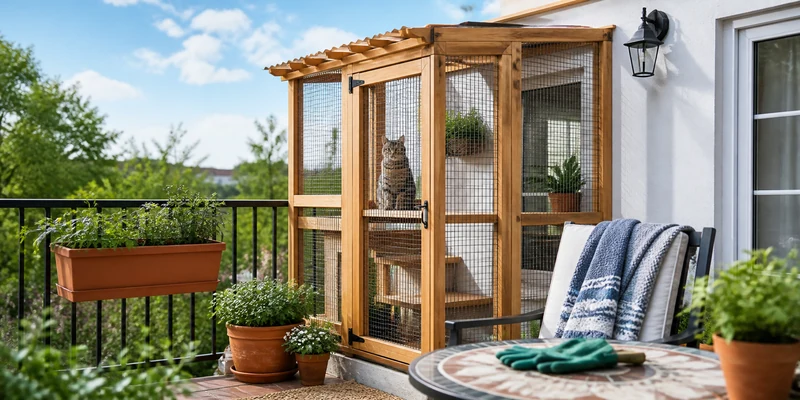
Last updated: August 8, 2026
Most people arrive at catio kits the same way: they want their cat to have real outdoor time, they have looked at what a custom build involves, and they would rather not spend three weekends learning to frame a wall. A kit is the shortcut. Panels arrive pre-cut, the mesh is already attached or ready to staple, and a weekend afternoon gets you an enclosure instead of a pile of lumber and a rented saw.
The trade is flexibility for speed, and the quality range inside the category is wide. Two kits that look nearly identical in a listing photo can differ enormously in the one thing that matters most, which is whether the structure keeps your cat in and keeps other animals out five years from now. This guide covers the formats worth knowing, the four build details that separate a solid kit from a flimsy one, and which kit type suits a yard, a deck, a balcony, or a single apartment window.
This article contains affiliate links. If you buy through them, we may earn a commission at no extra cost to you. Learn more.
Quick Answer
What separates a catio kit worth buying from one that will disappoint you?
- Check the mesh first. Welded wire or purpose-made pet screen holds up; thin hexagonal poultry netting, often sold as chicken wire, rusts, stretches, and is the single most common weak point in cheap kits.
- Look at the wood and the finish. Untreated softwood left bare will gray and soften within a couple of seasons, so plan on a pet-safe exterior stain or sealer even when the listing says weather resistant.
- Decide your format before you shop: window box for renters, freestanding run for a yard, walk-in if you want to go in with your cat. Then work out how the kit will be anchored against wind and digging.
Catio Kit Formats Compared
Nearly every kit on the market falls into one of these five shapes. Pick the row that matches the space you actually have before you compare brands, because the format decides most of the outcome.
| Format | What you get | Best suited to | Watch out for |
|---|---|---|---|
| Window box kit | A small screened or meshed box that mounts in or against a window opening | Renters, apartments, homes with no usable outdoor space | Window type and sill strength decide what fits; see our window catio box guide |
| Freestanding run | A wood-framed enclosure with mesh panels, a roof, and usually one or two shelves | Yards, decks, side passages where nothing attaches to the house | Your cat has to be carried out unless you add a tunnel or a cat door route |
| Walk-in catio | A structure tall enough to stand in, with a full human door | Owners who want to sit outside with the cat and clean easily | Largest footprint, heaviest shipping, most likely to touch local rules |
| Modular tube and cube system | Lightweight mesh panels or tunnels that clip together in different layouts | Trying the idea out, temporary setups, moving households | Play-grade rather than predator-grade; supervision is usually assumed |
| Balcony or tunnel add-on | Panels that close off a balcony, or a mesh run linking two points | Apartments with a balcony, or connecting a house to a yard enclosure | Landlord and HOA approval, plus wind loading higher up |
If you are still working out which of these your household can support, start with what a catio is for the wider picture. If none of the kit shapes fits your space, a custom build is the honest answer, and how to build a catio covers that route.
Mesh: The Detail That Decides Everything Else
Mesh is the whole security system of a catio, and it is where budget kits cut corners first. Three types show up in this category, and they are not interchangeable.
Hexagonal poultry netting, commonly called chicken wire. Thin, soft, twisted rather than welded, and designed to keep chickens contained rather than to keep anything out. It stretches under pressure, the galvanizing wears through at the twists, and cut edges leave sharp ends at exactly cat height. Raccoons can work it open at the seams. If a listing mentions chicken wire, or the photos show a loose hexagonal pattern, treat that as a reason to keep looking or to plan on replacing the mesh yourself.
Welded wire, sometimes sold as hardware cloth. Straight wires welded at each intersection into a square grid, usually galvanized and sometimes vinyl coated on top of that. It holds its shape, resists pushing and pulling, and the smaller grid sizes stop smaller wildlife rather than just larger animals. This is the standard worth aiming for on any enclosure that will hold a cat unsupervised. Coated versions last longer in wet climates and are kinder on paws than raw galvanized wire.
Pet screen. A heavy polyester or vinyl-coated mesh, far tougher than window screen but not structural. It is quiet, it does not rust, and it looks better on a balcony or a window unit. On a full outdoor enclosure it works best as a secondary layer or on panels that are out of reach, rather than as the only barrier at ground level.
Two things to check beyond the material itself. First, how the mesh is fastened: staples alone pull out over time, while staples plus a wooden batten strip, or mesh sandwiched between frame layers, stays put. Second, the gaps at corners, along the roof line, and where panels meet. An enclosure is only as secure as its smallest opening, and kits vary a lot in how neatly they close those joints.
Wood, Weatherproofing, and Hardware
Most freestanding and walk-in kits are built from softwood, usually fir or pine, occasionally cedar at the higher end. Cedar is naturally more rot resistant and holds up better in wet climates without much help. Fir and pine are perfectly serviceable and much more common, but they need a finish and they need it early.
Listings often describe the wood as weatherproof or pre-treated. Read that as a light factory stain rather than a long-term solution. The practical approach is to seal or stain every surface, including the cut ends and the underside of the base rails, before the enclosure ever goes outside. End grain drinks water, and untreated end grain sitting on damp ground is where rot starts. Use an exterior product rated as pet safe once cured, let it cure fully before your cat goes in, and expect to reapply every year or two depending on your climate.
Roofing is the other durability question. A solid roof panel over at least part of the enclosure gives shade and rain shelter, which is what actually extends the usable season. Asphalt shingle roofs shed water well and are common on wooden kits. Clear or translucent polycarbonate panels keep the light in, which suits shaded yards. A fully open mesh roof looks airy in photos and leaves your cat with nowhere to go when the weather turns.
Hardware is the quiet failure point. Outdoor fasteners need to be galvanized or stainless, hinges take weather as well as weight, and any bracket that came bare steel will bloom rust in a season. Some owners replace the supplied screws as a matter of course. It is also worth adding a second fixing anywhere a shelf or a ramp carries a cat, since a perch that shifts underfoot gets abandoned quickly. The same stability thinking we apply indoors in our cat furniture safety guide applies outdoors, with weather added on top.
Our Top Picks for Catio Kits
How we chose: we compared widely available catio kits on mesh type and how it is fastened, frame material and weather protection, door and latch design, and how the structure is meant to be anchored. Selections are based on manufacturer specifications and the patterns that come up repeatedly in owner reviews, not on hands-on assessment.
Two things to know before you click. Shipping weight and assembly time are the specs people underestimate most, so check both against what you can realistically handle in an afternoon. And almost every wooden kit benefits from a coat of sealer before assembly, which is easier to do while the panels are still flat.
🏆 Best Overall
A wood-framed outdoor cat enclosure with wire mesh, a weatherproof roof section for shade, multiple internal platforms and resting boxes, and a walk-in door for cleaning access. The format that suits the most households: enough room for levels, small enough to place beside a deck or along a fence line.

💛 Best Value
A modular mesh play system of connectable cubes and tunnels that assembles without tools and packs down flat. A low-commitment way to see whether your cat takes to outdoor time at all, with the caveat that it is designed for supervised use rather than unattended security.

⭐ Upgrade Pick
A walk-in run on an aluminum frame with mesh panels, a side access door, and a UV-proof cover panel. Built for permanence rather than portability, and the step up when you want a real multi-cat outdoor room.

Premium worth knowing about: Habitat Haven sells direct rather than through the big marketplaces and sits at the top of this category. Their kits use heavier gauge mesh, modular panel systems designed to attach to a house with a cat door, and tunnel components for linking spaces. If you want something closer to an architectural addition than a garden structure, they are the reference point, and they sit at the premium end accordingly.
Doors, Latches, and How Your Cat Gets In
Access is the part of a kit that people think about last and regret first. There are really two separate questions: how the cat gets in, and how you get in.
Cat access. An enclosure your cat can enter alone gets used many times more than one that requires a human to open something. The cleanest arrangement is a cat door in a wall, a door, or a window insert, connecting the house directly to the catio. Some kits are designed to butt up against a wall for exactly this. Freestanding kits usually assume you carry the cat out, which is fine for a supervised afternoon and much less good as a daily routine. A tunnel section between house and enclosure is the usual retrofit.
Human access. You will be cleaning this space, retrieving toys from it, and occasionally coaxing a reluctant cat out of it. A door you can walk or at least reach fully into makes all of that manageable. Kits where the only opening is a small hatch on one end tend to get cleaned less, which is a welfare issue as much as a convenience one.
Latches. This is the safety detail worth being fussy about. A simple hook and eye can be nudged loose and gives no protection against a determined raccoon. Look for a two-stage latch, a barrel bolt, or a lockable catch, ideally something you have to actively undo rather than something that closes by luck. Self-closing hinges help on the doors people walk through carrying a laundry basket. And if your enclosure has two doors, an airlock arrangement where both are never open at once removes the classic escape scenario entirely.
Picks for Small Yards, Renters, and Bigger Setups
If the three above do not match your space, these cover the situations that come up most: a compact yard footprint, a rental with nothing but a window, and a household ready to commit to something larger.
🐾 Best for Small Yards
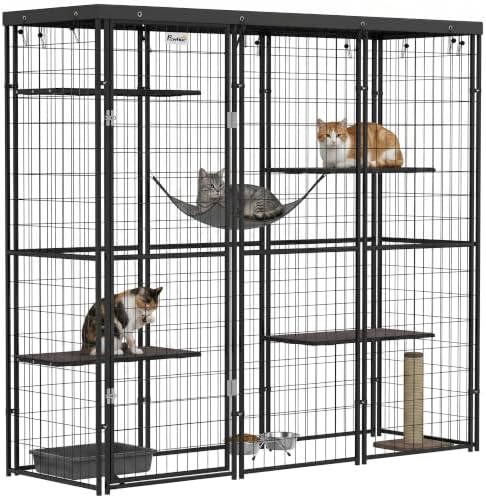
A compact weld-wire catio that stacks four levels and a hammock in a narrow footprint, with a waterproof cover panel. It uses vertical space rather than sprawl, which is what makes a narrow side yard or a deck corner workable.
🪟 Best for Renters
A window-mounted enclosure that lets a cat step straight out from the sill into screened air, sized to fit a range of standard window widths. The smallest version of the idea and the one most likely to pass a landlord.

👍 Also Great
A larger wooden walk-in enclosure with a full waterproof roof and a lockable door, aimed at multi-cat households or owners who want to sit outside alongside the cat. The step up when a run alone stops being enough.

Whichever route you take, a window unit is a legitimate destination rather than a consolation prize, and our window catio box guide covers what fits which window type. If nothing outdoors is possible in your building, a well-placed cat window perch delivers the sun and the view without the air.
Anchoring, Siting, and Assembly
A kit that is not anchored is a kit that moves. Wind is the obvious force, and a large meshed panel catches more of it than you would expect. Digging is the quieter one: on bare soil a cat can dig out and other animals can dig in, and that is the failure mode that turns a safe enclosure into an open one overnight.
Three approaches solve it, and many owners combine two. A buried mesh skirt, meaning wire that runs down and then outward under the soil for a foot or so, stops digging from both directions. A hard base such as pavers, a concrete pad, or decking removes the question entirely and makes cleaning far easier. Ground stakes or screw anchors at each corner hold the structure down in wind. If the enclosure sits against the house, adding a couple of brackets into solid framing is the simplest wind fix of all.
Siting matters as much as anchoring. Put the catio where the household already spends time, because a structure behind the garage sees a fraction of the use of one off the living room. Aim for a spot that gets sun for part of the day and shade for the rest, sheltered from the prevailing wind, with something worth watching in view: a feeder placed safely out of reach, a hedge, a bit of street. Check the ground is level before you build, since a racked frame will never close its door properly.
On assembly, plan for two people on anything walk-in sized. Lay the panels out and identify them before you start, seal the wood while it is flat, and dry-fit the frame before driving every screw home. Then give the whole thing a full inspection before the cat goes in: run a hand along every mesh edge for wire ends, check every latch, and push on each shelf. Ask your veterinarian about parasite prevention and vaccination status before a previously indoor-only cat starts spending time outside.
Common Mistakes to Avoid
- Accepting poultry netting. Chicken wire is the most common downgrade in budget kits and the first thing that fails. Welded wire or heavy pet screen is the standard to hold out for.
- Leaving the wood bare. Factory finishes on softwood kits are light. Seal every face and every cut end before assembly, and reapply on a schedule.
- Skipping the ground treatment. No skirt, no pavers, no anchors, and the enclosure becomes a digging project for whatever lives nearby.
- Buying an all-mesh roof. With no solid section, there is no shade and no rain shelter, which cuts the usable season sharply.
- Relying on a hook and eye. Latches are a security component. A two-stage or lockable catch is worth the small extra effort every time you use it.
- Forgetting the rules. Renters need landlord approval, condo owners usually need HOA sign-off, and a large attached structure can fall under local permit requirements.
- Buying floor area instead of levels. A tall enclosure with staggered shelves gets more use than a wide empty one, exactly as it does with cat wall shelves indoors.
Where to Go From Here
If you are still deciding whether an enclosure makes sense for your cat and your home, what is a catio lays out the formats and the reasoning without the shopping. If a kit’s fixed dimensions will not fit your awkward corner or your particular door height, building is the better answer and how to build a catio walks through the sequence. Renters and apartment dwellers should go straight to the window catio box guide, and there is more on working around a lease in cat furniture for renters. Whatever you end up with outside, the indoor half of the setup still matters: a cat tree or a window spot keeps the climbing and watching going on the days nobody is opening the back door.
Frequently Asked Questions
Are catio kits cheaper than building your own? Not always, and that is not really their advantage. A kit buys you pre-cut parts, matched hardware, and instructions, which saves time and tool rental. A build usually wins on fit and on how far your budget goes on materials.
How long does a catio kit take to assemble? Small window and modular units go up in an hour or two. Wooden runs and walk-in enclosures are more realistically a full day, and easier with two people. Sealing the wood adds drying time on top.
Is chicken wire safe for a catio? It is the weakest common option. It stretches, rusts at the twists, and leaves sharp cut ends, and it does little against raccoons. Welded wire mesh is the safer standard for anything a cat uses unsupervised.
Can a catio kit be used in an apartment? Yes, in window and balcony form. A window catio box needs no yard and often no permanent fixings, though balcony enclosures usually need landlord or HOA approval.
Do I need a permit for a catio kit? It depends on your municipality and on how large and permanent the structure is. Small freestanding runs and window units rarely raise questions, while a large enclosure attached to the house sometimes does. Check locally first.
Can my cat stay in the catio overnight? Many owners bring cats in at night, and that is the cautious default. It depends on your climate, your local wildlife, and how securely the enclosure is anchored and latched.
The Bottom Line
A catio kit is the fastest route from wanting an enclosure to having one, and the good ones are separated from the poor ones by four things: welded wire mesh rather than poultry netting, sealed softwood or cedar with a partly solid roof, a latch that cannot be nudged open, and a plan for anchoring against wind and digging. Choose the format your space allows first, then judge the kit on those four points. If nothing fits, building your own is the better use of the money.