Last updated: August 8, 2026
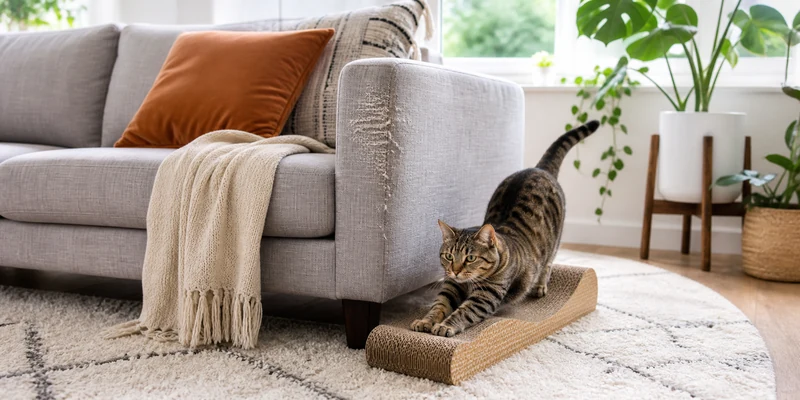
The arm of the sofa is going bald, the corner of the box spring is shredded, and you have started apologizing for your furniture before guests sit down. If you are looking for how to stop a cat from scratching furniture, the short version is that you cannot stop the scratching itself, and you do not want to. What you can do is move it, and that works far better than any attempt at discipline.
The approach below has three parts that have to happen in the right order: give your cat a better place to scratch, make the furniture temporarily boring, and reward the switch. Skip the first part and you will chase the problem from the couch to the armchair to the curtains. You will also find what to use on each type of furniture, how long the transition realistically takes, and the responses that make everything worse.
Quick Answer
Redirect the behavior instead of trying to end it: better target first, deterrent second, reward third.
- Put a tall, stable post right beside the damaged spot, close enough that your cat could reach either one without moving.
- Make the old spot unpleasant only after that, using double sided tape, a smooth cover, or a scratch guard, and treat it as temporary.
- Never punish, yell, or use a spray bottle. It teaches your cat to scratch when you are out of the room and damages your relationship with them.
Top Picks on Amazon
Prices and availability may change. Check the current listing on Amazon.



The Three Part Fix, at a Glance
Each move on its own tends to fail. Together, and in this order, they resolve most household scratching within a few weeks.
| Move | What it looks like in practice | Why it works |
|---|---|---|
| 1. Add a better target | A post taller than your cat’s full stretch, heavy enough not to shift, placed directly beside the damaged furniture | Scratching is not optional for a cat, so it needs somewhere to go before you close the current option |
| 2. Make the old spot dull | Double sided tape, a slick cover, a fitted scratch guard, or cardboard over the exact corner in use | Take away the grip and the post beside it becomes the easy choice |
| 3. Reward the switch | Quiet praise and a treat within a couple of seconds of any scratch on the post | Timing beats treat size; a reward a minute later is unconnected as far as your cat is concerned |
| What to skip | Shouting, spray bottles, and declawing | Punishment works only while you are watching, and surgical options carry real trade offs (see below) |
One expectation to set now: the goal is a cat who scratches the post instead of the couch, not a cat who has stopped scratching. If it helps to understand why the behavior is non negotiable, why cats scratch covers the five jobs it does, from shedding claw sheaths to leaving scent marks.
Step 1: Put a Better Option Right Next to the Damage
This is the step people skip, and it decides the outcome. Your cat chose that couch arm for reasons: it grips claws well, it is tall enough for a full stretch, it does not budge when pulled, and it sits in the busiest room in the house. An alternative has to win on all four points, and the fourth is where most attempts fall apart, because a post in the spare bedroom is not competing with the couch at all.
So put the new surface within arm’s reach of the damaged spot, close enough that a cat standing at the couch arm could just as easily use the post. It will look slightly absurd next to your sofa for a while. Once it has been getting steady use for a few weeks, move it a few inches at a time toward a spot you prefer, and stop the moment usage drops off.
Match the surface to what your cat is already doing, too. Vertical damage on couch arms and door frames calls for a tall post; a cat working on rugs needs a flat scratcher, since a vertical post cannot satisfy a horizontal preference. Coarse textures such as sisal rope, sisal fabric, and corrugated cardboard grip claws the way upholstery does; smooth wood and slick fabric do not. Our guide to what matters in a cat scratching post covers height, base weight, and material, and sisal posts tend to outlast carpeted ones.
Homes with more than one cat usually need more than one station, and so do homes where a cat sleeps in several places, since much of the scratching is a post nap stretch. If your cat has no vertical territory at all, a cat tree or a run of cat wall shelves often takes pressure off the furniture by itself, and renters who cannot drill will find options in cat furniture for renters.
Step 2: Make the Furniture Less Rewarding, Temporarily
Only once the post is in place does it make sense to close the old option; do it the other way around and the scratching usually relocates to a third piece of furniture. Think of these deterrents as scaffolding that comes off once the new habit holds.
| What is being scratched | What tends to work | Worth knowing |
|---|---|---|
| Fabric couch arm or corner | Double sided tape strips made for furniture, a fitted vinyl scratch guard, or a snug slipcover | Test tape on a hidden patch first; delicate weaves can pill when it comes off |
| Leather or faux leather | A throw or cover over the target area, plus clipped claw tips | Adhesives are risky here, so cover rather than stick |
| Rug or carpet edge | A plastic carpet runner laid nubs side up, or a flat cardboard or sisal mat scratcher alongside | Horizontal scratchers fix this faster than deterrents, so lead with the alternative |
| Wooden chair or table legs | A smooth plastic leg sleeve, plus a sisal or bare wood post nearby as a decoy | Some cats specifically want a rough, bark like texture |
| Door frames and wall corners | Clear corner protectors, and a tall post in the same walkway | Usually scent marking in a traffic route, so placement beats the deterrent |
| Mattress side or box spring | A fitted cover or a board against the side, plus a post beside the bed | Bedroom scratching often peaks at dawn, so a station your cat can reach on waking helps most |
Two notes on the popular options. Aluminum foil taped over a corner works for some cats and is ignored by others, so treat it as a short experiment. And be careful with scent based sprays: cats generally dislike citrus, but many essential oils are unsafe around cats, so choose products formulated for cats and check anything you are unsure about with your veterinarian.
Routine nail trims sit alongside the deterrents rather than replacing them. Taking the sharp tips off cuts the snagging damage considerably without taking anything away from your cat, and your veterinarian or groomer can show you how far to stay from the quick. Soft vinyl nail caps, glued over trimmed claws and replaced as they grow out, are another option, though some cats tolerate them poorly and the first set is best fitted by a professional.
Step 3: Reward the Behavior You Want
The deterrent tells your cat where not to scratch. The reward tells them where to go instead, and it is the half people forget. Keep treats near the post for the first couple of weeks and mark every scratch on it with calm praise and a treat, ideally within a second or two, because cats connect a reward to whatever they were just doing rather than to what happened a minute ago.
You can also stack the deck. Cats scratch most right after waking, when you come home, and around play, so lead a wand toy up the side of the post at those moments and let the claws catch the surface on the way. Picking your cat up and moving their paws down the post is the version that backfires, since being handled that way teaches many cats to avoid the post entirely. If you already own a post your cat simply will not touch, the full introduction routine lives in how to get a cat to use a scratching post, while this article stays on protecting the furniture.
What Not to Do: Punishment, Spray Bottles, and Declawing
Some responses feel productive and are not, so it is worth being direct about them.
Do not punish, yell, or spray water. Cats do not connect a delayed telling off with something they did earlier, and even in the moment the lesson they take away is about you, not about the couch. The reliable outcome is a cat who waits until you leave the room and who is warier around you, which makes the reward step harder to run. Loud noises aimed at the cat and physical corrections fall in the same category.
Do not remove the alternative before the habit sets. Taking away a scruffy post because it looks bad, or clearing the deterrent off the couch after four good days, is how households end up repeating this whole process twice a year.
Treat declawing as a veterinary conversation, not a fix. It is not a heavy duty nail trim: the procedure removes part of each toe, it is banned or restricted in a growing number of places, and a number of veterinary organizations discourage it. If it has been suggested to you, take it to your own veterinarian as a discussion about your specific cat and ask what else can be tried first. For nearly every household, an appropriate post plus regular nail trims addresses the same problem declawing is meant to solve.
How Long It Takes and What Progress Looks Like
Give the setup two to four weeks before you judge it. Progress rarely looks like a clean switch, and the middle stage confuses people: your cat uses the post, then goes back to the couch that same evening. That is normal, and what you are watching for is the ratio shifting. Expect investigation in the first few days, daily post use by around week two, and the furniture mostly out of rotation by week four, at which point you can ease off the deterrent one small area at a time while leaving the post exactly where it is.
If nothing has changed after a month, the usual culprits are location (not close enough to the original spot), height (no full stretch), or stability (it shifts when pulled). A sudden change in a cat who was fine for years, especially alongside hiding, appetite changes, or litter box trouble, is worth raising with your veterinarian rather than treating as a furniture question.
Common Mistakes That Keep the Couch in Play
Most stalled cases come down to one of these rather than to a difficult cat.
- Deterrent first, alternative later. Covering the couch without offering somewhere else to scratch relocates the damage instead of ending it. Add first, redirect second.
- Placing the post where it looks tidy. Scratching marks are meant to be seen, so a post in a quiet corner is asking your cat to give up the whole point of the location they picked.
- Buying short or light. A post that stops below a full stretch or wobbles under a real pull fails at the exact job your cat is doing on the sofa.
- Offering one texture and calling it settled. Vertical sisal, flat cardboard, and rough wood are genuinely different experiences, and putting out two options for a week answers the question quickly.
- One post for a multi cat household. Cats often will not share a scratching station, and the lower ranking cat quietly returns to the furniture.
What to Do Next
If you do not own a suitable post yet, that is the purchase to get right, since height, base weight, and material decide whether it gets used: start with what to look for in a cat scratching post. If you already have one and your cat ignores it, the introduction routine in how to get a cat to use a scratching post is the next step. To understand the pattern behind the spots your cat chose, why cats scratch explains what each location is telling you, and the placement logic in where to place a cat tree applies just as well to scratching stations.
Frequently Asked Questions
Can you actually train a cat to stop scratching furniture? You can train a cat to scratch a post instead, which is what people mean in practice. Scratching itself is normal maintenance and communication behavior that a cat cannot give up, so the plan is always redirection rather than elimination.
Does double sided tape damage upholstery? It can on delicate or loosely woven fabrics, so test a strip on a hidden section first and remove it slowly. On leather, cover the area instead of using adhesives.
Is a spray bottle ever appropriate? No. It does not teach a cat which surface to use, it only teaches them to scratch when you are not present, and it makes your cat warier of you at the exact moment you need to be rewarding good choices.
Will trimming my cat’s nails solve it? It reduces the damage and the snagging, but the stretching, scent marking, and territory functions remain, so your cat still needs an appropriate surface. Trims work best alongside the three part plan, not instead of it.
My cat only scratches the furniture at night. What can I do? Put a scratching station in that room, close to where the damage happens, since a lot of night and early morning scratching is a post nap stretch. Blocking the room without offering an alternative usually just moves the behavior.
Is my cat doing this out of spite? No. Scratching leaves scent and visible marks, and cats target prominent, socially important spots, which is why your favorite chair gets picked. Why cats scratch covers what each location signals.
The Bottom Line
Put a tall, stable scratching surface directly beside the furniture your cat is damaging, and only then make that spot dull with tape, a cover, or a guard. Reward every post session within a couple of seconds, keep the claws trimmed, and give the whole setup two to four weeks before you judge it. Skip punishment and spray bottles entirely, and treat declawing as a conversation with your veterinarian rather than a shortcut.