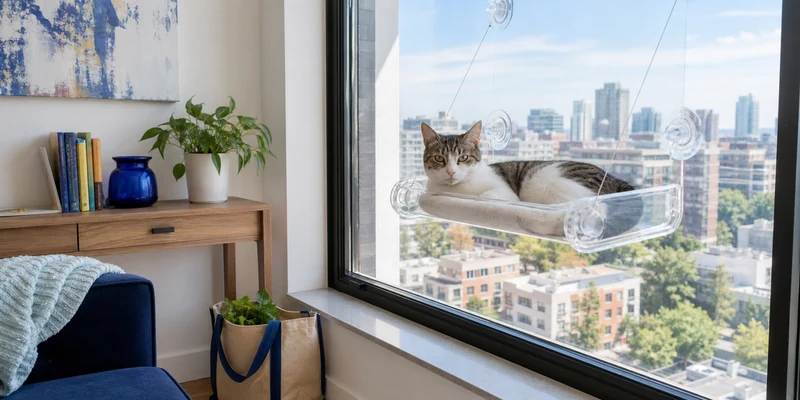
Last updated: August 8, 2026
There is one question every shopper asks before buying a suction cup cat window perch, and it is not about the fabric or the color. It is whether the thing will stay on the glass with a cat on it. The doubt is reasonable. Most of us have watched a suction hook let go of a bathroom tile in the middle of the night for no obvious reason, and a cat is heavier than a towel. So the honest starting point is this: these perches do hold, reliably, for a lot of households. They also fail in a specific and predictable way, and whether yours does depends far more on your glass, your climate, and your maintenance habit than on which brand you buy.
This guide is about that question rather than a general tour of the category. Which windows suction cups grip and which ones they never will, what the real failure mode looks like (a slow sag over days, not usually a dramatic drop), how often the cups need reseating, and which cats are simply too heavy or too dramatic on the landing for glass mounting to be the right answer. If you want the wider view of perch types first, including sill-mounted and floor-standing options, start with our hub guide to the cat window perch and come back here once you know you want the suction cup version.
This article contains affiliate links. If you buy through them, we may earn a commission at no extra cost to you. Learn more.
Quick Answer
Do suction cup window perches actually hold a cat?
- Yes, on clean, smooth, dry glass, with average-sized cats, and with the cups reseated every few weeks. Those three conditions do most of the work.
- The normal failure is gradual: a cup loses vacuum, the perch tilts, and the cat steps off. Mount it low over a soft landing zone and that stays a nuisance rather than a scare.
- Textured or frosted glass, applied window film, constant condensation, and heavy or leaping cats all point to a sill-mounted or floor-standing perch instead.
Will Suction Cups Hold on Your Window? A Surface by Surface Guide
A suction cup does not stick to glass. It holds because you squeeze the air out from underneath it and the outside air pressure presses it flat against a surface smooth enough that no air can creep back in. That single sentence explains every success and every failure in this category. The question is never how strong the cup is; it is how well your particular window seals it. Check yours against the table before you buy anything.
| Window surface or condition | What happens under a cat | Verdict |
|---|---|---|
| Clean, smooth, dry interior pane (single or double glazed) | The cup seals fully and holds its vacuum for weeks at a time | Ideal, this is what the product is designed for |
| Frosted, textured, patterned, or reeded glass | Microscopic ridges leave air paths, so the cup never reaches full vacuum | Will not work, choose a sill-mounted perch |
| Applied film (privacy, tint, security, UV) | The cup can grip the film rather than the glass and slowly peel it away from the pane | Risky, and the damage is to your film rather than the perch |
| Windows that sweat or run with condensation | A water layer feeds air back under the rim, so cups creep and let go early | Poor, expect frequent reseating at best |
| Very cold glass in winter | The cup material stiffens, holds its shape, and seals less completely | Workable but needs a warm cup and more frequent checks |
| South-facing glass in strong summer sun | Trapped air expands with heat, which pushes the cup off the glass from the inside | Workable, though this is the fastest creeping season |
| Small panes divided by grids or muntins | Cups cannot all land on flat glass, so the load rests on two of four | Measure the clear pane first, many perches will not fit |
| Painted wood, vinyl frame, or the sill itself | Porous or textured, no vacuum forms at all | Not a mounting surface, whatever the packaging suggests |
Two things follow from this table. First, the decision is made by your window, not by your shortlist, so it is worth walking over and running a hand across the glass before you read another review. Second, if your glass is right, a suction cup perch is one of the few pieces of cat furniture that leaves absolutely no trace when it comes down, which is why it is such a staple in rentals. Our guide to cat furniture for renters covers the other no-damage options worth pairing with it.
How These Perches Actually Fail (and Why That Is Reassuring)
Owners imagine a sudden drop. What almost always happens instead is creep. Air works its way back under the rim of one cup over hours or days, that corner sinks a fraction, the perch tips slightly out of level, and the load shifts onto the remaining cups. Cats notice this long before you do. The first sign is usually behavioral: a cat who used to sleep up there now sits on the sill, or gets on and immediately gets off again.
That slow sequence is genuinely reassuring, because it gives you a warning window that a bracket snapping would not. It also tells you what to look for. A perch that has dropped half an inch on one side is not broken; it is a perch whose cups need cleaning and reseating. The real risk sits in what happens if you ignore that warning for weeks and the last cup finally lets go while the cat is asleep on it.
Which is why placement is a safety decision, not a decorating one. Mount the perch low on the window rather than at the top of the glass, keep the drop underneath it short, and keep the landing zone clear of hard furniture, ceramic pots, and anything breakable. A perch mounted a foot or so above a carpeted floor turns the worst case into a startled cat. The same tip-over and fall logic runs through every format we cover in our overview of cat furniture safety.
Weight Ratings, Leverage, and the Cat’s Landing Style
Manufacturers publish generous capacity figures for these perches, and those figures are not dishonest. They are simply measured under laboratory conditions: perfectly clean glass, cups freshly seated, and a static load applied straight down. Your living room delivers none of that. The load arrives suddenly when a cat jumps up, it arrives at the front edge rather than the center, and it arrives on cups that were seated three months ago.
Leverage is the part most people miss. A cat sitting at the outer edge of a perch acts on the cups like a hand on the end of a long lever, pulling the top pair away from the glass instead of pressing everything flat. That is why the top cups almost always fail first, and why a deeper perch is not automatically a better one. Designs that keep the cat’s weight close to the glass, or that use four cups spread wide rather than two, deal with this far better.
Landing style matters more than the number on the scale. A calm ten pound cat who steps up from the sill is an easy customer. A lean but athletic cat who launches from the back of the sofa and lands hard is a much tougher one, and a genuinely big cat, a Maine Coon well into the double digits in pounds, is asking for more than glass mounting comfortably gives. Rough guidance that holds up well in practice: average-sized cats who use a stepping stone to get up are ideal candidates, and anything heavier or more acrobatic belongs on a perch that carries its load through the sill or the floor.
Our Top Picks at a Glance
How we chose: we compared widely available window perches on cup count and cup diameter, how far the platform holds the cat from the glass, whether the cover comes off for washing, and whether the frame keeps its shape when the fabric is wet or sagging. Selections are based on published specifications and the patterns that come up repeatedly in owner reviews, not on hands-on assessment.
Two expectations worth setting before you buy. Every suction cup perch needs reseating on a schedule, so treat that as part of ownership rather than a defect. And most cats need a few days plus a stepping stone before they will commit to a surface that floats in mid air.
🏆 Best Overall
The category benchmark: a rigid frame with four large heavy duty cups, a removable washable cover, and a long track record with average-sized cats. Widely stocked, so replacement parts are easy to find.

💛 Best Value
A simple fabric hammock stretched over a light frame with four cups, the low-commitment way to find out whether your cat is a window sleeper at all before spending more.

⭐ Best for Nervous Cats
A bolstered version of the same idea, with raised sides that give a cat something to tuck against. Useful for nervous cats and for anyone whose cat sleeps curled rather than sprawled.

The benchmark model in this category is worth a closer look before you commit, including how its cups behave over a full year of seasons. Our K&H EZ Mount window perch review goes through it in detail.
When to Skip Suction and Mount to the Sill Instead
Four situations make glass mounting the wrong tool, and in every one of them the fix is the same: transfer the load to something structural. A sill-mounted perch rests on the window ledge and is often braced against the wall below, so the glass carries nothing at all. It gives up the floating look and a little of the view, and it gains an installation you never have to think about again.
Skip suction if your cat is heavy or lands hard, since neither problem improves with better cups. Skip it if your glass is textured, filmed, or permanently damp, because no product on the market can seal a surface that leaks air. Skip it in a multi-cat household where two cats will want the spot at once, since a shared perch takes sideways knocks a vacuum grip is poor at resisting. And skip it if the only good window in the house sits above a tile floor or a staircase, where the consequence of a slow sag is not one you want to accept at all.
🐾 Best for Heavy Cats
A sill-mounted perch that rests on the window ledge and takes its support from the sill and wall rather than the glass, for big cats, hard landers, and any window that fails the surface test above.

👍 Also Great
A heated or insulated window bed for cold-climate rooms, where the appeal of the spot is as much the warmth as the view and a plain fabric sling gets abandoned by November.

If warmth is the real draw in your house, compare formats in our roundup of the best heated cat bed before defaulting to a window mount, since a sunny sill and a heated bed solve overlapping problems.
Mounting It So It Stays Up
Nearly every complaint about these perches traces back to the first ten minutes. The routine below is not fussy, and it is the difference between reseating every few weeks and reseating every few days.
- Clean both surfaces properly. Wash the glass, then wipe it with rubbing alcohol and let it dry completely. Do the same to the cups themselves, which pick up a dusty film in the box. Any residue from a glass cleaner that leaves a shine is a lubricant, and lubricated cups creep.
- Warm the cups before seating them. Cold vinyl is stiff and holds the shape of the packaging. A few minutes in warm water makes it pliable enough to conform to the glass, which is exactly what you want. Dry it before mounting.
- Seat one cup at a time. Press the center firmly, work outward to push the air out from under the rim, then move to the next. Seating all four at once traps air under at least one of them.
- Mount low, not high. Aim for a perch height a cat can step onto from the sill or a nearby chair, with a short, soft drop underneath.
- Load test with your hand. Push down and outward on the front edge with real force, roughly what a landing cat delivers, and hold it there. Anything that shifts or clicks comes off and gets reseated now rather than at three in the morning.
- Give the cat a route up. A stool, a low shelf, or a step lets your cat approach without launching. This does more for perch longevity than any product feature.
Then set a reminder. Every two to four weeks, press each cup back down firmly, and every couple of months take the perch off, wash the cups and the glass, and reseat from scratch. Wash the cover on the same schedule if your cat sheds heavily, because a damp or greasy cover eventually transfers to the cups. Seasonal changes are the moment to be extra attentive: the first hard freeze and the first genuinely hot week both accelerate creep, exactly as the table above suggests. If you are still working out which window deserves the perch, the light and traffic logic in our guide to where to place a cat tree applies just as well to a window seat.
Common Mistakes to Avoid
- Mounting on a window you never cleaned. A film of dust or cleaner residue is the single most common reason cups let go within days. Rubbing alcohol, then dry glass, then mount.
- Believing the capacity figure covers your cat. Published ratings assume clean glass, fresh cups, and a static load. Leverage from a cat sitting at the front edge is a different kind of force entirely.
- Sticking cups to window film. The vacuum can be stronger than the film adhesive, and the perch stays up while your privacy film peels off the pane.
- Mounting high because the view is better. Height turns a slow sag into a real fall. Cats are perfectly happy with a lower window seat.
- Treating it as install-and-forget. Reseating is maintenance, like re-tightening the bolts on a cat tree. Skipping it for six months is how the scary stories start.
- Giving up after two days. Many cats ignore a floating perch at first. A blanket that already smells of them, a stepping stone, and a week of patience usually settles it.
Where to Go From Here
If your glass passed the surface test and your cat is average sized, a suction cup perch is a genuinely good buy: cheap to try, invisible when removed, and the fastest way to give an indoor cat a front row seat. Start with the hub guide to the cat window perch if you want to compare it against sill and floor-standing formats side by side, and read the K&H EZ Mount window perch review for a close look at the model most people end up with.
If your window failed the test, or your cat is too big for glass mounting, you have two good routes. A sill-mounted perch or a small piece of furniture pushed under the window gets the same view with none of the anxiety, and our roundup of the best cat bed covers the shapes that work in a sunny spot. If the window itself is the attraction and you own the building, a catio window box extends the idea outward and gives a cat fresh air and real depth rather than a ledge.
Frequently Asked Questions
How much weight can a suction cup cat window perch really hold? More than most people expect on clean glass, and much less than the packaging implies on dirty or cold glass. Rather than working from the published number, judge by cup count, cup size, and how far the platform holds the cat from the pane, since leverage at the front edge is what pulls the top cups loose.
How often do the suction cups need to be reseated? Press them firmly back down every two to four weeks and do a full clean and reseat every couple of months. Cold snaps and hot sunny spells both speed up creep, so check more often when the weather turns.
Will the cups damage my window or leave marks? On bare glass, no. They can leave a temporary ring that wipes off. On applied window film the risk is real, because the vacuum may be stronger than the film adhesive and can lift it away from the pane.
My cat will not use the perch. What now? Give it a week. Put a blanket that already smells of your cat on it, set a stool or low shelf next to it so there is no jump involved, and mount it on the window with the most bird traffic. Most refusals are about the approach, not the perch.
Is a suction cup perch safe for a large cat like a Maine Coon? It is the wrong tool for that job. Big cats combine weight with a heavy landing, and both work against a vacuum grip. A sill-mounted perch, or a tower placed at the window, is the sensible choice. See our hub guide to the cat window perch for those formats.
The Bottom Line
Suction cups hold fine on clean, smooth, dry glass with an average-sized cat, and they fail slowly rather than suddenly, which gives you time to notice and reseat. Your window decides this more than the brand does: textured glass, applied film, and constant condensation are all disqualifying, and so is a heavy or hard-landing cat. Mount low over a soft floor, reseat every few weeks, and treat a sagging corner as a maintenance reminder rather than an emergency.