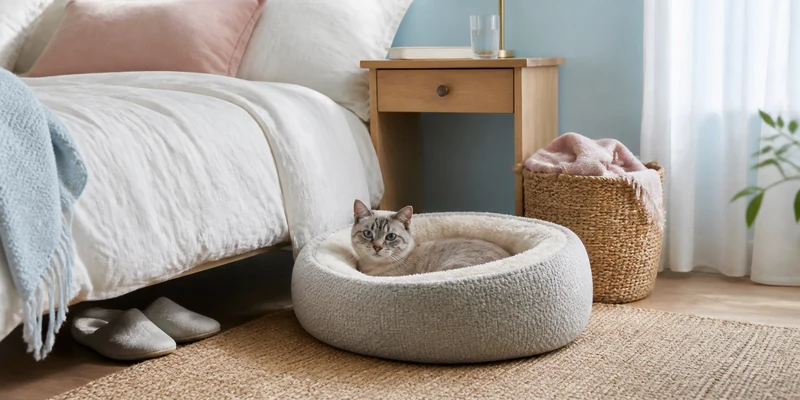
Last updated: August 8, 2026
Finding the best cat bed is less about the bed and more about the cat lying in it. Cats sleep for a large part of the day, and they are picky in a very specific way: one cat curls into a tight ball and wants walls around it, another sprawls flat on its side and wants nothing touching it, and a third only sleeps somewhere warm and slightly elevated. Buy the wrong shape for the sleeper you actually have and the bed becomes an expensive rug that gets walked past for a year.
This guide covers the formats worth knowing, the three signals that predict whether a bed gets used (sleeping posture, size, and how easily the thing washes), and picks across the main categories: donut and cuddler beds, cave and covered beds, heated beds, elevated beds, and the design led end that has to look right in a visible room. Where a category deserves its own comparison, we point you to it rather than cramming it in here.
This article contains affiliate links. If you buy through them, we may earn a commission at no extra cost to you. Learn more.
Quick Answer
How do you pick a cat bed your cat will actually sleep in?
- Match the shape to the posture you already see. Curlers want a raised rim or an enclosed cave, sprawlers want a flat open mat or a lounger with a low edge.
- Size it to the cat, not the room. A cat should be able to stretch out fully inside the bed without a paw hanging over the edge, which usually means going one size up from the label.
- Buy for the washing machine. A removable, machine washable cover, or a bed that fits in the drum whole, is the difference between a bed you keep and one you throw out.
Cat Bed Types at a Glance
Narrowing to a format first saves far more time than comparing individual models. Each of these solves a different sleeping problem, and most homes end up with two of them in different rooms rather than one bed doing everything.
| Type | What it does well | Best suited to | Watch out for |
|---|---|---|---|
| Donut and cuddler | Deep filled rim to tuck against, soft center, holds warmth around a curled cat | Cats that sleep curled tight, nervous cats, cold rooms | Inner diameter is often much smaller than the outside; check the usable center |
| Cave and covered | Enclosed hood or felted shell that gives cover and blocks light | Cats that hide, sleep in boxes, or retreat when guests arrive | Some cats refuse enclosure entirely; a stiff hood can collapse over time |
| Bolster and lounger | Raised edge on two or three sides with an open front, so a cat can curl or stretch | Cats that switch postures, the safe pick when you are unsure | Thin bolsters flatten quickly and stop supporting the head |
| Flat mat and pad | Low profile cushion that fits inside furniture, shelves, or a carrier | Sprawlers, hot rooms, cats that already claim a specific spot | Offers no cover or edge, so it wins on placement rather than comfort |
| Heated | Low wattage warming element or a self warming reflective layer | Senior cats, thin coated breeds, drafty homes, winter | Cord management and a heat setting the cat can move away from |
| Elevated and hammock | Raised frame or window mounted sling that lifts the cat off the floor | Homes with dogs or toddlers, cats that want a lookout, warm climates | Fabric tension and frame stability matter more than the fabric itself |
| Design led | Molded shells, wood frames, and neutral fabrics made for a visible room | Living rooms, studio apartments, anyone tired of pet aesthetics | Confirm the liner is removable and washable before you commit |
Several of these categories are deep enough to shop on their own terms. Our roundups of heated cat beds, elevated cat beds, and orthopedic style cat beds go model by model, and the modern cat bed guide covers the design end.
Start With Your Cat’s Sleeping Posture
This is the single most useful thing you can do before shopping, and it costs nothing. Watch where your cat sleeps for a few days and note the shape it makes.
The curler. Nose tucked into the tail, body in a tight circle, often pressed against something. Curlers want contact on as many sides as possible, which is why donut beds and caves work so well for them. A flat mat leaves them with nothing to brace against and they will usually move to a chair cushion instead.
The sprawler. Flat on one side, legs extended, sometimes belly up. Sprawlers need surface area more than walls, and a deep rimmed donut actively works against them because there is nowhere to put their legs. A flat pad, a lounger with one low edge, or a large open bolster suits them better.
The loafer. Paws tucked under, upright, alert. Loafers are usually happy in almost anything, but they tend to prefer a firmer base than a squashy one, and they often choose beds with a view rather than beds with cover.
The perched sleeper. Windowsills, the back of the sofa, the top of a bookcase. These cats are choosing height and sightline over softness, and a floor bed rarely competes. A window mounted perch is a better use of money, which is what our cat window perch guide covers.
Most cats use more than one posture depending on the season and how safe they feel, which is a good argument for a bolster style bed as a first purchase and a second, more specialized bed later.
Washability: The Feature That Decides Whether You Keep the Bed
Cat beds get hair, dander, the occasional hairball, and in older cats sometimes worse. A bed that cannot be cleaned properly ends up in the trash long before it wears out, so treat washability as a primary specification rather than a bonus.
Removable cover beats whole bed washing, usually. A zippered cover means the filling keeps its loft while the fabric goes through the machine, and you can wash more often because it is less hassle. The catch is cheap zippers and covers cut so tight that getting them back on is a wrestling match. If a bed advertises a removable cover, look for owner comments about refitting it, since that is where the complaints show up.
Whole bed washing works if it fits your drum. Small donut beds and flat mats often go in whole, which is genuinely simpler. Measure your washing machine opening against the bed diameter, because a bed that has to go to a laundromat gets washed roughly never.
Watch what happens after the first wash. Polyester fiberfill mats down, faux fur can stiffen, and glued bases sometimes separate. Beds that survive repeated washing tend to use sewn through construction and a fill that recovers.
Hard shell beds are a different equation. Molded or wooden beds with a fabric liner move the washing problem to the liner alone, which is the easiest arrangement of all, provided a replacement liner is available. Check that before you buy a design piece.
Getting the Size Right
Cat beds are sold in a small number of sizes with vague labels, and the numbers on the listing describe the outside of the bed rather than the space your cat gets. Two measurements sort this out.
Curled length. Measure your cat asleep in a ball, across the widest point. That number is the minimum usable interior, not the minimum outside diameter. On a deep donut bed, the rim can eat several inches on each side, so a bed that looks generous in photos can leave a medium cat wedged.
Stretched length. Nose to base of tail with the cat extended. A bed your cat can also stretch out in gets used across seasons instead of only in winter, and it matters more for larger breeds. Maine Coons, Ragdolls, and Norwegian Forest Cats regularly need what a manufacturer labels a dog size, and there is nothing wrong with buying one.
When in doubt, go up. A slightly oversized bed still works for a curled cat, since they will simply use a corner of it. A slightly undersized bed does not work for anyone. The exception is nervous cats, who often prefer a snug enclosed space, in which case a cave sized closely to the cat is the point rather than a flaw.
Multi cat homes need multiples. Two cats occasionally share a large bed, but far more often one cat claims it and the other loses out quietly. Two smaller beds in two places beat one large bed almost every time, as our guide to a cat tree for multiple cats explains.
Our Top Picks at a Glance
How we chose: we compared widely available cat beds on shape, usable interior size, washability, and value, using manufacturer specifications and the patterns that come up repeatedly in owner reviews. Colors, sizes, and availability change often, so check the current listing before ordering.
Two things worth saying up front. A more expensive bed is not more likely to be used, since fit and placement decide that, not materials. And no bed converts a cat that has already chosen the sofa; what changes behavior is putting the right shape in the spot the cat already likes.
🏆 Best Overall
A deep rimmed donut bed in soft faux fur, the format most curled sleepers take to immediately, and one that goes in the washing machine whole in the smaller sizes. The sensible default if you are buying one bed and your cat sleeps in a ball.

💛 Best Value
A simple bolster cuddler bed with a raised edge around the rim and a cover that zips off for the wash. A reasonable first bed, or a second one for a bedroom or home office where you do not want to spend much.

⭐ Upgrade Pick
A design led nest bed with a removable fleece liner, built to look like furniture rather than pet gear while still giving a cat the enclosed, supported shape it wants. Worth considering when the bed has to live in a visible room.

Want to compare inside one category rather than across them? The modern cat bed roundup narrows the design end, and luxury cat beds covers the premium segment where materials and finish do most of the work.
Matching the Bed to Your Cat and Your Home
Senior cats. Older cats often want warmth, easy entry, and a firmer base that does not swallow them. A low sided bed they can walk into, ideally somewhere they do not have to jump to reach, keeps a familiar sleeping spot accessible. Beds sold as orthopedic use denser foam that holds its shape under a resting cat, which is a comfort feature rather than a treatment; if your cat seems stiff, reluctant to jump, or has changed sleeping habits noticeably, that is a conversation for your veterinarian. Our orthopedic cat bed roundup covers what to look for in the foam itself.
Cold rooms and thin coated cats. Cats seek heat consistently, and in a drafty apartment or an unheated back bedroom the warmest available surface usually wins over the softest one. Self warming beds use a reflective layer to bounce body heat back, which needs no power and works reasonably well in a mild room. A powered heated bed does more in genuinely cold spaces, and the heated cat bed guide goes through the safety points worth understanding first.
Nervous or newly adopted cats. Cover beats comfort during a settling in period. A cave bed, a hooded bed, or a covered spot tucked into a quiet corner gives a cat somewhere to observe from without being exposed. If your cat wants something more substantial than a fabric shell, an enclosed cat condo gives the same cover in furniture form.
Homes with dogs or small children. Height is protection. An elevated bed, a padded perch on a shelf, or a bed on a cat tree platform lets a cat rest without being reachable. Our elevated cat bed roundup covers raised frames and hammock styles, and a cat tree with a padded top level is often the better answer in a busy household.
Renters and small apartments. A bed needs no installation, which makes it the natural starting point when you cannot drill into walls. Pair it with a window perch and you have warmth, cover, and a lookout without touching the lease, an approach we go into further in cat furniture for renters.
Picks for Warmth, Height, and Cats That Want to Hide
These cover the situations where a standard soft bed is not quite the right answer. Each one solves a specific problem rather than adding features.
🔥 Best for Cold Rooms
A low wattage heated bed with a removable, washable cover and a thermostatically controlled element designed to warm to around a cat’s normal resting temperature rather than run hot. A strong choice for senior cats and drafty rooms in winter.

🪟 Best Elevated Pick
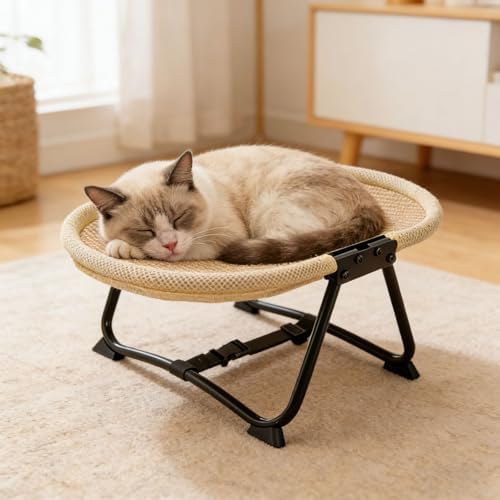
A raised bed on a low frame that lifts the cat off a cold floor and away from foot traffic, with a taut fabric or mesh surface that stays breathable in warm weather. Useful in homes with dogs, and easy to move between rooms.
🫧 Best for Cats That Hide
An enclosed cave style bed with a soft shell that holds its shape, giving cover on all sides and a single opening facing into the room. The right shape for anxious cats and for anyone whose cat claims every cardboard box that enters the house.

If the bed is going into a room where the look matters as much as the function, the modern cat furniture hub covers how beds, trees, and shelving can be chosen as a set rather than one at a time.
Placement, Introduction, and Upkeep
Placement does most of the work. A bed in the wrong spot stays empty no matter how good it is. Put it where your cat already sleeps: the sunny patch by the window, the corner of the sofa, the foot of your bed. Warm, quiet, and with a view of the room beats tucked away in a corner nobody uses. The same reasoning we set out in where to place a cat tree applies directly to beds.
Introduce it, do not install it. Do not lift your cat into the new bed. Put it in the chosen spot with a blanket or worn t-shirt that already smells of home, and leave it alone. Many cats investigate within a day or two. If yours ignores it for a week, move it rather than replacing it, since placement is the more common problem.
Seasonal rotation is normal. Cats abandon enclosed and heated beds in summer and return to them when it cools down. A bed that goes unused in July is not a failed purchase.
Upkeep. Wash covers on a gentle cycle without fabric softener, since softener leaves a residue and a scent that some cats dislike. Shake filled beds between washes to keep the loft, and vacuum cave beds regularly, because they trap hair faster than open shapes. Replace a bed once the fill has permanently flattened.
Common Mistakes When Buying a Cat Bed
- Buying the shape you like rather than the one your cat sleeps in. A donut bed for a cat that sprawls is the most common wasted purchase in this category.
- Reading outside dimensions as usable space. On rimmed beds, the interior can be dramatically smaller than the listing suggests. Check the inner measurement or assume you need a size up.
- Ignoring how it washes. If the cover does not come off and the bed does not fit your machine, you have bought a disposable item.
- Putting it somewhere convenient for you. Cats choose sleeping spots by warmth, safety, and sightline. A bed in a spare room satisfies none of those.
- Expecting a bed to fix a scratching or climbing problem. Those are different needs entirely, handled by a scratching post and vertical space, not by a softer surface.
- Overlooking cords and stability. Heated beds need a cord your cat cannot chew comfortably, and any raised bed needs a base that does not tip when a cat lands on the edge, a point covered further in cat furniture safety.
Where to Go Next
If warmth is the priority, heated cat beds covers powered and self warming options and the safety points that go with them. If your cat is older or noticeably stiffer, orthopedic style beds explains what the denser foams actually do. For homes with dogs or cats that want a lookout, start with elevated cat beds. And if the bed has to earn its place in a room you entertain in, modern cat beds and luxury cat beds cover the design and premium ends respectively.
Frequently Asked Questions
Why does my cat ignore the bed I bought? Usually placement or shape. Move it to the spot your cat already sleeps in and add something that smells familiar. If it is still ignored, the format is probably wrong for how your cat sleeps.
What size cat bed should I get? Measure your cat curled up and stretched out, then compare against the interior of the bed rather than the outside dimensions. When you are between sizes, go up, unless you are deliberately buying a snug cave for a nervous cat.
Do cats prefer covered or open beds? It depends on the cat. Cats that hide, claim boxes, or retreat from visitors usually prefer covered beds, while confident cats often want an open shape with a view. Offering one of each in different rooms is the practical answer.
Are heated cat beds safe? Beds designed for pets use low wattage elements intended to warm to roughly a cat’s resting body temperature, and a cat should always be able to move off the heat. Our heated cat bed guide covers cord protection and what to look for on the listing.
How often should I wash a cat bed? Every two to four weeks for a bed in daily use, more often if your cat goes outdoors or has allergies. Skip the fabric softener, since the residue and scent put some cats off the bed entirely.
How many beds does one cat need? Most cats use two or three resting spots across a day, following warmth and light. Two beds in different rooms tend to get more total use than one, and in multi cat homes separate beds prevent one cat monopolizing the good spot.
The Bottom Line
A cat bed works when three things line up: a shape that matches how your cat actually sleeps, an interior big enough to stretch out in, and a cover you can put through the washing machine without a fight. Get those right and placement handles the rest. Everything above that, materials, finish, and design, is about your room rather than your cat.