Last updated: August 8, 2026
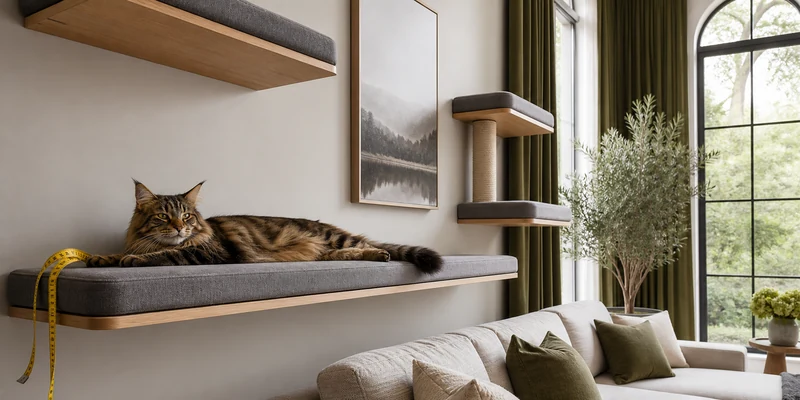
Shopping for cat wall shelves for large cats exposes the same problem over and over: the platform that looked generous in the product photo turns out to be a narrow ledge once a fourteen pound cat is standing on it, front paws hanging off one edge and tail off the other. Most of the category is designed around an average adult cat, roughly eight to ten pounds and compact enough to curl up on a small square. A Maine Coon, a Ragdoll, a Norwegian Forest cat, or a big domestic shorthair carrying a few extra pounds does not fold up that neatly, and none of them land that gently either.
That makes size the starting point rather than a footnote. A heavier cat needs more surface to settle on, more depth to turn around on, shorter hops between pieces, and considerably more attention to what the bracket is screwed into. Worth stating up front: this guide is about matching dimensions and mounting to the animal. Our roundup of sturdy cat wall shelves covers construction quality across the whole category, whatever your cat weighs, and the two guides are meant to be read together.
This article contains affiliate links. If you buy through them, we may earn a commission at no extra cost to you. Learn more.
Quick Answer
What changes when the cat on the shelf is a big one?
- Depth and length. A large cat wants a platform deep enough to lie down across rather than balance on, which usually means going a size up from the category default.
- Fixings. Every piece a heavy cat lands on should be anchored into a wall stud, ideally with two fixings rather than one, because impact load is much higher than resting weight.
- Landing zones. Shorter gaps, wider targets, and a clear route back down matter more as body weight goes up.
Sizing Wall Shelves to Your Cat: A Practical Reference
There is no industry standard for cat shelf dimensions, and manufacturers rarely state which size of cat a piece was drawn around. The table below is a set of rules of thumb rather than a specification: measure your cat lying stretched out on its side, then work backward from that. Anything narrower than the cat’s resting body length starts to feel like a perch to balance on instead of a place to sleep.
| Cat profile | Platform depth | Platform length | Mounting per load-bearing piece |
|---|---|---|---|
| Average adult, compact build | Around ten inches is workable | Enough to sit and turn around | One stud fixing, correct screw length |
| Large adult, eleven to fourteen pounds | Twelve inches or more | Long enough to lie down without overhang | One stud minimum, two fixings preferred |
| Very large or long-bodied breed | Fourteen inches or more on resting spots | Roughly the cat’s stretched-out length | Two fixings into a stud, steel bracket |
| Heavy and less agile | Generous, with a raised lip or padded top | Wide target, easy to aim at | Two fixings, plus shorter vertical gaps |
| Two large cats sharing a route | As above, on every resting spot | Double-width platforms or a wide bridge | Two studs where the span allows it |
Two caveats. Depth figures on product listings sometimes include the bracket, so the usable surface is smaller than the number suggests. And a stated weight capacity is not a size rating: a small shelf can be rated for plenty of weight and still be an uncomfortable place for a big cat to sleep. Comfort and capacity are separate questions, and you need both to come out right. If you are still working out which components a route needs at all, our hub guide to cat wall shelves covers the types before you start sizing them.
Depth Is the Number That Decides Everything
If you only get one dimension right, make it depth. A cat settling in wants to rotate, tuck, and lean against something, and a shallow shelf allows none of that. Owners of large breeds report the same pattern repeatedly: shelves that are technically strong enough get used as stepping stones and ignored as resting spots, because there is nowhere comfortable to commit to. The cat climbs the route, reaches the top, and then jumps to the windowsill or the bookcase to actually sleep.
Length matters second. A platform that is deep but short forces a long cat to hang its back end over the edge, which is fine for a nap in the sun and less fine as a daily habit. Where a range offers the same shelf in two sizes, the larger one is almost always the right call for a heavy cat, and the cost difference is usually small next to the difference in how much it gets used.
A few design details do real work at this size. A raised lip or a slightly curved surface gives a big cat something to brace against. Carpet, felt, or plush tops offer grip that bare varnished wood does not, which matters because a heavier animal slides further when it lands off-center. Solid wood or thick plywood tolerates repeated impact better than thin particleboard with a laminate skin, and the difference shows up over months rather than on day one.
Mounting: Studs, Fixing Count, and Why Two Beats One
Weight is where wall shelves stop being decor and start being structural. A resting cat applies a steady downward load. A cat jumping up from the floor applies a much larger momentary force, and it applies it at an angle, pulling the top of the bracket away from the wall. Body weight multiplies both effects, which is why the mounting advice for large cats is stricter than the generic version.
- Studs, not drywall. The plastic plugs bundled with inexpensive sets are not designed for impact loading. In typical US framing, studs sit sixteen inches on center, sometimes twenty-four. Find them with a stud finder, mark them floor to ceiling with painter’s tape, and design the layout around those lines instead of around a sketch.
- Two fixings per resting platform. A single screw becomes a pivot point, and a pivot point works itself loose. Two fixings into solid timber, vertically spaced, resist the outward pull far better. Brackets that spread load across a wide backplate help for the same reason.
- Screw length is not a detail. The screw has to pass through the bracket and half an inch of drywall and still bite well into the stud behind it. Hardware supplied with budget kits is sometimes too short for that, and swapping in longer screws is a cheap upgrade.
- Heavy-duty anchors are the fallback. When a piece has to land between studs, toggle bolts or similar rated hardware are the right answer, not the default. Keep your heaviest destination platform on a stud regardless.
- Older walls change the rules. Plaster and lath, masonry, and metal framing all need their own fixings, and a system that installs easily in a modern apartment can be a different job in a prewar building.
Published capacity figures are useful as a comparison between products, but read them as an upper bound rather than a target. They assume correct installation into solid backing, fully seated screws, and static load, and none of those describe a fifteen pound cat arriving at speed. The step-by-step in our guide to installing cat wall shelves covers wall types, stud finding, and the order of operations in more detail.
Our Top Picks at a Glance
How we chose: we compared widely available wall shelves and modular systems on usable platform depth and length, bracket design and the number of fixings each piece uses, materials, and whether the range offers pieces large enough to serve as a destination rather than a step. Selections are based on manufacturer specifications and patterns that come up consistently in owner reviews, not on physical assessment.
Two expectations worth setting. Larger platforms cost more per piece and there is no way around that, so it is usually better to buy three generous pieces than six small ones. And every option here assumes you are willing to drill into studs, because that is what makes the difference at this weight.
🏆 Best Overall
A solid wood shelf system with a published per-shelf load rating, built around stud mounting with platforms deep enough for a big cat to lie down on. The most flexible route to a wall setup you can size up as you go.

💛 Best Value
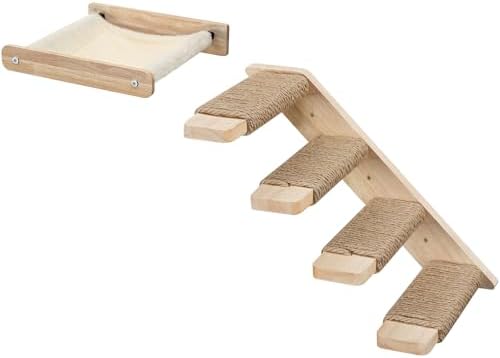
A multi-piece wall shelf set that covers steps, a hammock, and a scratching surface in one purchase. Sensible for a first route on a modest budget, provided you check the usable depth and swap the supplied hardware for longer screws into studs.
⭐ Upgrade Pick
A design-led wall perch with a furniture-grade finish and a broad, gently shaped surface, aimed at living rooms where the system has to look deliberate. Suits a large cat because the resting area is generous rather than token.

If the wall is not the right answer for your home, a heavy floor tower does the same job with no drilling; see our roundup of cat trees for large cats, which works through base weight and post thickness for heavier animals.
Landing Zones: Designing a Route a Heavy Cat Will Use
A big cat climbs differently. It is less inclined to make a long vertical jump, it needs more room to gather itself before pushing off, and it arrives with more force at the other end. Design the route with that in mind and the same shelves work far better.
Shorten the gaps. Watch how far your cat casually hops onto the sofa or a counter and treat that as the comfortable distance, then stay a little inside it. Heavy cats often manage a big jump once and then decline to repeat it, which is how a well-built route ends up unused.
Stagger, do not stack. Steps offset sideways as they rise let a cat approach at an angle with a short run-up. A vertical column of shelves demands a straight-up leap at every stage, which is exactly what a heavier animal avoids.
Make the landing zone wider than the step. The piece a cat aims at from a distance should be the most forgiving one on the wall: deep, grippy, and ideally with something to stop a slide. This is the single most useful adjustment for a large cat, and it is the one most layouts skip.
Plan the way down. A descending sequence beats a single drop, and it matters more with weight, since the landing impact goes up with it. Keep the floor beneath the route clear of glass tables, floor lamps, and anything else that turns a misjudged jump into an incident. Our overview of cat furniture safety goes further into tip-over and fall risks across the category.
Give the route a destination. Height alone does not hold a cat’s attention; a view does. Ending the run beside a window, or pairing it with a cat window perch, is what turns an installation into a daily habit.
Large Breeds, Multi-Cat Homes, and Older Cats
Three situations shift the priorities again, and each has a straightforward answer.
Large breeds are long as much as they are heavy, and length is what catches people out. A Maine Coon or a Norwegian Forest cat can be perfectly comfortable with a modest jump and still find every shelf in a standard set too short to stretch out on. Buy fewer, bigger pieces and accept a shorter route. Our guide to Maine Coon cat trees works through the same length problem on floor furniture.
Multi-cat homes with two large cats need passing places, not just perches. A narrow shelf forces one cat to squeeze past another or to back down, and that is where friction starts. Build in at least two comfortable resting spots at similar heights rather than one prized summit, and include a wide bridge or double-width platform somewhere in the middle of the run. The reasoning is the same as in our roundup of cat trees for multiple cats.
Heavier or older cats that jump less confidently benefit from a low entry step, close spacing, and a ramp or a piece of furniture acting as the first stage. If your cat has recently become reluctant to jump, or has gained weight quickly, that is a conversation for your veterinarian rather than a furniture problem to design around.
Wall Pieces for Landing Zones and Shared Routes
The picks above cover the backbone of a route. These three address the specific pieces that a heavier cat, or a second heavy cat, tends to need.
🐾 Best for Landing Zones
A large wall-mounted lounge or hammock with a wide, soft surface, meant as the destination at the top of a route. The forgiving surface is what makes it a good target for a heavy cat arriving with momentum.

🌉 Best for Multi-Cat Homes
A wide wall-mounted walkway with a guardrail, adding a shared horizontal run so a second cat has somewhere to be without displacing the first. Fix every mounting point into a stud rather than relying on anchors.

👍 Also Great
A heavy-duty wooden wall set that covers the whole route in one purchase, with an extra wide hammock as the destination. Check the usable depth on the resting platforms before committing.
Installing It and Living With It
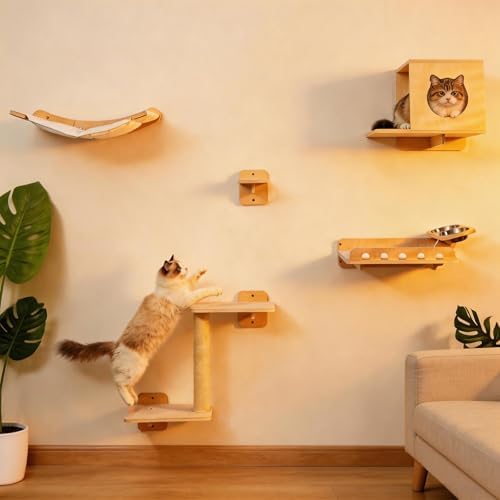
Dry-fit before you drill. Cut paper templates the size of each piece, tape them to the wall along your marked stud lines, and leave them up for a day. It costs nothing and it catches the gap that is too big or the platform that ends over a radiator. Then work bottom to top, checking each piece with a level, because a shelf that slopes slightly is unpleasant for a cat to settle on and worse for one that is heavy enough to slide.
Load-test by hand before your cat gets near it. Lean on each platform, push down and pull outward, and watch the bracket and the wall around the screws. Anything that moves comes off and gets remounted properly, ideally into a stud. With a big cat this step is not optional.
Introduce the route slowly. Treats placed on successive steps and a wand toy tracing the path usually do it within a week or two. If one step gets skipped repeatedly, the gap is almost certainly too large for your cat’s build. For upkeep, re-check every fixing a few weeks after installation and then two or three times a year, since impact loosens screws over time. Vacuum plush tops with an upholstery attachment, wipe wood surfaces, and trim frayed sisal flush rather than pulling at it.
Common Mistakes to Avoid
- Buying on weight rating alone. A shelf rated for plenty of weight can still be too shallow for a large cat to lie on. Capacity and comfort are different specifications, and you need both.
- Using the hardware in the box. Supplied screws and plastic plugs are sized for the average case. For a heavy cat, longer screws into a stud are the baseline, and rated anchors are the fallback.
- One fixing per platform. A single screw is a hinge waiting to happen. Two vertically spaced fixings into solid timber behave completely differently under an off-center landing.
- Designing for the wall, not the cat. Evenly spaced shelves photograph well and often climb badly. Stagger the route and match the gaps to how your cat actually jumps.
- Leaving hazards under the route. Glass, lamps, and hard furniture below a climbing wall turn a misjudged landing into a real problem, and the risk scales with the cat’s weight.
- Skipping the re-tighten. Fixings work loose faster under a heavy cat. Two minutes with a screwdriver a couple of times a year is the entire maintenance routine.
Where to Go From Here
If you are still deciding which components you need, start with our hub guide to cat wall shelves, which lays out the categories and how they fit together. For construction quality across brands, whatever your cat weighs, read sturdy cat wall shelves. If you want a full climbing route rather than a couple of perches, our guide to the wall-mounted cat tree approach covers designing an entire wall, and DIY cat wall shelves is the route to oversized platforms if you own a drill and a saw. Prefer to stay on the floor? Compare heavy-duty towers in our roundup of cat trees for large cats.
Frequently Asked Questions
How deep should a cat wall shelf be for a large cat? There is no official standard, but a useful rule of thumb is to measure your cat lying stretched out and aim for a resting platform that is at least as deep as the cat is wide when curled up, which for most large cats means going a size up from the category default. Check whether the listed depth includes the bracket.
Do cat wall shelves have to go into studs? For a heavy cat, effectively yes on any piece it lands on or rests on. Heavy-duty anchors such as toggle bolts are the alternative when a shelf must sit between studs, but the light plastic plugs supplied with many sets are not suitable for impact loads.
What weight can a cat wall shelf hold? It varies widely by bracket design, material, and the number of fixings, and every published figure assumes correct installation. Treat it as an upper bound rather than a target, and leave real margin on anything two cats might share. Our guide to sturdy cat wall shelves compares construction across brands.
Are wall shelves a good idea for a Maine Coon? They can be excellent, since vertical territory suits big climbers, but the pieces have to be sized for the body length. Fewer, larger platforms with short gaps between them work better than a long route of standard shelves.
My big cat uses the shelves as steps but never rests on them. That is usually a depth problem. If there is nowhere comfortable to commit to, a cat will pass through on the way to a windowsill or a bookcase. Replacing one shelf with a genuinely wide lounge at the top of the route often fixes it.
Is a wall system safer than a floor tree for a heavy cat? Neither is inherently safer. A wall system removes the tip-over risk entirely but depends completely on the mounting, while a heavy floor tower fails more gracefully but needs a wide, weighted base. Both are fine when installed properly.
The Bottom Line
For a large cat, wall shelves come down to two numbers and one habit: enough depth and length that your cat can genuinely lie down, and two fixings into a stud on everything it lands on. Design the route with short, staggered gaps and a wide, grippy landing zone at the top, then re-tighten the hardware a couple of times a year. Get those right and a heavy cat will use a wall setup as happily as any tower.