Last updated: August 8, 2026
Choosing the best cat wall shelves comes down to two questions that most product listings answer badly: what is the shelf made of, and what is it going to be screwed into. Everything else, the shape, the finish, the felt-lined hexagons that photograph so well, is secondary. A beautifully made shelf fixed to bare drywall with the plugs from the box is a worse purchase than a plain plank bolted into a stud, and cats have no interest in which one looked better on the product page.
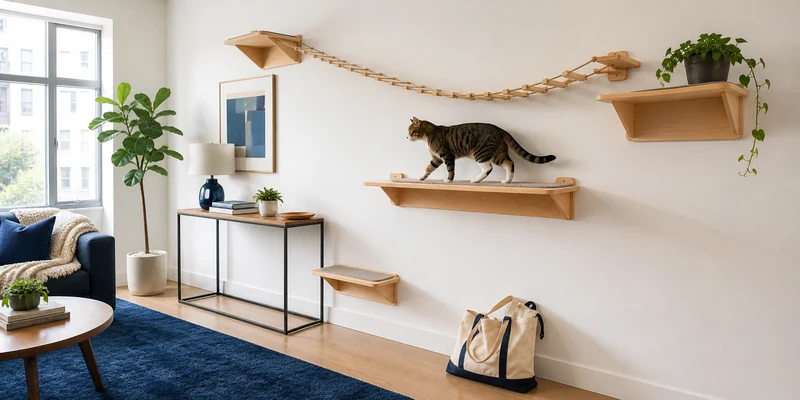
This guide is the starting point for the wall furniture category. It covers the component types you can actually buy, how mounting and weight capacity really work, how to size shelves to your cat, and picks for the common situations: a modular system to grow over time, an affordable multi-piece set, a design-led perch, something built for a big cat, and a scratching element that lives on the wall. It is about the pieces themselves. If you want to combine several of them into a full climbing route that replaces a tower, that is a different job, covered in our guide to the wall-mounted cat tree.
This article contains affiliate links. If you buy through them, we may earn a commission at no extra cost to you. Learn more.
Quick Answer
What separates a good cat wall shelf from a bad one?
- The bracket and the fixing. Look for steel brackets with two or more screw points that can reach a wall stud, not a single hidden keyhole slot.
- Solid wood or quality plywood over thin laminated particleboard, and a surface with grip: carpet, felt, or sisal rather than bare varnish.
- A platform deep and wide enough for your cat to turn around and lie down on, not just stand on.
Cat Wall Shelf Types at a Glance
Wall furniture is sold as one category, but the pieces do different jobs and only some of them are load-bearing in the serious sense. This overview covers what you will find on the shelf listings and what each format is realistically good for.
| Type | Form and surface | Good at | Keep in mind |
|---|---|---|---|
| Floating plank shelf | A straight board on concealed or L brackets, often carpet or sisal topped | Steps and climbing stages; the cheapest way to add height | Concealed brackets look tidy but concentrate the load on few fixings |
| Hexagon shelf set | Geometric boxes, usually felt lined, sold in multiples | Filling a bare wall attractively while giving a cat several landings | Interior width is smaller than the outer shape suggests; check it against your cat |
| Wide perch or platform | A deep shelf with a padded, plush, or carpeted top | The spot a cat settles on for hours rather than passing through | Carries the most weight of anything on the wall; the fixing matters most here |
| Bridge or walkway | Wood slats, rope, or a solid span between two mounted ends | Crossing a gap, linking a wall run to a bookcase or window | Both ends need solid anchoring; flexible spans unsettle some cats |
| Hideout, cubby, or hammock | An enclosed box or a fabric sling in a frame | Nervous cats and multi-cat homes that need separation and cover | Adds its own weight before the cat gets in; harder to clean up high |
| Sisal step or scratching panel | A small shelf or vertical plate wrapped in sisal | Building scratching into the route so no floor post is needed | Scratching pulls sideways, which loosens weak fixings faster |
| Corner shelf | Triangular platform that spans an internal corner | Turning a route around a wall, and using dead space | Corner framing is not always where you expect; check for studs first |
Most homes need fewer pieces than the inspiration photos suggest. Two or three steps, one wide perch worth lying on, and a scratching element cover the majority of cases. Everything after that is decoration.
Mounting: The Part That Decides Whether Any of This Works
Cat wall shelves are one of the few pet products where installation matters more than the product. Drywall is a panel, not a structural surface, and it copes poorly with the shock of a cat landing from a jump. Almost every story about a shelf coming off a wall traces back to the same cause: the small plastic anchors supplied in the box, used as though they were a real fixing.
In typical US framing, studs sit behind the drywall at regular intervals, most commonly sixteen inches on center and sometimes twenty-four. That spacing, not your design sketch, is what determines where a shelf can go. Find the studs with a stud finder, mark them floor to ceiling with painter’s tape, and lay out the shelves against those lines before you commit to anything.
- Anything a cat lands on should reach a stud. Steps and perches take impact loads, not just static weight, and the better manufacturers say so plainly in their instructions.
- Check the bracket before the finish. Two or more screw points spread across a steel plate behave very differently from a single hidden slot. Bracket design is the clearest quality signal in this category.
- Screw length is a real variable. The screw has to pass through the bracket and the drywall and still bite properly into timber, and hardware bundled with budget sets is sometimes too short to do that.
- Heavy-duty anchors are a deliberate choice, not a default. Toggle bolts and similar hardware are rated far above plastic plugs and are the right answer when a piece has to land between studs. They are not a reason to skip the stud on your main perch.
- Old walls change everything. Plaster and lath, masonry, and concrete all need their own bits and fixings, and none of them behave like drywall.
If you have never done this kind of installation, read our step-by-step guide to installing cat wall shelves before you open a box. It covers stud finding, wall types, spacing, and the order of operations in more detail than any product manual.
Weight Capacity: Read the Number, Then Read the Conditions
Serious brands publish a weight capacity per component. That figure is useful, and it is also routinely misread, because it assumes conditions that many installations do not meet: correct mounting into solid timber, screws fully seated, and a static load. A cat springing up from the floor delivers considerably more force than a cat sitting still, and a shelf held by drywall alone is not operating anywhere near its rated figure regardless of what the listing says.
Marketplace listings make this worse by copying capacity claims with no context at all, and by quoting numbers no one can verify. Rather than shopping for the highest figure, judge a shelf on the things that produce it. Bracket design and the number of fixings come first. Material comes second, since solid wood and good plywood absorb repeated impact better than thin particleboard with a laminate skin, which crumbles around the screw holes over time. Shelf thickness and how the bracket attaches to the board matter more than the species of wood.
Treat the published capacity as an upper bound rather than a target, and leave genuine margin on anything two cats might share or that a heavy cat will land on hard. Our roundup of sturdy cat wall shelves looks at construction across the category, and cat furniture safety covers the wider question of what fails and why.
Our Top Picks at a Glance
How we chose: we compared widely available cat wall shelves on bracket and mounting design, materials and build, usable platform size, surface grip, and whether a range offers enough component types to extend later. Selections are based on manufacturer specifications and patterns that come up repeatedly in owner reviews. Availability, finishes, and set contents change often, so check the current listing before ordering.
Two things worth saying up front. A more expensive shelf is not automatically a stronger one, and the hardware in the box is frequently the weakest part of an otherwise good product, which is a cheap thing to upgrade at the hardware store.
🏆 Best Overall
A solid wooden wall perch from a modular range sold as individual shelves, hammocks, and planters you can combine into a full route, designed around stud mounting. The sensible default if you want one system you can add to over the years.

💛 Best Value
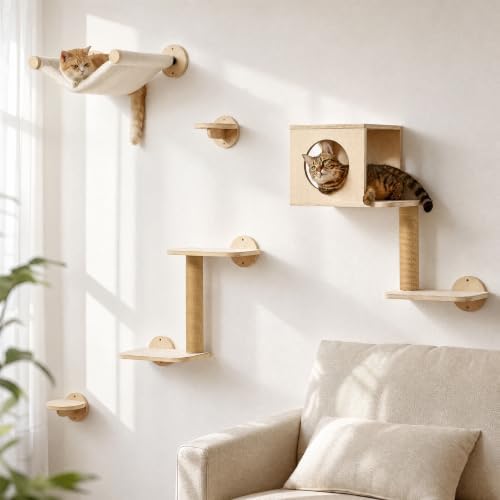
A multi-piece wall shelf set that arrives with steps, a hammock, a house, and a scratching post in one purchase. A reasonable first buy, provided you upgrade the supplied screws where a piece needs to reach a stud.
⭐ Upgrade Pick
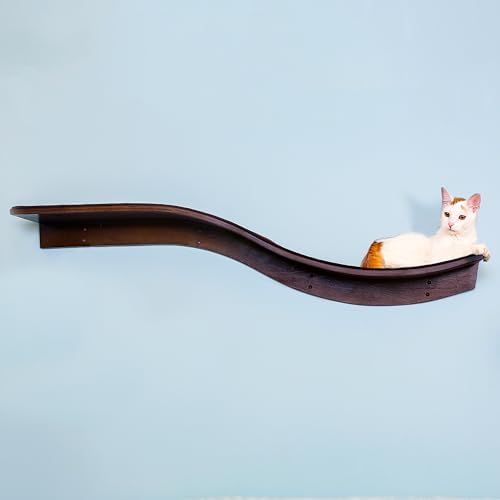
A design-led wall perch with a furniture-grade finish and a curved, generously sized platform. Worth the money when the shelf sits in a room where it has to look like something you chose rather than pet equipment.
Want a closer look at the most searched set in the category before deciding? Our Fukumaru cat shelves review goes through what the range includes and where owners run into limits.
Sizing and Placement: How Many Shelves, and How Big
Platform size. A shelf your cat can only stand on will be used as a step and nothing more. For a resting spot, you want enough depth for the cat to turn around and settle without hanging over an edge, which for most adult cats means a genuinely wide platform rather than a narrow plank. Measure your cat curled up on a windowsill or a folded blanket and use that as your reference, since published dimensions are the one specification you can check reliably.
Surface. Bare varnished wood is slick, and a cat landing on it from a jump will scrabble. Carpet, felt, plush, or sisal all give grip. Removable or wipeable tops are worth looking for on the perch a cat actually sleeps on, because that is the piece that collects hair.
Spacing. Watch how far your cat casually hops onto furniture and keep the gaps near that distance rather than at the limit of what it can manage. Staggering the shelves sideways as they rise works better than stacking them in a straight vertical column, since a cat gets a small run-up on each landing.
Where on the wall. A wall the household walks past gets used far more than a tidier arrangement in a spare room, and a run that ends near a window gets used most of all. Many owners finish a wall route at a cat window perch for exactly that reason. For how to connect several pieces into a full climbing route with an entry point and a way back down, our guide to the wall-mounted cat tree covers the layout side properly.
Picks for Big Cats, Scratchers, and Bare Walls
These cover the cases where a standard shelf set is the wrong starting point. Each solves one specific problem.
📐 Best for Large Cats
An extra deep, extra wide wall platform pair with a published weight rating, sized so a long-bodied cat can lie down rather than perch. The depth of the board is what matters here, more than the length of the run.

🧶 Best for Scratchers
A sisal-wrapped wall step or vertical scratching panel that builds claw maintenance into the climb, so you are not also fitting a floor post underneath. Fix this one carefully, since scratching pulls sideways rather than down.

👍 Also Great
A hexagon shelf set with climbing steps for filling a bare wall with several landings in one purchase. Check the usable interior width against your cat, since the outer shape flatters the actual space inside.

If your cat is on the larger side, our roundup of cat wall shelves for large cats goes further into platform depth and bracket strength. And if a wall build is more project than you want, a slim floor tower from the cat tree buying guide covers similar ground with no drilling.
Installation, Living With It, and Upkeep
Dry-fit first. Cut paper templates the size of each shelf, tape them to the wall, and leave them for a day. It costs nothing and it catches the step that is too high or the perch that ends up over a radiator. Mark your stud lines before you place the templates, then adjust the design to the studs rather than the reverse.
Work bottom to top, and check with a level. A shelf that slopes even slightly is unpleasant for a cat to settle on and puts uneven load on the fixings. Tighten everything fully, then load each piece by hand before your cat goes anywhere near it: lean on it, push down and outward, and watch the bracket. Anything that shifts comes off the wall and gets remounted.
Introducing it. Cats rarely take to new shelves on day one. Treats placed on successive steps and a wand toy tracing the path usually do it within a week. If one step is skipped repeatedly, the gap is probably too big or the surface too slick.
Upkeep. Re-check every fixing a few weeks after installation and then a couple of times a year, because repeated impact loosens screws. Vacuum plush and carpeted tops with an upholstery attachment, wipe wood surfaces, and trim frayed sisal flush rather than pulling at it. Keep the floor under the route clear of glass, lamps, and anything else you would rather not have a cat land on.
Common Mistakes When Buying Cat Wall Shelves
- Mounting into drywall alone. The single most consequential error in this category. Hit a stud, or choose heavy-duty anchors deliberately, and never rely on the plugs that came in the box.
- Buying for the photo. Evenly spaced shelves in a neat grid look good and often climb badly. Stagger them and match the gaps to how your cat actually jumps.
- Shelves too small to rest on. A route of narrow steps with no wide destination gets used as a shortcut and then abandoned. At least one piece should be comfortable enough to sleep on.
- Trusting the capacity number. The published figure assumes a correct installation into timber. Treat it as an upper bound, not a goal, and add margin for landing impact.
- Slick surfaces. Bare varnished wood offers no grip. If you love a piece that has it, add a carpet tile or a non-slip mat cut to size.
- Skipping the re-tighten. Fixings work loose over time. Two minutes twice a year is the entire maintenance routine.
Where to Go From Here
If build quality is your sticking point, sturdy cat wall shelves compares construction across the category, and cat wall shelves for large cats narrows it to heavier cats. When you are ready to fit them, work through how to install cat wall shelves first. If you own a drill and would rather build than buy, DIY cat wall shelves covers materials and brackets. Renting, and unsure how much drilling you can get away with? Cat furniture for renters works through the alternatives, and modern cat furniture is the place to start if the whole room has to look considered.
Frequently Asked Questions
Do cat wall shelves need to be mounted into studs? Any shelf a cat lands on or rests on should reach a stud wherever possible. Heavy-duty anchors such as toggle bolts are the alternative when a piece has to sit between studs, but the light plastic plugs supplied with many sets are not designed for a cat’s impact loads.
How much weight can a cat wall shelf hold? It varies widely by bracket design, material, and the number of fixings, and every published figure assumes a correct installation. Treat the manufacturer’s number as an upper bound rather than a target, and leave margin on anything two cats might use at once.
How many shelves do I need? Fewer than most inspiration photos suggest. Two or three climbing steps plus one wide perch worth lying on covers most homes, and you can extend later if your cat uses what is there.
Can cat wall shelves replace a cat tree? Together they can, if you build a proper route with an entry point and a way back down rather than hanging one shelf. Our guide to the wall-mounted cat tree covers how to lay that out.
Are wall shelves a good idea in a rental? Often yes, since small screw holes in drywall patch easily at move-out, but check your lease before you drill. If permanent fixings are off the table, a floor-to-ceiling tension system or a floor tower is the practical alternative.
My cat ignores the shelves. What should I change? Look at the lowest step and the gaps first, because a route that starts too high or asks for a long jump gets skipped. Grip on the surface is the next thing to check, then patience: a week or two with treats and a wand toy usually settles it.
The Bottom Line
Good cat wall shelves are a hardware decision as much as a furniture one: solid wood or quality plywood, a steel bracket with several fixing points, a grippy surface, and platforms wide enough to lie on. Mount the load-bearing pieces into studs, read published weight capacities as an upper bound rather than a goal, and re-tighten twice a year. Start with a few well-placed pieces and extend once you see which ones your cat uses.