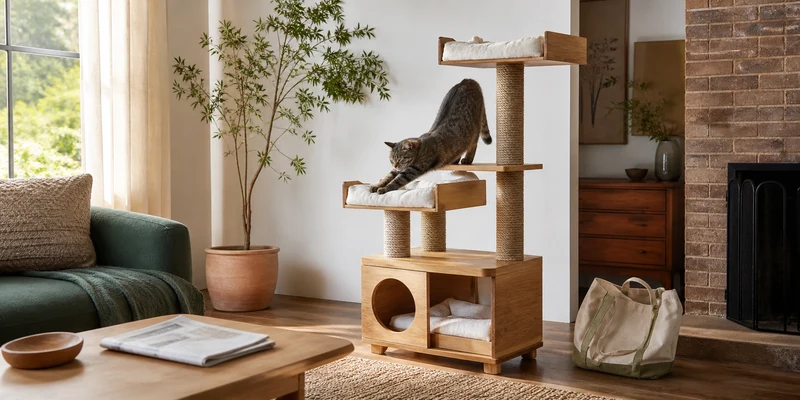
Last updated: August 8, 2026
A solid wood cat tree is not the same thing as a cat tree that looks like wood, and the gap between those two categories is where most disappointment in this market comes from. Listings use the words natural wood, real wood, and wooden frame fairly loosely, and a tower photographed in warm oak tones can turn out to be laminate paper over particleboard, with hollow cardboard tubes doing the structural work inside the posts. It holds up fine for a while. Then a cat lands hard on a corner, a screw strips out of a crumbling panel, and the whole thing develops a lean that never goes away.
Real wood changes the failure mode. It is heavier, it holds a fastener, it can be tightened again after a year of use, and its weight is the reason the tower stays put when a cat launches off the top platform. This guide explains what the different core materials actually are, how to spot the real thing from a product page, and which builds are worth the extra bulk and cost. If you are still deciding what format you need at all, start with our hub guide to cat trees, which compares towers, condos, and wall systems side by side.
This article contains affiliate links. If you buy through them, we may earn a commission at no extra cost to you. Learn more.
Quick Answer
Is a solid wood cat tree worth paying more for?
- For a heavy cat, a multi-cat home, or a tower you want to keep for years, yes. Real wood holds screws, survives repeated impact, and can be retightened instead of replaced.
- The weight is the point. A heavier base resists tipping when a cat jumps on and off, which is the main safety issue with tall towers.
- Read the shipping weight and the hardware, not the color. Wood-look laminate over particleboard is common at every price level.
What “Wood” Actually Means on a Cat Tree Spec Sheet
Almost every cat tree contains something in the wood family. The question is which form, and where in the structure it sits. A tower can have a solid hardwood frame and a particleboard shelf, or plywood platforms on cardboard posts. Here is what each material really is and how it behaves once a cat is using it daily.
| Material | What it actually is | How it holds up | What to expect |
|---|---|---|---|
| Solid hardwood | Milled boards of oak, acacia, rubberwood, or similar, sometimes finger jointed | Strongest option; holds screws well and takes repeated landing impact | Heavy, premium pricing, often visible grain and beveled edges |
| Solid softwood (pine, fir) | Milled boards from faster growing species | Strong enough for frames and posts, dents more easily than hardwood | A common middle ground; look for thick sections rather than thin slats |
| Plywood | Thin wood layers cross laminated into panels | Excellent for platforms; resists warping and holds fasteners | Often the right answer for shelves even on premium towers |
| MDF or fiberboard | Wood fibers pressed with resin into a dense panel | Stiff and flat, but swells if it gets wet and strips at screw points | Common in litter box cabinets and design pieces with painted finishes |
| Particleboard or chipboard | Wood chips bonded with adhesive, usually with a laminate skin | Weakest common panel; edges crumble and fasteners loosen over time | The default in budget towers, frequently sold as wooden or natural wood |
| Cardboard tube core | A spiral wound paper tube wrapped in carpet or sisal | Fine for a scratching surface, poor for a load bearing post | Very light; a post you can crush slightly by hand is a tube |
| Natural branch or trunk | Dried, bark on or debarked limbs used as posts and climbs | Structurally strong and irregular, so quality depends on the joinery | Handmade or small batch, striking to look at, usually heavy |
None of these is automatically wrong. Plywood platforms on a hardwood frame are a genuinely good build, and a particleboard base is acceptable on a short tower for a small cat. The problem is buying one and receiving another. Style focused towers vary just as much on this point, which is why our roundup of modern cat trees treats construction as part of the design conversation rather than a separate spec sheet.
How to Tell Real Wood From a Wood-Look Panel Before You Buy
You cannot see a core in a product photo, so you read around it. Five signals do most of the work.
- Shipping weight relative to size. This is the single most useful number on the page. Two towers of similar height and platform count can differ enough in weight that the lighter one has to be hollow somewhere. Heavier almost always means more real material.
- Edges and corners. Solid wood and plywood show grain running through the edge, and plywood shows its layers. Particleboard is finished with a wrapped or banded edge that hides a speckled core, and marketplace photos tend to shoot those pieces straight on.
- Hardware and joinery. Real wood construction usually means machine screws into threaded inserts, barrel nuts, or dowels and cam locks that grip properly. A kit of short wood screws and plastic washers points at panel board.
- Post construction. Ask what is under the sisal. Brands that use a wooden core generally say so, because it costs more. Silence usually means a tube.
- The language itself. Real wood and solid wood are meaningful claims. Wood look, wood grain, wood effect, and natural finish are not. Engineered wood is an accurate but broad phrase that covers plywood and particleboard alike, so it needs a follow up question.
Owner reviews are the other place to check. Complaints about a wobble that returns after tightening, screws spinning in their holes, or a chipped edge revealing a pale speckled core all describe the same underlying material, whatever the listing says.
Why Weight Is a Feature, Not a Drawback
Heavy is usually listed as a downside, and for shipping and rearranging your living room it is. For everything the tower has to do afterward, it is an advantage.
Cats do not step onto a platform, they arrive on it. A jump up delivers a sharp sideways and downward load, and pushing off to leave delivers the reverse. A light tower answers that by rocking, and rocking is what teaches a cat to stop using the top perch. Mass resists it. A solid wood tower with a wide base and a low center of gravity absorbs the same landing without moving, which is why real wood models tend to feel planted in a way that a comparable laminate tower does not, even before you anchor anything.
That said, weight is not a substitute for a sensible footprint. A narrow base is unstable at any material weight, and anything tall enough to reach a countertop deserves a wall anchor regardless of what it is made of. Our guide to cat furniture safety covers anchoring, tip-over risk, and the checks worth running after assembly. The practical downside is real too: a heavy tower is a two person lift, it can mark a soft floor, and you will not be nudging it across the room on a whim. Decide where it goes before it arrives.
Our Top Picks at a Glance
How we chose: we compared widely available towers on how much genuine wood is in the load bearing structure, base footprint relative to height, fastener quality, post construction under the sisal, and how consistently owner reviews describe long term stability. Selections are based on manufacturer specifications and recurring patterns in published reviews rather than any hands-on comparison of our own.
Two expectations to set. Real wood towers arrive heavy and in fewer, larger pieces, so clear an assembly space and allow an hour with a hex key. And they are not silent bargains: you are paying for material and for a build that can be tightened back to square in year three instead of replaced.
🏆 Best Overall
A multi-level tower from the real wood line, with milled wooden posts under the sisal, a broad base, and platforms sized for an adult cat to lie down rather than perch. The straightforward choice when you want genuine wood construction without moving into furniture pricing.

💛 Best Value
A smaller real wood tower with fewer levels, aimed at people who want honest construction more than height. Less tower for the money than a laminate model of the same size, and considerably more likely to still be steady after a couple of moves.
⭐ Upgrade Pick
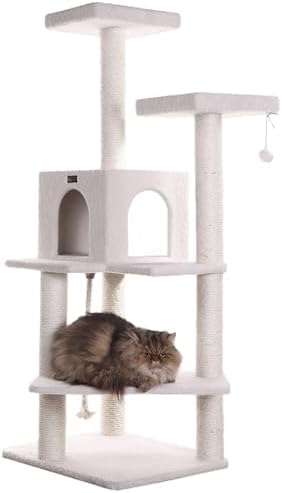
A furniture-grade wooden tower built to sit in a living room rather than a corner, with a sculptural profile, generous platforms, and a finish that suits open-plan spaces. Worth considering if the tower has to look like an object you chose rather than pet equipment.

Whatever the frame is made of, the scratching surface wears out first. Posts wrapped in dense natural fiber last far longer than carpet and are the part worth being fussy about, as our roundup of sisal cat trees explains in detail.
Which Build Suits Your Cat and Your Room
The case for real wood gets stronger as weight, activity, and household size go up.
Large and heavy cats are the clearest argument for it. A cat in the double-digit pound range loads a platform in a way that finds every weak fastener, and a laminate shelf that flexes underfoot discourages use long before it fails outright. Look for thick platforms, wide supports underneath, and a base broader than you think is necessary. Our roundup of cat trees for large cats works through platform sizing, and Maine Coon cat trees covers the long-bodied breeds specifically.
Multi-cat homes add a second problem: two cats moving at once, sometimes at speed and not always politely. Real wood handles the shared load and the chase, and it tolerates being climbed by a cat who is not being careful. Prioritize resting spots at more than one height over a single prized summit.
Small apartments and renters face the trade-off in reverse. Weight is harder to justify when you move often and carry furniture up stairs, and a compact laminate tower may genuinely be the better call for a single small cat. If footprint is your binding constraint, our guide to small cat trees covers the compact end of the market.
Design-led rooms are where wood tends to win on looks as well as build, because a visible grain and a simple silhouette read as furniture rather than as a carpeted tower. If that is your priority, aesthetic cat trees approaches the same category from the styling side.
Natural Branch Towers and Heavier Real Wood Builds
Two options sit outside the mainstream tower shape and are worth knowing about. Natural branch designs use dried limbs as posts and climbs, which gives cats varied gripping angles and gives the room something closer to a sculpture. They are usually small batch, often heavy, and quality lives entirely in the joinery, so check how the branches meet the platforms. At the other end, some carpeted towers use a real wood frame under a traditional finish, which suits households that want the durability without the design statement.
🌿 Best for a Natural Look
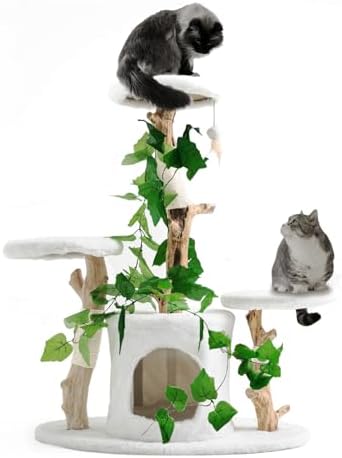
A cat tree built around real branches or trunk sections rather than uniform posts, with platforms fixed to the wood itself. Suits open rooms where the tower is going to be visible from everywhere, and gives cats a more varied climbing surface than a straight post.
👍 Also Great
A large wood-framed tower finished in real carpet rather than plush, combining a substantial structure with surfaces that stand up to claws. A sensible middle path when durability matters more than how the piece photographs.

Assembly, Placement, and Long-Term Care
Lay out every part before you start, since real wood kits tend to have similar looking pieces in different lengths. Thread all fasteners loosely first, square the frame, then tighten in sequence, because fully tightening one joint at a time is the usual reason a tower ends up slightly racked and rocking on one leg. Check level once it is standing, shim a leg rather than accepting a wobble, and push firmly on the top platform from a few directions before your cat is anywhere near it. If it is tall, anchor it, and put it where the cat wants to be rather than where it fits best, which our guide to where to place a cat tree works through in more detail.
Maintenance on wood is refreshingly dull. Retighten the hardware a few weeks after assembly and once or twice a year afterward, since seasonal movement and daily impact both loosen fasteners. Wipe the wood with a barely damp cloth and dry it, avoid soaking anything, and keep the tower out of a spot where a sunny window will bleach one side over years. Sisal is the consumable: trim frayed strands flush instead of pulling them, and rewrap or replace a post when it is worn through rather than retiring the whole tower. That repairability is most of the long-term case for buying real wood in the first place.
Common Mistakes to Avoid
- Trusting the word wooden. Wood look, wood grain, and natural finish describe a surface. Only real wood and solid wood describe the structure, and even then it is worth checking which parts they apply to.
- Ignoring the shipping weight. It is the cheapest lie detector on the page. A tall tower that weighs very little is hollow somewhere that matters.
- Assuming heavy means stable. Mass helps, but a narrow base under a tall tower is still a tipping risk, and tall towers deserve a wall anchor regardless of material.
- Buying wood and settling for carpet posts. The frame may last a decade while carpeted posts shed and matt within a year. Match the scratching surface to the build quality you paid for.
- Skipping the retighten. Two minutes with a hex key once or twice a year is the entire maintenance routine, and it is what keeps a real wood tower feeling solid years in.
Where to Go From Here
If you are weighing formats rather than materials, the hub guide to cat trees compares towers, condos, and wall systems and points you at the right subcategory. For the scratching surface that sits on top of whatever frame you choose, read our roundup of sisal cat trees. If looks are driving the decision, modern cat trees covers design-led builds, and our Refined Feline review takes a closer look at one of the better known wooden furniture brands. Handy with tools and set on real timber? Building a cat tree yourself is the one route where you control every material in it.
Frequently Asked Questions
Are solid wood cat trees actually more stable? Generally yes, because the extra mass and a lower center of gravity resist the sideways force of a cat jumping on and off. Base width still matters more than material on very tall towers, and anything above waist height is worth anchoring to the wall.
How can I tell if a cat tree is real wood before ordering? Compare the shipping weight against similarly sized models, look for visible grain on edges and plywood layers in close-up photos, check whether the hardware is machine screws into inserts rather than short wood screws, and see whether the brand states what is under the sisal on the posts.
Is plywood as good as solid wood for a cat tree? For platforms it is often better, since cross-laminated layers resist warping and hold fasteners well. Solid wood tends to have the edge on posts, frames, and anywhere a screw takes repeated load. Plywood is a genuine upgrade over particleboard either way.
Do solid wood cat trees still need sisal posts? Yes. Bare finished wood is not a satisfying scratching surface for most cats, and a tower without a good scratching option tends to get used as a bed while the sofa keeps taking the damage. See our guide to sisal cat trees for what to look for.
Is a solid wood cat tree worth it for one small cat? Not necessarily. A single lightweight cat in a small apartment is well served by a compact tower, and the weight becomes a nuisance if you move often. The case for real wood grows with the size of the cat, the number of cats, and how long you plan to keep it.
The Bottom Line
A solid wood cat tree earns its price through the things you notice in year three: joints that can be tightened, platforms that do not flex, and a base heavy enough that a hard landing does not move it. Read the shipping weight and the hardware rather than the finish, since wood-look laminate over particleboard is sold as wooden at every price level. For a big cat, a busy multi-cat home, or a tower you want to keep, real wood is the sensible buy; for one small cat in a rental you move out of often, it may be more tower than you need.