Last updated: August 8, 2026
Shopping for the best small cat tree is usually a floor space problem, not a cat problem. You have a studio, a one-bedroom apartment, or a living room where the only free spot is a two-foot gap beside the couch, and every tower that looks good online turns out to need a corner you do not have. Meanwhile your cat still wants somewhere high to sit and something tall enough to sink her claws into on a full stretch.
The good news is that those two needs do not require a six-foot tower. A well designed compact tree can hold a real perch, a genuine full-height scratching post, and a hiding spot inside a footprint smaller than an end table. The trap is the other kind of small tree: the shrunken one, where the post is too short to stretch on and the top perch sits below the windowsill, so nobody uses it. This guide covers how to tell those apart, how much floor space each compact format actually needs, and which layouts work in tight rooms.
This article contains affiliate links. If you buy through them, we may earn a commission at no extra cost to you. Learn more.
Quick Answer
What makes a small cat tree worth buying instead of just short?
- Buy on footprint, not on height. Most compact towers occupy somewhere between 16 and 24 inches square, which is the number that decides whether it fits your room.
- Keep one uninterrupted sisal post of roughly two feet or more. An adult cat scratches at full stretch, and a post broken up by platforms every ten inches does not allow that.
- Aim the top perch at windowsill height or just above. A compact tree that reaches the view gets used; one that stops below it usually does not.
Compact Cat Tree Formats at a Glance
Small covers several very different shapes, and they solve different room problems. Work out which format your space calls for before you start comparing individual models.
| Format | Typical height | Floor space to plan for | Works best for |
|---|---|---|---|
| Cube or condo box | Under 24 in | About 16 in square | Kittens, seniors, a second hideaway in a bedroom |
| Compact tower | 28 to 40 in | 16 to 20 in square | Studios, one cat, spots beside a sofa or bed |
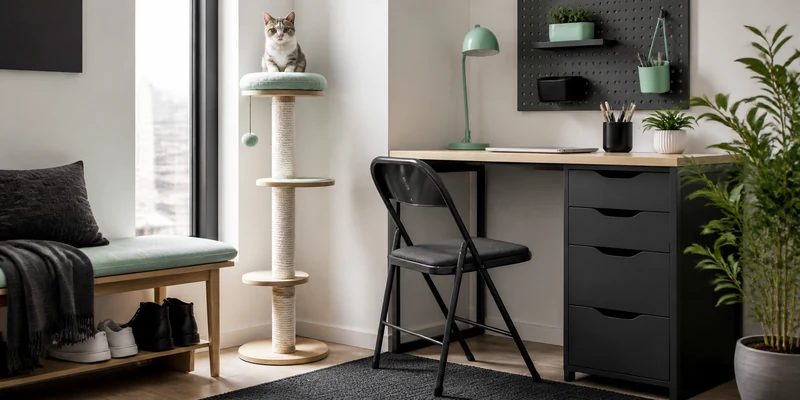
| Slim tall tower | 40 to 55 in | 18 to 22 in square | Reaching a standard windowsill without a wide base |
| Corner or wedge design | 30 to 50 in | Two walls plus a triangle of floor | Rooms where only the corners are free |
| Wall mounted set | Wall height | None at floor level | Renters with permission to drill, very tight rooms |
Two of these are worth flagging. If your ceiling is available but your floor is not, a narrow tall cat tree buys height on a base barely wider than a compact model. And if there is genuinely no floor to give, the shelf route is the honest answer: our wall mounted cat tree guide covers the mounted systems that free the floor entirely. For the whole category side by side, start at the cat tree buying guide.
Footprint Math: The Number Nobody Checks
Product listings lead with height because height sells. In a small room, the number that matters is the base, and the base is not the whole story either. Three measurements decide whether a tree fits:
- Base dimensions. The plate on the floor, usually given in inches square. Under about 16 inches you are into cube territory; 24 inches square already reads as furniture in a studio.
- Maximum overhang. Top perches, hammocks, and side platforms often extend past the base. Measure the widest point, not the base, when planning a gap between other furniture.
- Landing room. Cats jump down as well as climb down. A couple of feet of clear floor on the approach side keeps the tree usable and stops it becoming an obstacle in a walkway.
There is a real tradeoff hiding here. A narrow base under a tall tower means a longer lever and more sway, so compact trees that reach 50 inches need either a heavier base or a wall strap to stay steady. Owners report the same pattern with slim towers: solid on assembly day, then noticeably wobbly once a cat starts launching off the top instead of stepping down. Our overview of cat furniture safety goes into anchoring hardware and tip-over risk in more detail.
Keeping the Scratching Post Full Height
This is where cheap small trees fall down, and it is the one specification worth being stubborn about. An adult cat scratching properly reaches up and pulls down through a long stroke, which needs roughly two feet of uninterrupted post, more for a big or long-bodied cat. Plenty of compact towers stack a platform every eight or ten inches, which leaves four short stubs of sisal instead of one usable post.
What to look for instead: at least one main post running unbroken from the base to the second level or higher, sisal rope rather than a printed or carpet-wrapped finish on that post, and rope wound tightly enough that it does not slide when you push it sideways. A vertical post also matters more than an angled one for cats who currently scratch the arm of your sofa, since the motion is closer to what they are already doing. If scratching is the main reason you are buying, a standalone post next to a shorter tree is often the better split; the cat scratching post guide covers that option, and sisal cat trees explains rope type and thickness.
Our Top Picks for Small Spaces
How we chose: we compared widely available compact towers on base footprint relative to height, whether the main sisal post runs unbroken for a full stretch, perch size, and whether the layout reaches typical windowsill height. Selections are based on manufacturer specifications and themes that come up repeatedly in owner reviews, not on hands-on assessment.
Two things worth knowing before you click. Compact trees ship in one manageable box and usually assemble in under half an hour, which makes them far easier to move between apartments than a large tower. And a smaller tree is more likely to be pushed around on hard floors, so a thin rubber mat underneath is a cheap fix.
🏆 Best Overall
A multi-level compact tower in the high-30-inch range with a roomy condo, a large top perch, and a sisal scratching post on a compact base. A sensible default when you want climbing, hiding, and scratching in one small piece.

💛 Best Value
A basic compact tower around three feet tall with a cubby, a padded top perch, and a hanging toy. Good value when the tree is a starter piece or a second spot in another room.

⭐ Upgrade Pick
A compact modern design in a wood-look finish with a small footprint and replaceable sisal elements. Suits a living room where the tree has to sit in plain sight rather than hide in a corner.

Studios, Apartments, and Rentals
In a studio the tree is not a cat accessory, it is furniture, and it lives in your line of sight all day. That changes what to look for. Neutral fabric ages better than bright plush in a room you cannot escape from, and a design with an enclosed cubby gives your cat somewhere to withdraw when you have guests in a space with no spare room to retreat to.
Placement in a small apartment usually comes down to one of three spots: beside a window, in a corner of the main room, or at the end of a bed. The window is almost always the winner, because a compact tree that reaches the sill turns into a viewing platform and earns its footprint twice over. Measure sill height first; that number, not the marketing label, decides which model to buy. Our guide to where to place a cat tree works through sightlines and traffic routes.
Renters have an extra constraint, since anchoring straps and wall shelves both involve fixings. A wide-based compact tree that needs no wall contact avoids the conversation entirely, and there are other damage-free ways to give a cat vertical territory in a rental: see cat furniture for renters for the full set of options, including free-standing and tension-mounted alternatives.
Two More Small Trees Worth a Look
If the picks above do not fit the gap you are working with, these two cover the awkward cases: a corner that is the only free floor, and a plain neutral tower for a room where the tree needs to disappear.
🐾 Best for Tight Corners
A compact tower with a square base designed to tuck against two walls, with the perch and cubby stacked vertically rather than spread sideways. Useful when the only free floor in the room is a corner.

👍 Also Great
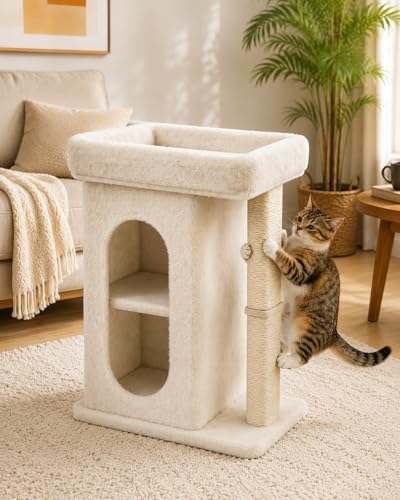
A plain compact tower with neutral beige fabric, two cubbies, and a large top perch. A solid alternative if the picks above are out of stock or you want something that blends into the room.
If your cat is a heavy jumper or a big breed, size the perches to the cat before worrying about the footprint, since compact platforms and thick cats are a poor match. Once you have the space for it, the step up in scale is covered in the large cat tree roundup. And if looks are driving the decision as much as the measurements, modern cat trees covers the design-led end of the category.
Setting It Up in a Small Room
Assembly on a compact tree is genuinely quick, but a few habits make the difference between a tower that stays solid and one that starts rocking within a month. Build it in the room where it will live, tighten the bolts in stages rather than fully seating each one in turn, and check the base sits flat before you load the upper levels. On hard floors, add a thin rubber mat; on thick carpet, expect a little rock and consider a wall strap if the tree is over about 40 inches.
Give it two weeks of use, then go back around every fastener. Fabric compresses under the bolt heads in the first weeks and things loosen as a result, which is the usual cause of the wobble people blame on build quality. After that, re-tighten every few months.
Maintenance in a small space is mostly about the tree not becoming an eyesore. Vacuum plush surfaces with an upholstery attachment, trim frayed sisal strands flush rather than unwinding them, and rewrap the main post with sisal rope when it wears through instead of replacing the whole tower. Compact trees are light enough to carry outside for a proper clean, which is one small advantage over the big ones.
Common Mistakes to Avoid
- Buying by label instead of by tape measure. Small, compact, and medium mean nothing consistent across brands. Get the base dimensions and the widest overhang, and mark them out on your floor with tape.
- Accepting a chopped-up scratching post. Four short sisal stubs do not add up to one full-height post, and a cat who cannot stretch on the tree will go back to the sofa.
- Stopping below the windowsill. An extra few inches of height often decides whether the tree becomes a favorite spot or an ignored one.
- Ignoring stability on the slim tall models. A narrow base under a 50-inch tower needs weight, a wall strap, or both.
- Putting it in the quiet room. Cats want to watch the household. In a studio that is rarely a problem, but in a one-bedroom the spare corner of the bedroom is usually the wrong choice.
Where to Go From Here
If the floor space simply is not there, skip the tree and go up the wall: wall mounted cat trees free the floor completely, and cat furniture for renters covers the versions that survive a lease and a move. If you have a little more room than you thought, a slim tall cat tree gets you windowsill height and beyond on a similar footprint. Still deciding whether a tree is the right piece at all? Start with do cats need a cat tree, then the hub guide to cat trees.
Frequently Asked Questions
How small is a small cat tree? Most towers sold as small sit between about 28 and 40 inches tall on a base of 16 to 20 inches square. Below roughly 24 inches you are looking at a condo cube rather than a tree.
Is a small cat tree enough for one cat? For many single-cat apartments, yes, provided the perch is big enough to lie on and the main post allows a full stretch. Cats care more about the quality of one or two good spots than about the number of levels.
Will a small tree work for a large breed? Often not well, since compact perches and small cubbies are sized for average adults. Check platform dimensions and stated weight limits against your cat first, and consider the large cat tree options if the numbers are tight.
Do small cat trees tip over? The short ones rarely do. Slim towers pushing 50 inches on a narrow base are the ones to watch, especially with a cat who launches off the top. A wall strap removes the risk in normal use.
Can I use a small cat tree in a rental? Yes, and a free-standing model with a wide base avoids drilling altogether. If you want height without fixings, our renter-friendly cat furniture guide covers damage-free options.
Where should I put it in a studio apartment? Beside a window is usually the strongest spot, ideally with the top perch at or just above sill height, and away from the main walking route so the cat has clear landing room.
The Bottom Line
A small cat tree works when the footprint fits your room and the tree still does the full job: one uninterrupted sisal post long enough for an adult stretch, a perch big enough to lie on, and a top level that reaches the window view. Measure the base and the widest overhang before you compare models, and add a wall strap to anything slim that climbs past about 40 inches. If the floor space is not there at all, mounted shelves are the more honest answer than a shrunken tower.