Last updated: August 8, 2026
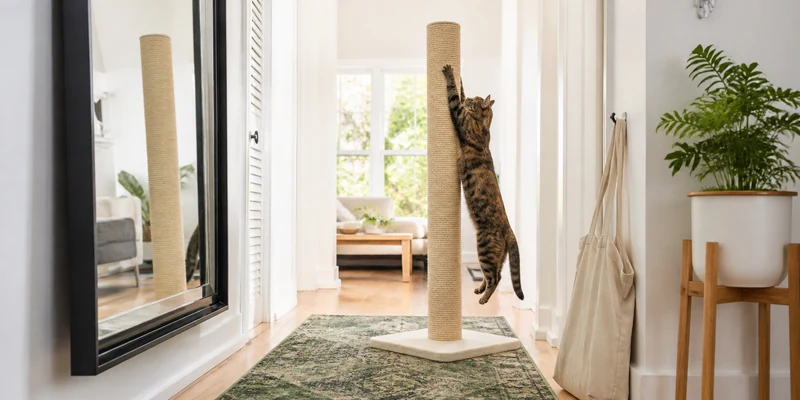
Most people go looking for a tall cat scratching post after the short one failed. The cat used it for a week, then went back to the arm of the couch, and the obvious difference is that the couch lets her reach as far as she wants while the post ran out of rope somewhere around her shoulders. Height is not a luxury feature on a scratching post. For a lot of cats it is the whole point.
This guide is about posts in the 30-inch-and-up range: what full extension actually requires, why the number climbs for a big cat, and why stability gets harder to solve with every inch you add. If you are still deciding between a post, a pad, and a wall-mounted scratcher, start with our hub guide to the cat scratching post category and come back here once you know you want a vertical one.
This article contains affiliate links. If you buy through them, we may earn a commission at no extra cost to you. Learn more.
Quick Answer
How tall should a cat scratching post be?
- Around 30 to 32 inches of usable scratching surface suits most adult cats, because it lets them reach up with front paws while the back feet stay planted on the floor.
- Large and long-bodied cats often need 35 inches or more. Measure your own cat stretched against a door frame instead of trusting the size on the box.
- Height only helps if the post does not move. Past 30 inches, base weight and base width matter as much as the sisal does.
How Tall Does the Post Need to Be for Your Cat?
There is a simple measurement that settles this, and it takes about a minute. Wait until your cat stretches up against a door frame or the side of the couch, then mark where the top of her front paws lands. That mark, plus a couple of inches of margin, is the minimum height of scratching surface you want. Not the total product height: the height of the part actually wrapped in rope.
| Your cat | Typical reach when stretched | Scratching surface to look for | What a shorter post costs you |
|---|---|---|---|
| Kitten or petite adult | Roughly 18 to 24 in | 24 to 28 in | Little, for now, but kittens grow into a post they cannot yet use |
| Average adult, around 9 to 12 lb | Roughly 24 to 30 in | 30 to 32 in | She crouches to scratch, which skips the shoulder and back stretch |
| Large adult, 13 lb and up | Roughly 30 to 36 in | 35 in or more | The post becomes a paw rest, and the door frame becomes the real scratcher |
| Long-bodied breeds such as Maine Coon or Ragdoll | Frequently past 36 in | 36 in and up, or a tall post on a cat tree | Almost every standard post is too short, so furniture wins by default |
| Senior or stiff-jointed cat | Often shorter than it used to be | Whatever she still reaches, plus a horizontal option | Nothing, if you also give her a flat pad; forcing height helps no one |
Two footnotes on that table. First, a cat’s reach changes with mood and age, so measure a couple of times over a week. Second, if your cat has started scratching lower than she used to, or seems reluctant to stretch at all, mention it to your veterinarian rather than assuming she has simply lost interest in the post.
Why Full Extension Is the Point of a Tall Post
Scratching is not just claw maintenance. When a cat reaches up and drags down, she is loading the muscles along her shoulders, back, and forelegs, shedding the worn outer layer of claw sheath, and leaving both a visible mark and scent from the glands in her paws. Our explainer on why cats scratch covers the behavior in detail, but the practical takeaway is short: a cat who cannot fully extend is only getting part of what she came for.
That is why height beats almost every other spec on a vertical scratcher. Owners report the same pattern repeatedly. A short post gets polite use for a while, then attention drifts to whatever in the house is tall enough to do the job properly, which is usually the sofa corner, a door frame, or the bed base. The cat is not being difficult. She is picking the surface that lets her finish the movement.
Two design details decide whether the advertised height is real:
- Where the rope starts and stops. A 32-inch product with a 4-inch base and a plastic cap at the top may only give you 26 inches of usable surface. Read the description for the scratching height, not the overall height.
- Whether anything blocks the top. Posts with a perch or a toy platform on top can stop a tall cat from reaching the last few inches, because her paws hit the underside of the platform first.
The material matters too, though less than height. Tightly wound natural sisal rope and woven sisal fabric both hold up far better than carpet, which frays into loops and teaches cats that carpeted surfaces are fair game. Our guide to the sisal cat scratching post compares the two sisal formats in depth.
Stability: The Problem That Grows With Every Inch
Here is the trade-off nobody mentions on the product page. A cat scratching a vertical post pulls sideways and down with real force, and the taller the post, the longer the lever she has. The same base that felt rock solid under a 20-inch post can rock, skid, or tip under a 35-inch one.
Wobble is also self-defeating in a way that is easy to miss. A post that shifts under load feels unreliable, and most cats will simply stop using it rather than fight it. So stability is not only a safety question. It is the difference between a tall post that works and a tall post that gathers dust in the corner.
- Base weight over base looks. A dense, heavy base panel resists movement in a way a thin sheet of particleboard cannot, no matter how wide it is.
- Base width relative to height. As a rough guide, a base roughly half as wide as the post is tall stays planted; much narrower and you are relying on weight alone.
- How the post meets the base. A thick center dowel bolted through the base from underneath is far stiffer than a slim post screwed into a surface plate.
- Post diameter. A thin column flexes at the top under a big cat. Thicker posts stay rigid and feel better to scratch.
- Floor surface. Hard floors let a base slide, thick carpet lets it rock. A thin rubber mat underneath solves both cheaply.
If the post will stand anywhere near a walkway, or you have a cat who launches off things, it is worth reading our overview of cat furniture safety before you place it. Tip-over risk on a freestanding tall post is lower than on a six-foot tower, but it is not zero.
Our Top Picks at a Glance
How we chose: we compared widely available tall posts on usable scratching height, base weight and width, post thickness, and the scratching material, then favored designs that hold up under a heavy cat rather than ones that simply look tall in the photo. Selections are based on manufacturer specifications and patterns that come up repeatedly in owner reviews, not on any hands-on assessment of our own.
Two things worth knowing before you scroll. Tall posts are heavy on purpose, so a lightweight box is usually a warning sign. And assembly is normally a matter of bolting one column to one base, which means a wobbly result is more often an under-tightened bolt than a design fault.
🏆 Best Overall
The 32-inch sisal-fabric classic with a wide, weighted wooden base. It hits the height most adult cats need, and the base is the reason it stays put while they use it.

💛 Best Value
A straightforward tall post wrapped in natural sisal rope on a plain, sturdy base. Fewer refinements than the pricier options, but the height is there and the material is right.

⭐ Upgrade Pick
A design-led tall post on a solid wood base in a neutral finish, for people who would rather not park a beige carpet column in the living room. Same job, quieter presence.
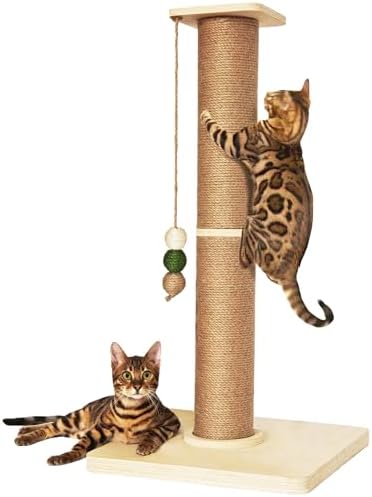
The first pick is the one most people end up comparing everything else against, and we take a closer look at it in our SmartCat Ultimate Scratching Post review, including where it falls short for very large cats.
Matching a Tall Post to Your Cat and Your Room
Large and long-bodied cats are the group tall posts exist for, and also the group most often let down by them. A 13-pound cat can reach past the top of a standard 32-inch post and will apply serious sideways force doing it. Look for the tallest usable surface you can find on the heaviest base you can find, and consider a cat tree with a full-height post instead, which our roundup of cat trees for large cats covers.
Multi-cat households need more posts, not one taller one. Cats scratch to mark as well as to stretch, and a single post in a shared house tends to become one cat’s territory. Two posts in different rooms usually get more total use than one premium post in the hallway.
Kittens grow faster than most people plan for. Buying a full-height post early is fine as long as it is stable, since a kitten cannot yet apply enough force to move it, and she will grow into the top half within a year.
Seniors may be happier with a shorter vertical post plus a horizontal pad, so they can choose the angle that suits their joints on a given day. Height for its own sake is not a kindness here.
Small apartments have a genuine advantage with tall posts: the footprint is tiny compared to a cat tree, so a post fits in a corner a tower never could. If the look is the sticking point, our roundup of the modern cat scratching post covers pieces that read as furniture.
Tall Posts for Specific Situations
Two cases come up often enough to deserve their own picks: the very big cat who defeats standard posts, and the household that wants a second post somewhere else in the house without much fuss.
🐾 Best for Large Cats
An extra-tall, heavy-duty post with a thick sisal-wrapped column and a broad, weighted base. The kind of build that does not shift when a big cat throws her weight into it.

👍 Also Great
A tall single-column post with a sisal-wrapped shaft on a simple stable base, useful as a second scratcher in another room once the main one is established.

If the cat still ignores whatever you buy, the problem is usually placement or timing rather than the product. Our walkthrough on how to get a cat to use a scratching post is the next thing to read, and if furniture damage is the reason you are here at all, how to stop a cat from scratching furniture covers the redirection side.
Placement, Setup, and Upkeep
Put the post where the scratching already happens. The single most common setup mistake is exiling a new post to a spare room while the couch corner it was meant to replace stays untouched and available. Set it directly beside the damaged spot for the first few weeks, then move it a few feet at a time if you want it somewhere else eventually. The same sightline logic applies as with a tower, which our guide to where to place a cat tree explains.
Sleeping spots are the other reliable location. Cats stretch and scratch on waking, so a post near a favorite napping place gets used almost automatically.
On assembly: tighten the center bolt hard, then check it again after a week. A tall post loosens from the repeated sideways pull long before anything wears out, and nearly every complaint about a wobbly post traces back to a bolt that was snug rather than tight. Re-check it every couple of months.
Upkeep is minimal. Vacuum loose fiber off the base, trim frayed sisal flush instead of pulling at it, and rotate the post a quarter turn every few months so the wear spreads around the column rather than hollowing out one side. When the rope finally gives out, rewrapping the post with fresh unoiled sisal rope is straightforward and cheaper than replacing the whole piece.
Common Mistakes to Avoid
- Reading total height instead of scratching height. Bases and top caps can eat several inches of the number on the box.
- Buying tall on a light base. Height without weight produces a post that rocks, and a post that rocks gets abandoned.
- Choosing carpet over sisal. Carpeted posts teach cats that carpet is a legitimate scratching surface, which is rarely what you want at home.
- Picking a post with a platform on top. It looks like a bonus and can physically block a tall cat from reaching the last stretch.
- Putting it out of the way. A scratcher in an unused room competes with furniture that is right where the cat lives.
- Assuming one post is enough for two cats. Scratching is territorial, and shared posts get contested.
- Giving up in week one. Cats need a little time to adopt a new surface, especially if the old target is still available.
Where to Go From Here
If height is settled and material is the open question, our sisal cat scratching post guide compares rope and woven fabric. If you want the post to disappear into the room, see the modern cat scratching post roundup. If a tall post feels like half a solution and you have space for climbing too, a tall cat tree bundles the scratching column with perches. And for a Maine Coon or a similarly long cat, the dedicated Maine Coon cat tree guide starts from dimensions rather than from features.
Frequently Asked Questions
How tall should a cat scratching post be? Tall enough for your cat to reach up with front paws while her back feet stay on the floor. For most adult cats that lands around 30 to 32 inches of scratching surface, and for large or long-bodied cats it is often 35 inches or more.
Is 30 inches tall enough for a big cat? Sometimes, but it is borderline. A 13-pound cat can reach past 30 inches, and once she has to crouch to scratch, the post loses much of its appeal. Measure her stretched against a door frame before deciding.
Do tall scratching posts tip over? They can if the base is light or narrow relative to the height. A wide, heavy base, a thick center post, and a thin mat underneath on slippery floors keep a tall post planted in normal use.
Sisal rope or sisal fabric on a tall post? Both work far better than carpet. Rope gives a coarser texture that many cats prefer, while woven fabric wears more evenly and sheds less fiber. Our sisal scratching post guide goes through the trade-offs.
My cat still scratches the couch. Is the post too short? Height is the first thing to check, followed by location. A post placed away from the furniture your cat actually targets rarely wins, however tall it is.
Should I get a tall post or a cat tree? A post if you want scratching in a small footprint, a tree if you also want height, perches, and napping space. The scratching post hub lays out the formats side by side.
The Bottom Line
A tall cat scratching post earns its place by letting your cat finish the stretch she started, which means 30 to 32 inches of usable surface for an average adult and 35 inches or more for a large one. Measure your own cat against a door frame rather than trusting the size on the box, then spend your attention on base weight and post thickness, because at this height stability is what decides whether she keeps using it. Sisal over carpet, beside the couch rather than in the spare room, and one bolt check a week after assembly.