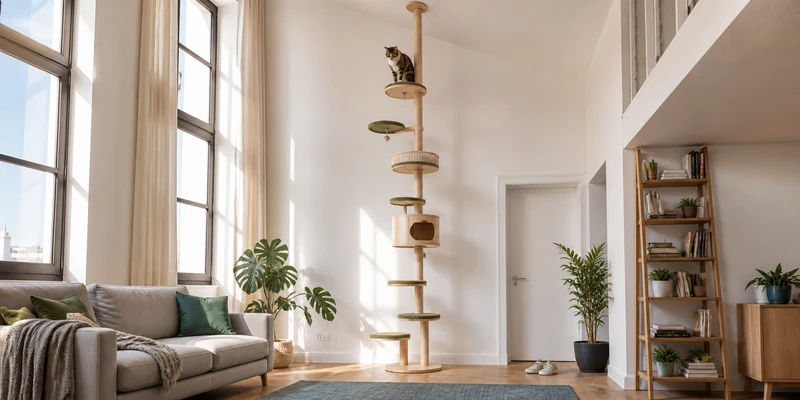
Last updated: August 8, 2026
Shopping for the best tall cat tree is usually a floor space problem in disguise. You want your cat higher up, above the sofa back, above the windowsill, ideally above the dog, but you do not have a corner to hand over to a sprawling five-foot-wide structure. A slim tower solves that: it buys elevation by going up rather than out, and in a studio apartment or a narrow hallway that is the only direction left.
This guide covers towers in roughly the 65 to 80 inch range that keep a compact base. That is a different purchase from a big multi-level structure with lots of napping real estate, which our large cat tree roundup handles. The questions here are narrower: how high can you go before the ceiling becomes the limit, how narrow can a base get before the tower sways, and how does a cat get safely back down.
This article contains affiliate links. If you buy through them, we may earn a commission at no extra cost to you. Learn more.
Quick Answer
How tall should a tall cat tree be, and how slim can it safely get?
- With standard eight-foot ceilings, 65 to 72 inches is the practical sweet spot. It clears every windowsill in the house and still leaves a cat room to sit up on the top perch.
- Keep the base at least a third as wide as the tower is tall. A 72-inch tower wants roughly 24 inches of base; much narrower and you need a wall anchor to make it feel solid.
- Height is only useful if the route up and down is easy. Look for steps spaced about a body length apart, not one huge gap between the last platform and the summit.
How Tall Can You Go in Your Room?
Ceiling height, not the product page, sets your maximum. A cat needs headroom to sit upright on the top perch, roughly 12 to 16 inches of clearance. Work backward from your ceiling and the shortlist shrinks fast.
| Your ceiling | Comfortable tower height | Base width to look for | What you gain |
|---|---|---|---|
| 8 ft (96 in) | 60 to 72 in | 20 to 24 in square | Clears sofa backs, bookcases, and standard windowsills |
| 9 ft (108 in) | 72 to 80 in | 24 to 28 in square | A true above-the-room perch with space to stand and stretch |
| 10 ft and up | 80 in and up, or a ceiling-mounted system | 28 in square, or tension mounted | Room for a branching top section instead of a single summit |
| Sloped or low ceiling | Measure at the tower position, not the room center | Same as the height band | Avoids the classic mistake of a top perch under a slope |
| Rental with no drilling | 60 to 68 in, heavy base | 24 in or wider | Stability from mass rather than from a wall anchor |
One more measurement worth taking: the height of the windowsill your cat already tries to reach. Matching or slightly clearing it turns the tower into a window seat, which predicts daily use better than any other number on the box. Our guide to where to place a cat tree goes into the sightlines that make a spot popular, and the hub guide to cat trees lays out the whole category.
Tall and Large Are Not the Same Purchase
Manufacturers use both words loosely, and the overlap causes a lot of returns. A tall tree is about reach: maximum elevation from a modest footprint, usually a vertical column with platforms stacked around it. A large tree is about volume: several perches at similar heights and a base that eats a corner of the room.
You can spot the difference in the specs without seeing the product. Divide the base width by the total height. Slim towers land around a third or slightly less; big multi-level structures land closer to a half, because they need the spread to carry perches that stick out sideways. If the number is small, stability becomes something you plan for rather than something the base provides on its own.
The practical consequence: a slim 72-inch tower suits one or two cats who want a lookout, and suits a household of four who all want to nap at once far less well. In that case a wider structure or a set of cat wall shelves distributes the value better than one contested summit does.
What Keeps a Slim Tower Steady
Wobble is the complaint that dominates owner reviews of tall trees, and it is mostly physics rather than a manufacturing fault. The taller the column, the longer the lever a jumping cat applies to the base. Reviews consistently mention the same sequence: the tower feels fine on assembly day, then develops a sway once the cat starts launching off the top instead of climbing down.
- Base mass, not just base width. A thick, heavy base resists movement in a way a thin panel cannot, whatever its dimensions.
- Full-length posts. Posts running continuously through several levels stiffen the whole column. Short posts stacked between platforms create a flex point at every joint, and those add up over six feet.
- An anti-tip strap. Past about 60 inches this is the cheapest safety upgrade there is. Check whether one is included if you cannot drill.
- Perch placement. Platforms clustered on one side pull the center of gravity off axis. Alternating them left and right keeps the load balanced.
- A wall or corner. A tall tower against a wall has something to lean into. One marooned mid-room has nothing to catch it.
Flooring matters more than people expect. Thick carpet lets a base rock a few degrees, hard floors let it slide, and a thin rubber mat underneath fixes both cheaply. Our overview of cat furniture safety covers anchoring hardware and tip-over risk in more detail.
Our Top Picks at a Glance
How we chose: we compared widely available tall towers on the ratio of base width to total height, post construction, how evenly the climb is spaced, and whether the footprint genuinely suits a small room. Selections are based on manufacturer specifications and patterns that come up repeatedly in owner reviews, not on hands-on assessment.
Two things to know first. Tall towers ship as long, heavy flat-pack boxes and take an hour or more to assemble, so build them in the room where they will live. And carpeted construction still dominates at this height; wood-look finishes exist but the choice narrows, which our solid wood cat tree guide covers separately.
🏆 Best Overall
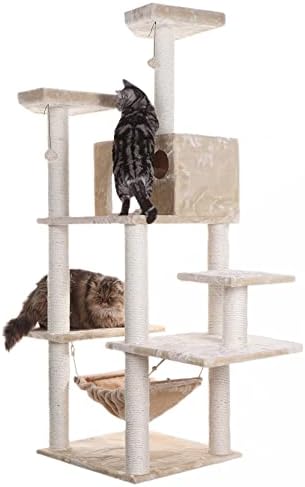
A classic tall multi-level tower in the low-70-inch range with a compact rectangular base and sisal-wrapped posts running the full height. A sensible default when you want maximum elevation from a corner rather than a whole wall.
💛 Best Value
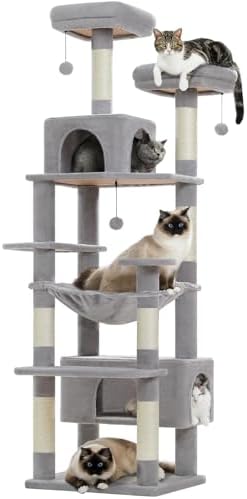
A tall tower with a slim profile, a roomy hammock, and enclosed condos lower down. Good value if you want height without paying for a design finish.
⭐ Upgrade Pick
A slim, design-led tower on a small base for people who care what the piece looks like in a living room. Fewer levels than a mass-market tree, but a cleaner profile and better materials.

Matching the Tower to Your Cat
Height suits some cats far better than others, and it is worth being honest about yours before you commit to six feet of tower.
Confident climbers and young adults are the natural audience. They treat the lower levels as a staircase and go straight to the top. For these cats the climb spacing matters more than the perch count.
Seniors and cats with stiff joints often want the view without the vertical scramble. A tall tower can work if the route up is gradual or includes a ramp, but a mid-height tree beside a windowsill is frequently the kinder answer. When mobility is a concern, ask your veterinarian before assuming a cat can manage the climb.
Heavy or long-bodied cats are the group most often disappointed by slim towers. The base carries the load fine, but narrow-profile perches are frequently too small to lie on properly. Size the platforms first; our guides to cat trees for large cats and the Maine Coon cat tree cover the dimensions that work.
Two cats sharing one tower creates a single contested prize at the top. It can work if there is a second good perch two thirds of the way up, but if elevation is a shared need, see our roundup of cat trees for multiple cats instead.
Tall Towers for Small Apartments and Rentals
The tightest version of this problem is a rental with no drilling allowed, limited floor space, and a cat who wants to be up high anyway. Two approaches work: a tower that gets its stability from a heavy base rather than a wall anchor, or a tension-mounted system that braces between floor and ceiling and leaves no holes.
🐾 Best for Small Apartments
A narrow-base tall tower with platforms alternating up a single column, so the whole piece tucks into a corner and still reaches well above windowsill height.

👍 Also Great
A floor-to-ceiling design with adjustable poles that brace against the ceiling instead of relying on base width alone. Worth considering when you want real height but cannot fit or anchor a conventional tower.

Renters have a few other options worth knowing about, from freestanding systems to removable mounting methods, and our guide to cat furniture for renters collects them. If the look of the piece matters as much as the function, the modern cat tree roundup covers slim towers designed to be seen.
Assembly, Placement, and Upkeep
Build the tower where it will stand. A finished 72-inch column is awkward to carry through a doorway and easy to rack out of square in the attempt. Tighten bolts in stages rather than fully seating each one before moving on, which keeps the platforms level and prevents the slight twist that later reads as wobble.
Fit the anti-tip strap while the top is still within easy reach. If you cannot drill, load the base instead: some owners lay a paving slab or a couple of heavy books under the carpeted base panel, hidden from view, which lowers the center of gravity noticeably.
Then leave it two weeks and re-tighten everything. Fabric compresses under the fasteners during the first weeks of use, bolts loosen as a result, and on a tall column that small amount of slack is magnified at the top. Repeat every few months.
Upkeep is simple. Vacuum plush surfaces with an upholstery attachment, trim frayed sisal flush rather than unwinding it, and rewrap a worn main post with fresh rope when it gives out. Our guide to sisal cat trees covers rope thickness and material if you plan to do that.
Common Mistakes to Avoid
- Buying the tallest tower you can find. If the top perch sits within a hand span of the ceiling, your cat cannot sit up comfortably and will settle a level lower.
- Ignoring the base ratio. A narrow base under a tall column is the most reliable predictor of sway, and sway is why cats abandon top perches.
- Leaving the strap in the box. Especially with kittens learning to launch, or when the tower sits near a walkway.
- One giant step to the summit. Cats manage an oversized leap going up and hesitate coming down, which is when accidents happen.
- Assuming tall means roomy. Measure your cat lying stretched out and compare it to the platform dimensions.
- Putting it in the spare room. Cats want to watch the household. A tall tower behind a closed door is furniture nobody visits.
Where to Go From Here
If the floor space is there and what you want is napping room rather than altitude, start with the large cat tree guide. If six feet is unrealistic, a small cat tree beside a windowsill often delivers the same view for less floor. If the floor is spoken for entirely, a wall mounted cat tree gives you height with no footprint at all. Still deciding whether you need one? See whether cats need a cat tree.
Frequently Asked Questions
How tall is a tall cat tree? In practice, anything from about 65 inches up. Below that most manufacturers use medium or standard, and above roughly 80 inches you are into floor-to-ceiling and tension-mounted systems rather than freestanding towers.
Is a tall cat tree safe for a cat to jump down from? Healthy adult cats handle descents from six feet routinely, provided the route down has intermediate steps and the landing area is clear floor rather than a glass table or a litter box. Spacing matters more than total height.
Do tall cat trees tip over? They can when the base is narrow relative to the height, the floor is uneven, or the anti-tip strap was never fitted. A heavy base, a wall or corner position, and an anchor make tipping unlikely in normal use.
What is the difference between a tall cat tree and a large one? Height versus volume. A tall tower maximizes elevation on a small footprint; a large tree spreads perches and napping space across a wide base. Our large cat tree guide covers the second case.
Will one tall tower be enough for two cats? Sometimes, if there is a second decent perch below the summit. If both cats compete for high ground, two mid-height trees in different rooms usually cause fewer standoffs than one tall column does.
Can I put a tall cat tree on carpet? Yes, though thick pile lets the base rock slightly. A thin rubber mat under the base spreads the load and takes most of that movement out.
The Bottom Line
A tall cat tree is the right buy when you want elevation and cannot spare the floor, and the two numbers that decide whether it works are your ceiling height and the ratio of base width to tower height. Aim for 65 to 72 inches under standard ceilings, keep the base at least a third of the height, anchor anything past five feet, and check that the climb up is evenly spaced rather than one long leap to the top.