Last updated: August 8, 2026
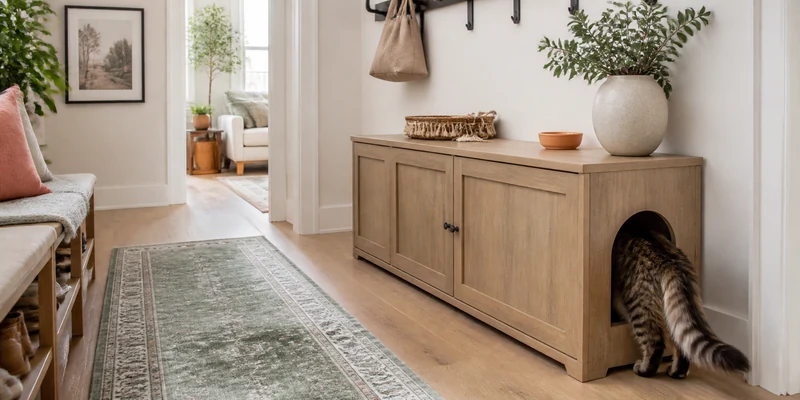
There is a specific moment that sends people looking for hidden litter box furniture. Guests are coming, the living room looks fine, and then you notice the plastic box in the corner of the room and realize it is the first thing anyone will see. The goal at that point is not a nicer looking litter box. It is a piece of furniture that reads as a side table, a bench, or a planter, with nothing about it that says cat bathroom at all.
That is achievable, and there are genuinely convincing options on the market. But hiding a litter box is a trade, and it is worth understanding the terms before you buy. Every layer of disguise you add takes something away from airflow, from how easily you can scoop, or from how comfortable the cat feels going in. This guide covers which disguise formats actually disappear into a room, what each one costs you in ventilation and access, and how to pick one your cat will keep using. If you want the wider overview of the category first, including open-topped covers and simple enclosures, start with our hub guide to litter box furniture.
This article contains affiliate links. If you buy through them, we may earn a commission at no extra cost to you. Learn more.
Quick Answer
Which hidden litter box furniture actually works, and what does hiding the box cost you?
- The formats that disappear best are end table cabinets, entryway benches, and planter style enclosures, because a room already expects furniture in those shapes.
- The cost is airflow and access. A sealed cabinet concentrates ammonia, and a small entry hole or a lid that only opens partway makes daily scooping annoying enough that people stop.
- Buy for interior size first, then for looks. The box plus turning room decides whether your cat keeps using it, and a cat that stops using a hidden box is the only real failure mode.
Disguise Formats Compared: How Well They Hide and What They Cost
Hidden litter box furniture is not one product type. It is four or five different pieces of furniture that happen to be hollow, and they hide the box in very different ways. The table below is the short version of what each format buys you and what it takes back.
| Format | How it hides the box | What you give up | Suits |
|---|---|---|---|
| End table or nightstand cabinet | Reads as a normal side table with a usable top surface, entry hole on the side or back | Interior height is often tight, and the top surface tempts you to stack things on the one panel you need to open | Living rooms and bedrooms where a side table is expected anyway |
| Bench or entryway seat | Long, low, and clearly a place to sit, with the box behind a hinged front or under a lift-up seat | Depth is usually the limiting dimension, and a seat lid means moving cushions before every scoop | Hallways, mudrooms, and the foot of a bed |
| Planter style enclosure | Looks like a potted plant, so the eye skips it completely | Interior volume is the smallest of any format, and the shape rarely suits large cats or clumping litter depth | Small apartments and corners where a cabinet would feel bulky |
| Console or credenza cabinet | Sits flat against a wall like storage furniture, often with a second compartment for supplies | Footprint is large, and the extra storage compartment can trap odor next to the litter side | Wider walls where the piece can also earn its keep as storage |
| Cabinet with a cat friendly top | Hides the box below while doubling as a perch or step, so the furniture has a visible second job | Less invisible, because the top gives the game away to anyone who knows cats | Homes that want one piece to do two things |
| Screened corner unit | Angled back panel tucks into a corner where a rectangular cabinet would stick out | The narrowing shape cuts usable interior space right where the cat needs to turn | Awkward corners and small rooms |
Notice that the two formats that hide best, the planter and the bench, are also the two that squeeze the interior hardest. That is the central tension in this category, and it is why the next two sections matter more than the styling.
What Hiding Costs You: Ventilation
An open litter box sits in room air, so odor disperses as fast as it is produced. Put that box inside a sealed wooden cabinet and the same waste is now off-gassing into a small enclosed volume. Ammonia builds up in that space between scoops, and the cat has to put its head into the concentration every time it goes in. It is not a hypothetical problem: owners of tightly sealed enclosures report exactly this pattern, where the room smells fine and the inside of the cabinet does not.
Two things decide how bad it gets. The first is air exchange. Look for a real path for air to move through the enclosure rather than a single entry hole: vent slots or drilled holes in the back panel, a gap under the door, a rear cutout, or a lid that sits slightly proud rather than gasket tight. Cross ventilation, meaning openings on two different sides, does far more than a bigger hole on one side.
The second is the material itself. Raw or lightly finished MDF and particleboard are porous, and if litter dust and moisture get into an unsealed edge, the panel itself starts holding odor and no amount of scooping fixes it. Sealed laminate, painted surfaces with finished edges, powder-coated metal, or solid wood with a proper finish all clean up rather than absorb. A removable interior tray or a wipeable liner on the floor of the cabinet is the single most useful feature in the whole category for exactly this reason.
It is also worth being realistic about what an enclosure can and cannot do for smell. Furniture contains the visual mess and slows the spread of odor into the room, but it does not neutralize anything, and a hidden box left an extra day is worse than an open one left an extra day. We go into this properly in does litter box furniture control odor, which is the article to read if odor rather than looks is your main reason for buying.
What Hiding Costs You: Access, for the Cat and for You
Access is where hidden designs quietly fail, and it splits into two separate questions.
Your access is about the daily scoop. A cabinet that only opens through one narrow front door means kneeling on the floor and working at arm’s length, which turns a thirty second job into something you put off. Designs with a hinged or lift-off top, or double front doors that open the whole face, are dramatically easier to live with. Before you buy, look at the product photos and ask yourself where your hands and the scoop and the waste bag all go at the same time. Also check whether the litter box can be lifted straight out for a full change, because some interiors are only fractionally larger than the box and turn a monthly deep clean into a wrestling match.
Your cat’s access is about the opening and the room to turn. A commonly cited guideline is that a litter box should be roughly one and a half times the length of the cat from nose to tail base, and the enclosure needs to fit that box plus space for the cat to turn around and dig. An entry hole that a cat has to squeeze through, or a high step over threshold, gets tolerated by a young athletic cat and quietly avoided by an older or heavier one. If your cat is stiff, senior, or has any mobility issue, a low or ground level entry matters more than any styling question, and it is worth raising with your veterinarian if you notice a change in litter box habits.
There is a behavioral angle too. Cats generally prefer not to be cornered where they cannot see out, and an enclosure with exactly one way in and out is a dead end from the cat’s point of view. Single cat homes usually take this in stride. In a multi-cat household, where one cat can camp outside the only exit, a single entry cabinet is a genuine risk factor for a cat starting to go elsewhere. Two openings, or one big opening rather than a small hole, both help. If you are covering more than one box, our guide to litter box furniture for 2 boxes deals with the layout side of that.
Our Top Picks at a Glance
🏆 Best Overall
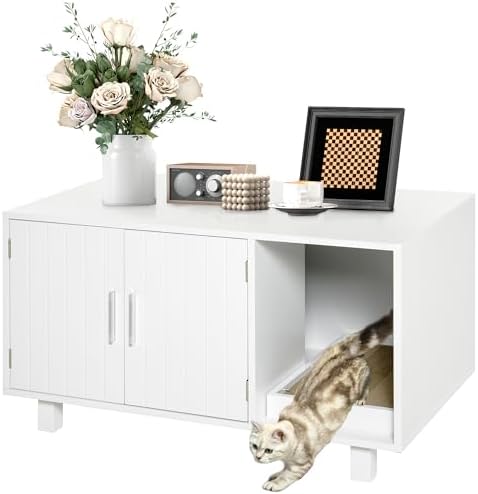
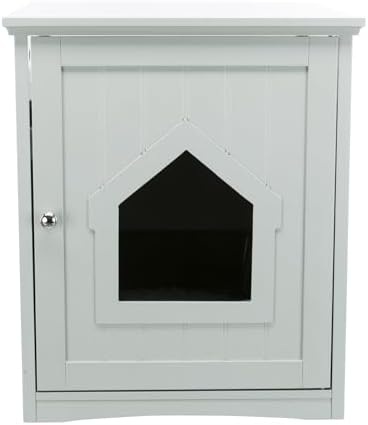
A wooden side entry cabinet in end table proportions, with magnetic front doors that open most of the face, so the box comes straight out and the piece still reads as ordinary furniture in a living room.
💛 Best Value
A straightforward wooden litter box cabinet with a barn-style door and a plain farmhouse finish, the sensible entry point if you mainly want the box out of sight and are willing to add ventilation holes yourself.

⭐ Upgrade Pick
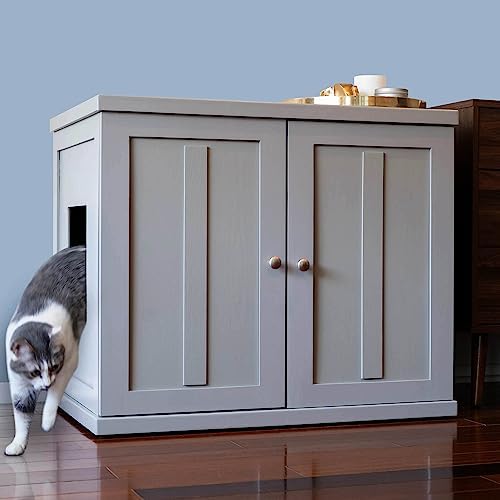
A furniture grade cabinet designed from the start as concealed cat plumbing, with a proper finish, a generous interior, and a top surface that genuinely belongs in a bedroom or living room.
How we chose: we compared widely available enclosures on how convincingly the shape reads as ordinary furniture, stated interior dimensions against a standard box footprint, ventilation openings and material finish, and how much of the enclosure opens for scooping. Selections are based on published specifications and the patterns that come up repeatedly in owner reviews, not on hands-on assessment.
Two expectations worth setting before you look. Nothing in this category eliminates odor on its own, so plan on the same scooping routine you already have. And the most convincing disguises tend to have the tightest interiors, which means measuring your current box before ordering is not optional.
If your priority is a piece that fits a considered interior rather than just disappearing, the design led end of the market is worth a look in our roundup of modern cat furniture.
Matching the Disguise to the Room
The right format depends less on your taste than on where the box has to live. Three situations come up constantly.
An open-plan room with no spare corner. Here the enclosure will be seen from several angles, so a piece with a finished back and no obvious entry hole on the visible side is what you want. Planter style units win on invisibility because a plant in a corner is invisible by default, but they are the tightest fit of all and suit small to average cats with a compact box.
A hallway, entry, or the foot of a bed. A bench does two jobs at once, and low horizontal furniture in a hallway attracts no attention at all. Watch the depth: many benches are shallow enough that a standard box only just fits, leaving no turning room.
A rental where you cannot modify anything. Freestanding furniture is the whole point here, and the pieces that work best are the ones you can pick up and move without disassembly. Our guide to cat furniture for renters covers the wider set of no-damage options.
🌿 Best for Open-Plan Rooms
A planter style enclosure with a faux plant top, which reads as decor from every angle rather than as a cabinet. Best suited to small and average sized cats, since interior volume is the trade for how well it hides.

🐾 Best for Hallways and Small Apartments
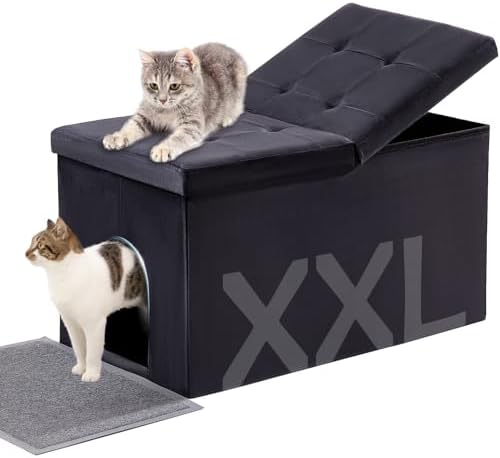
A bench height enclosure with a lift-up padded seat, so it works as a real seat in an entryway while the box stays completely out of sight below.
👍 Also Great
A compact wooden cat cabinet with a big front door and a large, low entry hole, easy to open wide for cleaning and forgiving for older cats that would rather step in than climb in.
Setting It Up So the Cat Keeps Using It
A hidden box is a change of environment as far as the cat is concerned, and the transition is where most problems start. Introduce it gradually. Put the new enclosure in the same spot the open box occupied, leave the door off or the top open for the first few days, and let the cat go in and out without the enclosure being a dark tunnel yet. Only once the cat is using it comfortably do you close things up.
A few practical points that make a real difference:
- Measure before you order. Note the footprint of your current box and add turning room. Compare that against the stated interior dimensions, not the exterior ones, which is the number most listings lead with.
- Add ventilation if the design does not have it. A few holes drilled in the back panel of an otherwise sealed cabinet, out of sight against the wall, change the internal air noticeably.
- Line the floor of the cabinet. A wipeable tray or mat under the box catches the litter that misses and stops moisture reaching bare board edges.
- Fill depth matters more in a small interior. A cat that digs enthusiastically will fling litter against the inside walls, so a slightly deeper box with higher sides inside the cabinet often works better than a shallow one.
- Leave the escape route open at first. If you have more than one cat, prop the door or remove it entirely for the first couple of weeks so nobody learns that the cabinet is a place to get trapped.
- Check stability if the top gets used. Any cabinet a cat jumps onto should sit level and not rock, and tall pieces near a wall deserve the same attention as any other furniture, as our overview of cat furniture safety explains.
Common Mistakes to Avoid
- Buying on exterior dimensions. A cabinet that looks generous can have thick panels, internal framing, and a divider that leave surprisingly little usable space inside.
- Choosing a fully sealed design. The tightest enclosure hides the box best and concentrates ammonia fastest. Openings on two sides are worth more than a nicer finish.
- Accepting a small entry hole. A hole sized for a photograph is not sized for a Maine Coon in winter coat. Bigger is safer, and low is better than high.
- Ignoring how it opens. If scooping means kneeling and reaching through one narrow door, the routine slips, and the whole point of the enclosure is lost.
- Putting it somewhere the cat will not go. Hiding the box in a closet, a basement, or behind a door that sometimes gets closed is the most common reason a cat starts going elsewhere.
- Skipping the transition. Swapping an open box for a closed cabinet overnight is asking for a refusal. A few days with the front open costs nothing.
- Using unsealed board where litter dust settles. Once a raw edge absorbs moisture, the furniture itself becomes the odor source.
Where to Go From Here
If you are still deciding between a full enclosure and something simpler like a covered box or an open topped cover, the hub guide to litter box furniture lays out every format side by side. If odor is your actual problem rather than appearance, read does litter box furniture control odor before you spend anything, because the answer changes what you should buy. Households with two or more cats should look at litter box furniture for 2 boxes, since the box count guidance matters more than the cabinet does. And if the piece has to hold its own in a carefully furnished room, our roundup of modern cat furniture covers the design led brands working in this space.
Frequently Asked Questions
Does hidden litter box furniture make the smell worse? It concentrates odor inside the enclosure rather than creating more of it, which is why ventilation openings and a wipeable interior matter so much. With a normal scooping routine and airflow on two sides, most owners find the room smells better and the cabinet interior stays manageable.
Will my cat actually use an enclosed cabinet? Most cats adapt, provided the interior is big enough to turn around in and the entry is easy to step through. Cats that refuse usually do so because the space is cramped, the opening is high, or the change happened too abruptly. Introduce it with the door off for the first few days.
Is a planter style enclosure big enough for a large cat? Usually not. Planter designs win on invisibility and lose on interior volume, so they suit small to average cats with a compact box. A large or long bodied cat is better served by an end table or bench format with a rectangular interior.
How do I clean inside a hidden litter box cabinet? Choose a design that opens from the top or across the full front so you can lift the box straight out, and put a wipeable tray or mat under it. Sealed or laminated surfaces wipe down; raw board edges are the part that holds odor over time.
Is one enclosure enough for two cats? Two cats generally need more than one box, and putting both inside one cabinet creates a single entry point that one cat can guard. Two separate pieces, or one designed for two boxes with two openings, is the safer setup.
Can I put a self-cleaning box inside furniture? Only if the interior clears the unit’s height and any lid movement, and only if you can reach the power cord and the waste drawer without dismantling the cabinet. Check both stated interior height and the door opening before ordering.
The Bottom Line
Hidden litter box furniture works, and end table cabinets, benches, and planter style units all disappear convincingly into a normal room. What you trade for that is airflow and access, so choose a design with openings on two sides, a wipeable interior, an entry your cat can step through rather than squeeze into, and a top or front that opens far enough to make scooping easy. Measure the interior against your actual box before ordering, because a cat that stops using a hidden box is the only outcome that really counts as a failure.