Last updated: August 8, 2026
Shopping for litter box furniture for 2 boxes is a different job from shopping for a single hidden cabinet. Most enclosures on the market are designed around one standard tray, and the interior is sized to match. The moment you need two boxes under one lid, internal width stops being a spec you skim past and becomes the entire decision. Multi-cat households run into this first, usually while trying to honor the familiar one box per cat plus one guideline without turning the laundry room into a row of open plastic trays.
There are really only two formats that work: one long cabinet or credenza with enough interior span for two boxes side by side, or a matched pair of single cabinets lined up to read as one piece of furniture. Each has trade-offs in cleaning access, ventilation, and how cats actually use the space. This guide walks through what to measure, how the n+1 guideline translates into furniture, and which widely available enclosures have the interior room to pull it off.
This article contains affiliate links. If you buy through them, we may earn a commission at no extra cost to you. Learn more.
Quick Answer
Can one piece of litter box furniture hold two litter boxes?
- Yes, but only if the stated interior width fits both trays plus a few inches of turning room. Measure your boxes first, then shop by interior dimensions, never by exterior width.
- Two entry holes, one at each end, beat a single shared opening. One doorway means one cat can block both boxes.
- A pair of matching single cabinets is often the more flexible buy, because you can split them between two rooms later if the cats want separation.
What to Check Before You Buy a Two-Box Cabinet
Every line here is something you can verify from a product listing, a spec table, or a tape measure before you spend anything. Interior numbers matter far more than the ones on the front of the box.
| What to check | Why it matters with two boxes | What to look for |
|---|---|---|
| Stated interior width | Wall thickness, hinges, and internal framing can eat several inches, so exterior width tells you almost nothing | An interior figure listed separately from the exterior one, ideally with a rough two inches of slack beyond the combined width of your trays |
| Interior height and clearance | Cats stand up and turn around before they squat, and a low ceiling is a common reason a cat abandons an enclosure | Enough headroom above the box rim for your largest cat to stand comfortably, plus room for a high-sided tray if you use one |
| Divider or open span | A shared open bay lets litter drift between trays; a full divider gives each box its own bay but blocks the crossing route | A removable divider panel, so you can try both arrangements without buying twice |
| Number and position of entries | One opening for two boxes creates a bottleneck, which is the whole problem you bought a second box to avoid | An entry at each end, or entries on opposite faces, so neither box depends on a single doorway |
| Door and lid access | Two boxes means twice the scooping, and awkward access is what turns a daily job into a skipped one | Full-width front doors, a lift-top, or both, with a clear reach to the far corners of each tray |
| Floor panel and finish | Litter and moisture reach the base of a two-box unit faster simply because it gets more traffic | A sealed, wipeable interior floor or a removable tray, rather than bare particleboard |
| Ventilation | Two boxes in one sealed cabinet concentrate odor and humidity in a way a single box does not | Vents, a slatted back, or a deliberate gap at the rear rather than a fully closed shell |
| Weight and moving it | A long two-box credenza is heavy and needs pulling out for deep cleaning | A unit you can slide or shift alone, or one designed to be cleaned in place through wide doors |
If you are still comparing formats rather than sizes, our hub guide to litter box furniture covers cabinets, benches, and bathroom-style units across every price tier. This page narrows the field to one question: what changes when you need room for two.
One Long Cabinet or Two Single Ones
The single wide cabinet is the neater answer visually. A long credenza with two entries reads as furniture, gives you a usable surface on top, and keeps everything in one footprint. It also tends to have the cleanest cleaning workflow, since a full-width front door exposes both trays at once. The trade-offs are practical: these units are heavy, they need a long clear wall, and if you ever want to move one box to another room, you cannot.
A matched pair of single cabinets solves that last problem and creates a new one. Two identical enclosures pushed together give you the same visual line as a credenza, and each has its own doorway, its own bay, and its own ventilation. If the cats turn out to want distance between boxes, you separate them without buying anything new. The cost is a seam down the middle, two surfaces to keep aligned, and usually a slightly deeper total footprint once you account for two sets of walls.
There is a third route worth knowing about, which is a single oversized enclosure sold as a cat washroom or bench, wide enough for two trays without a divider. These work well for cats who like a large open bay and badly for cats who prefer a defined space. If you have one cat who kicks litter enthusiastically, an open two-tray bay spreads that mess across the whole interior instead of containing it. Our guide to hidden litter box furniture goes deeper on how much concealment is realistic before cleaning gets difficult.
What the n+1 Guideline Actually Asks For
The guideline most shelters and cat behavior organizations repeat is straightforward: one litter box per cat, plus one spare. Two cats, three boxes. It is a rule of thumb rather than a law, and it exists because litter box access is a resource cats keep track of, in the same way they keep track of resting spots and food bowls. A spare box means a cat is never fully dependent on a location another cat is occupying, guarding, or has just used.
Here is the part that matters for furniture shopping. Behaviorists generally treat boxes clustered in one spot as a single location, not two. Two trays inside one cabinet against one wall give a cat more surface area and a cleaner choice, which is genuinely useful, but they do not give the same separation as two boxes in different rooms. So a two-box cabinet is best understood as one very good litter station rather than as two independent ones. In a two-cat home, the practical setup is often a two-box cabinet in the main spot plus a third box somewhere else entirely.
None of this means a shared cabinet is a bad idea. Plenty of two-cat households run happily on exactly that arrangement, particularly cats who grew up together. It just means you should not count the cabinet as having solved the distribution question on its own. If a cat starts avoiding the boxes, changes elimination habits, or strains, that is a conversation for your veterinarian rather than a furniture problem, and worth having promptly.
Our Top Picks at a Glance
How we chose: we compared widely available enclosures on stated interior width, headroom above the tray, entry layout, cleaning access, and how solidly the panels go together. Selections rest on manufacturer specifications and recurring themes in owner reviews rather than any trial of our own.
Two things before the list. First, measure your existing trays and write the numbers down, because interior specs vary far more than product photos suggest. Second, every one of these arrives flat-packed, and a long two-box unit is a genuine assembly session rather than a ten-minute job.
🏆 Best Overall
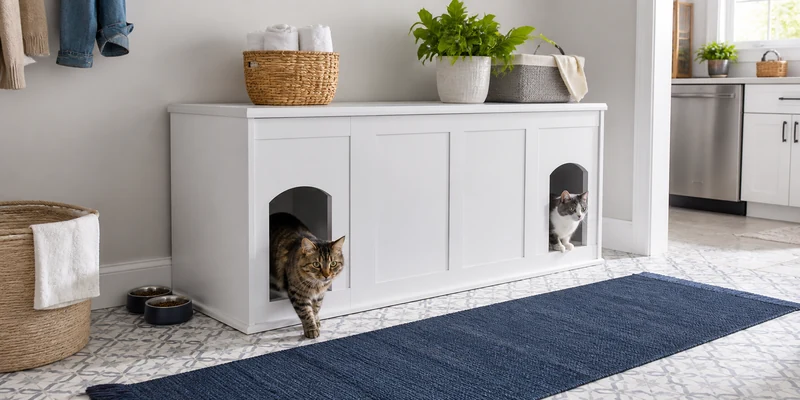
A wide wooden enclosure with the interior span for two standard trays, divided as a double room, with doors that open the bays for scooping. The straightforward default when you want both boxes in one piece of furniture.

💛 Best Value
A wide wooden litter cabinet that gets you two-tray interior width and a usable top surface without a premium finish. The value benchmark other two-box enclosures get measured against.

⭐ Upgrade Pick
A furniture-grade cabinet designed to be bought as a matching pair and lined up along one wall, so each box keeps its own doorway and ventilation. Suits living rooms where the unit has to look intentional.

Matching the Setup to Your Home
Two cats in a house is a different problem from two cats in a studio apartment, and a pair of large cats changes the math again.
- Two adult cats, average size. A single wide cabinet with two entries usually covers it, provided you add a third box elsewhere. Watch which tray each cat prefers over the first few weeks before deciding whether they need more separation.
- One cat who wants a choice. Many single cats use two boxes differently, one for each function. A two-tray cabinet handles this neatly, and the divider can come out if the cat treats the whole bay as one space.
- Large or long-bodied cats. Interior height becomes the limiting factor before width does. Check headroom above the rim, and consider two single cabinets rather than one long unit so each cat gets a full bay.
- Small apartments and renters. A credenza that doubles as a console or side table earns its footprint twice. Our overview of cat furniture for renters covers freestanding pieces that leave no marks behind.
- Open-plan living areas. If the unit will sit in view, finish and proportions matter as much as capacity. The pieces in our modern cat furniture guide are built to be looked at rather than hidden.
- Senior cats or kittens. Entry height is the detail to check. A high threshold that an adult steps over easily can be a real obstacle at both ends of the age range, and a low-cut opening solves it.
The two picks below cover the situations that come up most often once a single wide cabinet is not quite the right shape.
🧱 Best for a Side-by-Side Pair
A compact wooden enclosure sized for one tray, with clean lines that let two units sit flush against each other and read as a single run. Buy two now, split them between rooms later if the cats ask for it.
🪵 Also Great: Wide Bench Layout
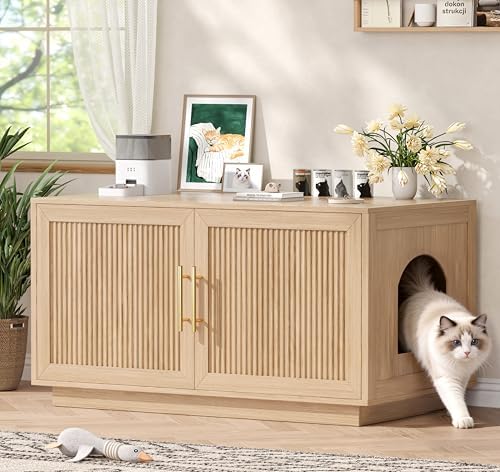
A bench-style washroom with a removable partition rather than a fixed divider, which suits cats who prefer one large bay over two defined ones. Easier to sweep out than a compartmented cabinet.

Placement, Assembly, and Keeping It Clean
Placement does more for whether a two-box cabinet gets used than the cabinet itself. Put it somewhere quiet but not remote, with a clear approach on at least two sides, and avoid dead-end corners where a cat entering has no second way out. Keep it away from the washing machine and the furnace, since sudden noise near a box is one of the more common reasons a cat quietly stops using it. And keep both entries unobstructed once the furniture is in place, because a chair pushed back six inches can close one of them without anyone noticing.
Assembly deserves patience on any long unit. Run all the cam locks and bolts in loosely first, get the carcass square against a flat floor, then tighten in stages while working around the piece rather than fully seating one fixing at a time. That keeps the panels from racking, which is what causes doors to stop closing flush a month later. Check whether the unit includes an anti-tip strap; a tall cabinet with a surface on top invites a cat to jump onto it, and our overview of cat furniture safety covers anchoring when you cannot reach a stud.
Cleaning is where two boxes in one cabinet either works or does not. Scoop both trays daily, since a shared enclosure concentrates odor faster than two boxes in separate rooms. Leave the doors open for a few minutes after scooping to let air move through, wipe the interior floor weekly, and pull the unit out for a proper clean every month or two. A washable mat under each tray catches most of the tracked litter before it reaches the wood. For a realistic look at what an enclosure can and cannot do about smell, see our piece on whether litter box furniture controls odor.
Common Mistakes to Avoid
- Shopping by exterior width. Wall thickness, hinges, and internal framing routinely swallow several inches. Only the interior figure tells you whether two trays fit.
- Forgetting headroom. Cats stand and turn before they squat. A cabinet wide enough for two boxes but short on vertical clearance gets abandoned.
- Accepting a single shared entry. One doorway for two boxes recreates the bottleneck you added a second box to remove, especially in a household where one cat guards.
- Treating the cabinet as two locations. Boxes clustered in one spot function as one station. Add a third box elsewhere in the home rather than counting the cabinet twice.
- Sealing it up completely. Full concealment with no ventilation traps humidity and odor. Vents, a slatted back, or a deliberate gap at the wall all help.
- Buying before measuring the trays. High-sided and top-entry boxes have footprints that catch people out, and two of them rarely fit an enclosure sized for two basic pans.
- Underestimating the cleaning access. If reaching the far corner of the second tray means kneeling and stretching, the far corner will get skipped.
Where to Go From Here
If concealment is your main goal and capacity is secondary, start with our roundup of hidden litter box furniture, which covers the formats that disappear best into a room. If the cabinet is going somewhere visible and has to hold its own against the rest of your furniture, the pieces in our modern cat furniture guide are built for exactly that. And if you are solving multi-cat friction more broadly rather than just litter logistics, our guide to a cat tree for multiple cats covers the same resource-spreading thinking applied to vertical space.
Frequently Asked Questions
How wide does litter box furniture need to be for two boxes? Measure the combined width of your two trays, then add roughly two inches of slack so a cat can turn without scraping the walls. Compare that figure against the stated interior width, since exterior dimensions include panels, hinges, and framing.
Should the two boxes be side by side or in separate rooms? Separate rooms give more genuine separation, because cats treat clustered boxes as a single location. A two-box cabinet is still worthwhile as your main station, ideally paired with a third box elsewhere in the home.
Does a two-box cabinet smell worse than a single one? It can, simply because more waste sits in one enclosed volume. Daily scooping of both trays and real ventilation matter more here than in a single-box unit; our guide on whether litter box furniture controls odor covers what actually helps.
Do I need a divider between the two boxes? It depends on your cats. A divider contains kicked litter and gives each cat a defined bay, while an open span suits cats who like a larger space; a removable panel lets you test both without committing.
Is two matching cabinets better than one long one? Neither is universally better. A pair gives each box its own entry and ventilation and can be split between rooms later, while a single credenza looks cleaner and usually offers easier full-width cleaning access.
Will my cats actually use an enclosed box? Most adapt within a week or two if the entries stay open, the interior has headroom, and the trays are kept clean. If a cat avoids the enclosure entirely or changes elimination habits, remove the lid or door temporarily and speak with your veterinarian.
The Bottom Line
For two boxes, shop by stated interior width and headroom rather than exterior size, and insist on two entries so neither tray depends on a single doorway. A wide credenza looks cleaner while a matched pair of single cabinets stays flexible, so pick based on whether you might want to separate the boxes later. Either way, treat the cabinet as one very good litter station and keep a spare box somewhere else in the home.