Last updated: August 8, 2026
Nobody buys a cat tree expecting it to fall over. It arrives flat packed, you follow the diagram, and it stands there looking perfectly solid in an empty living room. Cat furniture safety only becomes a subject the first time a cat launches off the top platform at full speed and the whole tower shifts an inch, or the first time you find a frayed loop of sisal twine in the hallway and cannot say for certain whether some of it was swallowed.
The good news is that almost everything that goes wrong falls into five areas, and all five are things you can check yourself in an afternoon. Below: why tall furniture tips and what actually prevents it, which materials are worth a second look, how placement changes the risk, what to inspect and how often, and what mounting to a wall or ceiling does and does not solve.
Quick Answer
What makes cat furniture safe or unsafe?
- Stability comes from the base, not the height. A wide, heavy, level footprint plus a wall anchor is what stops a tall tower from tipping when a cat launches off it.
- Materials matter next: loose sisal twine, dangling string toys, exposed staples, and furniture that still smells strongly of finish are the recurring problems.
- Everything loosens. Retighten the bolts a couple of weeks after assembly, then run a full check twice a year.
Top Picks on Amazon
Prices and availability may change. Check the current listing on Amazon.

The Cat Furniture Safety Check, Area by Area
Use this as a walk around list for furniture you already own, or as a shortlist of things to look for before you buy. Nothing here needs tools beyond a screwdriver and your own hands.
| Area | What tends to go wrong | What to do about it |
|---|---|---|
| Tip-over | A narrow base under a tall, top-heavy tower; a cat launching sideways off the highest perch. | Wide, weighted base plate; back it into a corner; use the included anchor strap into a stud. |
| Wobble | Thick carpet or an uneven floor leaves the base resting on three points instead of four. | Shim the low corner, or move to a hard floor. Push and rock the tower hard by hand before your cat uses it. |
| Loose fasteners | Bolts back out over weeks of climbing, especially in particleboard and on threaded pole sections. | Retighten after two weeks, then every six months. Replace stripped hardware rather than overtightening it. |
| Loose fibers and string | Frayed sisal twine, unraveling rope, dangling pom-pom toys on elastic cord. | Trim frays flush, cut off hanging toys once they start to shed, re-wrap posts that have gone stringy. |
| Finishes and materials | Strong chemical smell out of the box, flaking paint, exposed staples or screw points, splintering edges. | Air out in a ventilated room before use; sand or cover sharp points; skip anything with flaking coating. |
| Landing zones | Glass tables, floor lamps, tall plants, and radiators sitting where a cat comes down. | Keep the drop area clear on at least two sides and put breakables somewhere else. |
| Wall and ceiling mounts | Shelves anchored into drywall alone; tension poles fitted against a suspended ceiling. | Screw into framing wherever possible; use heavy duty anchors elsewhere; never rely on a drop ceiling. |
| Electrical | Cords from heated beds and fountains routed within reach of a chewer. | Route cords behind furniture, avoid running them under rugs, and follow the manufacturer instructions. |
If you are still shopping rather than inspecting, our hub guide to cat trees covers base widths, pole construction, and which formats stay steady at height. Build quality is where most of this is decided.
Tip-Over: Why Tall Cat Furniture Falls
A cat tree does not usually fall because a cat is too heavy for it. It falls because the load moves. A cat resting on the top perch pushes straight down through the pole and into the base, which is the situation the tower was designed around. A cat launching off that same perch pushes sideways and backwards, and for a fraction of a second the force acting on the base is well above the animal’s resting weight. Tall towers with a small footprint are the ones that lose that argument.
Three things decide how much margin you have:
- Base footprint. Width and depth do more work than anything else. A tower whose base is barely wider than its tallest perch has very little leverage to resist a sideways shove.
- Base weight. A thick, dense base plate lowers the center of gravity. This is one of the clearer differences between budget particleboard towers and heavier solid wood builds, and it is why a solid wood cat tree tends to feel planted even before it is anchored.
- Where the mass sits. Large enclosed condos, hammocks, and cradles mounted high up make a tower top-heavy. The same tower with those features low down is noticeably steadier.
Cat size changes the calculation too. A heavy cat moves with real momentum, and a big Maine Coon or Bengal will use the whole structure rather than settling on one shelf. If that is your household, treat base width as a hard requirement rather than a nice extra, and see our guide to cat trees for large cats for the formats built around it.
The simplest check costs nothing. Put both hands on the top perch, lean your weight into it, and shove it sideways, then repeat in the other direction. Anything that lifts a corner off the floor, creaks at the joints, or travels across the carpet will do all of that more dramatically with a cat on board.
Anchoring to the Wall and Ceiling
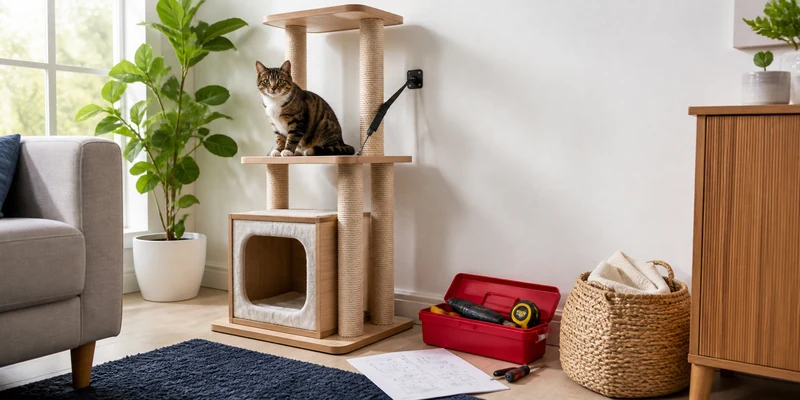
Anchoring is the single highest value safety step for any tall piece, and most people skip it because the strap is at the bottom of the hardware bag and the instructions barely mention it.
Wall straps. Many taller trees, condos, and shelving units ship with a fabric or metal strap that fixes the upper structure to the wall. It is doing the same job as the anti-tip hardware on a bookcase or a dresser: it does not carry weight, it removes the direction in which the piece can fall. Put the screw into a wall stud if you possibly can. In most US homes framing runs sixteen inches on center, and a stud finder plus a narrow pilot hole will confirm it quickly.
When there is no stud where you need one. A heavy duty toggle style anchor in drywall is far stronger than the plastic expansion plugs that come in the box, which are usually the weakest link in the whole assembly. Plaster and masonry need their own fasteners, and hollow metal studs in some apartment buildings need anchors made for steel framing rather than wood screws.
Ceiling mounts and tension poles. Floor to ceiling tension poles work by pressure between the floor and the ceiling, so they need solid structure above them. Suspended or drop ceilings, thin acoustic tile, and sagging older plaster are all reasons not to use one. Anything screwed into a ceiling has to go into a joist rather than the board alone, and if you are unsure what is up there, that is a job worth handing to someone who does it for a living.
Shelves are a different problem. Wall furniture has no base to fall over, so the failure mode is the fastener pulling out of the wall instead. That deserves its own sequence, which we cover step by step in how to install cat wall shelves.
Renters have a genuine constraint here, since anchoring means holes. Small screw holes patch and paint over easily, and are worth raising with a landlord rather than avoiding the conversation. Where drilling is truly off the table, a wide and heavy base in a corner position does a lot of the same work, and cat furniture for renters covers the no-drilling routes.
Materials: Finishes, Fibers, and Loose String
Cats groom constantly, so anything that comes off the furniture ends up in a mouth eventually. That is the lens worth applying to materials.
Finishes and smell. A piece that arrives smelling strongly of paint, lacquer, or glue is off-gassing, and the sensible move is to air it out in a ventilated room for a few days before your cat spends hours on it. Water based and low emission finishes are the ones to prefer when a manufacturer states what it used, and reputable brands increasingly do. Flaking or chipping coating is a clearer problem, since a cat lying on a surface that is shedding paint will ingest some of it.
Particleboard and MDF. Most affordable cat furniture is built on composite board, which is not a safety issue by itself. What matters is that cut edges stay sealed, that the board does not sit somewhere damp where it can swell, and that fasteners stay tight, because composite holds a screw less well than solid timber once the hole has been worked loose.
Sisal and rope. Natural sisal is the standard scratching surface for good reasons, but it frays with use. Trim loose strands flush rather than pulling them, since pulling unravels the whole wrap. A post that has gone smooth and stringy is a practical problem as much as a safety one, because cats abandon slick posts and go back to the sofa.
String, ribbon, and elastic. The dangling pom-poms and feather teasers attached to many towers are the most commonly removed part of a cat tree, and for good reason. Swallowed string is something veterinarians treat as urgent rather than wait and see, so if you suspect your cat has ingested any, call your veterinarian rather than watching to see what happens. Cut hanging toys off once they start to shed, and keep interactive wand toys put away between sessions rather than left on a perch.
Hardware and sharp points. Run your hand over every surface after assembly. Exposed staples along carpet edges, screw tips protruding through a platform, and splintering plywood all turn up on cheaper builds, and all are fixable in minutes with pliers, a file, or carpet tape.
Placement: The Room Decides Half the Risk
A tower can be perfectly built and still be in a bad spot. Placement is where two separate risks live: what the furniture stands on, and what a cat can hit on the way down.
- Level the floor first. Thick carpet and rugs compress unevenly, and a base resting on three points will rock every time a cat moves. A thin shim under the low corner fixes most of it.
- Back it into a wall or corner. This removes one or two directions the piece can travel in and costs nothing. For tall towers it is close to essential.
- Keep the landing zone clear. Cats come down faster and less precisely than they go up. Glass side tables, floor lamps, tall plants, and unsecured shelving next to a tree are all things a descending cat can knock into.
- Mind the heat. Radiators, heating vents, fireplaces, and candles below or beside a perch are worth designing around, particularly with soft furnishings involved.
- Watch the height above hard floors. A very tall perch over tile or stone is a different proposition from the same perch over carpet, especially for a senior cat.
- Leave two ways off. A cat that can only leave a perch in one direction is more likely to make an awkward exit, and an awkward exit is what puts sideways load on the base.
The full room by room version of this, including which spots cats actually use and how far to keep furniture from the litter box and bowls, is in where to place a cat tree.
One more placement note that is easy to forget: cords. Heated beds, fountains, and lamps near cat furniture all bring cable into a zone where a cat spends hours. Route cords behind furniture and out of reach of a known chewer, avoid running them under rugs where damage goes unseen, and follow the manufacturer instructions on anything that plugs in. Our guide to heated cat beds covers the electrical side.
Maintenance: What to Check and How Often
Cat furniture is one of the few things in a home that gets slammed into daily and then never inspected. A short routine catches nearly everything before it becomes a problem.
- Two weeks after assembly. Go around every bolt and screw with the supplied key or a screwdriver. Hardware beds in during the first weeks, and this is when threaded pole sections most often work loose. Push and rock the tower again afterwards.
- Every six months. Retighten all fasteners, check the base for cracks or swelling, look at every perch join, and inspect wall anchors and straps for movement around the screw head.
- Whenever you vacuum it. Trim frayed sisal, check for exposed staples along carpet edges, and look at hanging toys. This takes a minute and is the most useful habit on the list.
- After any move. Relocating a tower means a new floor surface and often a lost wall anchor. Re-level, re-anchor, and re-check before it goes back into use.
- When behavior changes. A cat that suddenly stops climbing furniture it used happily may be telling you the piece has become wobbly, or may be telling you something about itself. If the furniture checks out, that second possibility is a conversation for your veterinarian.
Some parts are consumable rather than repairable. Sisal wraps, replaceable scratching pads, and carpet-covered surfaces all wear out, and refreshing them keeps a cat on the furniture instead of on your upholstery. A piece with cracked board, a split pole, or a base that no longer sits flat has reached the end of its life.
Common Cat Furniture Safety Mistakes
- Leaving the anchor strap in the bag. The most common miss by a distance, and the cheapest one to fix.
- Judging stability with an empty tower. A tree that feels solid at rest can move a lot under a launching cat. Shove it hard yourself before you trust it.
- Buying on height alone. Tall is appealing and easy to compare. Base width and base weight are what keep tall furniture upright.
- Using the plastic plugs from the box. Supplied drywall plugs are usually the weakest component. A stud or a proper toggle anchor is a different class of fixing.
- Assembling on thick carpet and never looking again. Carpet compresses over weeks. What was level on day one may not be by month three.
- Skipping the retighten. Bolts back out, and loose hardware is what turns a solid tower into a wobbling one.
Where to Go From Here
If the piece you own fails the shove test and cannot be anchored, replacing it is usually more sensible than reinforcing it. Our hub guide to cat trees covers the construction details that separate a steady tower from a wobbly one, including base plates, pole diameter, and how the platforms attach. If your safety concern is specifically about height and mounting rather than freestanding furniture, sturdy cat wall shelves looks at load ratings and bracket design, and how to install cat wall shelves covers the fitting itself.
Frequently Asked Questions
Can a cat tree actually tip over? Yes, most often when a cat launches sideways off a high perch on a tower with a narrow base, or when the base is rocking on thick carpet. A wide weighted base, a corner position, and the anchor strap into a stud between them remove nearly all of that risk.
Do I really need to anchor a cat tree to the wall? If it is tall, top-heavy, or lives with a large or boisterous cat, yes. Anchoring does not carry weight, it simply removes the direction the tower can fall in, and it is the highest value five minutes you will spend on the whole assembly.
Is particleboard cat furniture unsafe? Not inherently. Keep cut edges sealed and covered, keep it out of damp spots, and stay on top of loose fasteners, since composite board holds a screw less well than solid wood once the hole is worn.
Should I remove the dangling toys on a cat tree? Once they start to shed fibers or the cord frays, yes. Swallowed string is treated as an emergency by veterinarians, so cut hanging toys off rather than waiting to see how they hold up.
How often should I check cat furniture? Retighten everything two weeks after assembly, then run a full check every six months, plus a quick look at frays and staples whenever you vacuum it. Recheck after any move.
Is a cat tree safe in an apartment with a drop ceiling? A freestanding tower is fine. A floor to ceiling tension pole is not, because it needs solid structure above it to press against. See cat furniture for renters for stable options that do not involve drilling.
The Bottom Line
Cat furniture safety comes down to a wide, heavy, level base, a wall anchor on anything tall, and materials that do not shed string or flake finish. Placement handles the rest: back it into a corner, keep the landing zone clear, and route cords out of reach. Then retighten the bolts two weeks after assembly and check the whole piece twice a year, because loose hardware is what turns a solid tower into a falling one.