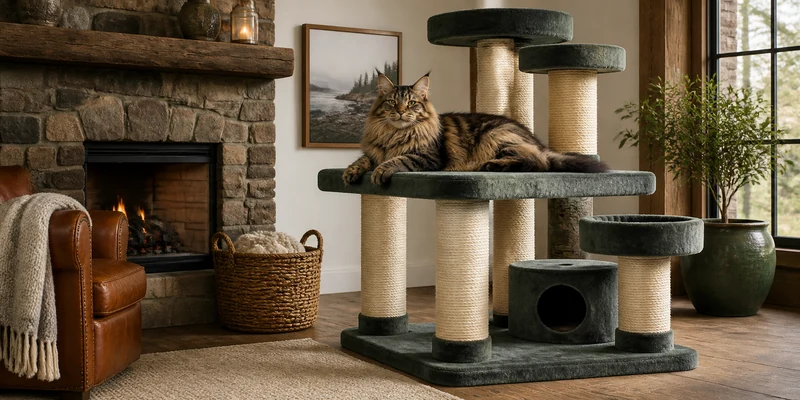
Last updated: August 8, 2026
Shopping for a Maine Coon cat tree is a different job from shopping for a cat tree. Most towers are built around an average house cat of roughly ten pounds. A grown Coon can be twice that, and long enough that his tail hangs off a standard perch while he is still trying to get comfortable. The result is familiar to anyone who has owned one: a new tower that sways under a hard landing, a cubby he can only get his head into, and a sisal post he outgrew within a year.
This guide covers what changes when the cat is this big, which specifications to check before you order, and which widely available towers are built to handle it. Picks below span a sturdy everyday option, a budget-friendlier route, a solid wood upgrade, and layouts for senior cats and multi-cat homes.
This article contains affiliate links. If you buy through them, we may earn a commission at no extra cost to you. Learn more.
Quick Answer
What should a Maine Coon cat tree have?
- Oversized flat surfaces, roughly sixteen inches square or larger, so a long cat can lie fully stretched instead of curled onto the edge.
- Sisal posts tall enough for a full upright stretch, with a thick core and a wide, heavy base that does not shift when a big cat launches off it.
- Generous stated weight capacity per level, plus wide steps or a low first platform so older or heavier Coons can climb comfortably rather than jumping.
What a Maine Coon Needs, Feature by Feature
Save this table on your phone and check listings against it. These are the specifications that separate a tower a Maine Coon will use from one that ends up as an expensive coat rack.
| Feature | What to look for | Why it matters for a Maine Coon |
|---|---|---|
| Perch size | Flat platforms around 16 by 16 inches or larger; oversized top perch or hammock | A long body needs somewhere to sprawl; a small perch forces a permanent loaf position |
| Weight capacity | Manufacturer figure stated per platform, not just for the whole unit | Adult males commonly land in the high teens or low twenties in pounds, plus impact force on landing |
| Sisal posts | Continuous vertical runs of roughly 20 inches or more, thick core, natural sisal rope | Coons stretch tall when they scratch; short stub posts get bypassed for your sofa arm |
| Base and footprint | Thick base panel, wide stance relative to height, anti-tip strap included | Heavy cats generate real sideways force; sway is the most common complaint on big towers |
| Cubby or condo openings | Wide entry holes, or an open-sided cubby rather than a small round hole | Standard openings are sized for an average cat and are often too tight through the shoulders |
| Climbing route | Short steps between levels, wide stairs, or a ramp to the first tier | Lets a heavy or older cat walk up in stages instead of jumping the full height |
| Materials | Solid wood or thick engineered panels; bolts rather than thin screws into particleboard | Thin board and short screws are where wobble and cracked platforms usually start |
If your household has a big cat that is not a Coon, the same logic applies with slightly different numbers. Our broader roundup of the best cat trees for large cats compares options across breeds and body types.
Size and Weight: Why Standard Towers Fall Short
Maine Coons are among the largest domestic cat breeds. Males often reach the high teens or low twenties in pounds once fully grown, which can take three to four years, and females are usually smaller but still well above the average house cat. Length matters just as much as weight. A Coon stretched out nose to tail tip can easily exceed three feet, and that dimension is the one product listings never account for.
Put those numbers against a typical mid-range tower and the mismatch is obvious. Platforms around twelve by twelve inches are common, which leaves a large cat hanging over two edges. Capacity is often quoted for the whole structure rather than per level, which tells you little about the top perch, and the top perch is the one your cat will want.
Impact force is the part owners tend to underestimate. A cat does not step onto a platform, he lands on it, and a heavy cat landing from a jump loads that platform with considerably more than his standing weight. Thick panels, bolted joints, and a broad base matter more here than any headline specification.
Height, Sisal, and Stability: Getting the Three Right Together
Height is what most people shop for first, and it matters, since surveying a room from above is a core part of how cats use vertical space. But height without a matching footprint is the classic mistake. The taller the tower, the wider the base needs to be, and anything over about five feet on a slim base should be strapped to a wall regardless of how solid it feels in the box. Our guide to cat furniture safety covers anchoring and tip-over risk in detail.
Sisal is where big cats get shortchanged most often. A Maine Coon rising onto his hind legs reaches high, and he wants to sink his claws in near the top of that reach and pull down through the full stroke. Posts interrupted every ten inches by a platform break that motion. Look for continuous vertical runs, a core thick enough that it does not flex under a hard pull, and natural sisal rope rather than a thin wrap over cardboard. If a tower you otherwise like is light on scratching surface, a separate sisal cat tree or a tall standalone post alongside it solves that without compromising the rest.
Stability, finally, is often an assembly problem rather than a design one. Even a well-engineered tower will wobble if it goes together out of square, so tighten every fastener partway first, square the frame up, then finish them off.
Our Top Picks at a Glance
How we chose: we compared widely available large-format cat trees on platform dimensions, stated weight capacity, sisal post height and thickness, base construction, and the issues that come up repeatedly in owner reviews from people with big cats. Selections are based on manufacturer specifications and reported owner experience, not on hands-on use.
One note before the list: if your Coon is still growing, buy for the adult cat rather than the current one, because a tower that fits a fourteen month old Coon rarely still fits at three years.
🏆 Best Overall
An extra-large multi-level tower with oversized perches, plenty of scratching posts, and a heavy base. A sensible default if you want one structure to cover climbing, scratching, and napping for a full-grown Coon.

💛 Best Value
A tall multi-level tower with a wide footprint at a friendlier price. Fewer refinements and thinner board than the pick above, but the platform sizes and post height are in the right range.

⭐ Upgrade Pick
A solid wood tower built to furniture standards, with generous platforms and a construction quality that suits a heavy cat and an open-plan living room. Worth it if you want something that will not look tired in two years.

Older Coons, Kittens, and Multi-Cat Homes
Not every Maine Coon wants the same tower, and the differences are worth planning around before you order.
Senior cats. Older or heavier Coons often climb less enthusiastically than they used to, and a tower with big gaps between levels quietly becomes a tower they stop using. A low first platform, wide stair-style steps, or a ramp keeps the whole structure in play, and putting the most comfortable bed on a mid level rather than at the top helps too. If your cat starts avoiding heights he used to enjoy, or seems reluctant to jump at all, that is worth mentioning to your veterinarian rather than solving with furniture alone.
Kittens. Coon kittens are clumsy for longer than most breeds simply because they keep growing. Stability and enclosed lower cubbies matter more than maximum height in the first year.
Multi-cat households. One tall tower creates one prime perch and therefore one thing to argue about. Two medium towers in different rooms, or a tower plus wall shelving, spread the territory out. Our roundup of cat trees for multiple cats goes into layouts that reduce standoffs.
🪜 Best for Easy Access
A large tower with a ramp or wide stepped route to the lower levels, so a heavy or older cat can walk up rather than jump. A practical choice for Coons who have slowed down.

🐾 Best for Multi-Cat Homes
A tall tower with several separated perches and more than one condo, so two big cats can use it at the same time without crowding each other.

🌿 Also Great
A natural wood-toned tower with roomy upper levels and a hammock, for owners who want the size without the beige carpet look in a main living room.
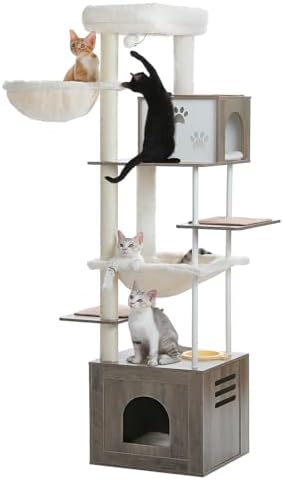
If a climbing structure is not the right shape for your home, an enclosed furniture-style option can work better in a living room. Our guide to the best cat condo for a Maine Coon covers the enclosed route, including the entry dimensions that trip people up with large cats.
Placement, Assembly, and Upkeep
Placement decides usage more than any specification does. A tower with a view of a window, a bird feeder, or the room where your household actually spends its evenings will be used many times more than the same tower in a spare bedroom. Keep a wall or a corner behind it for extra stability, and leave clear floor around the base so a big cat has room to land. Our guide on where to place a cat tree works through the trade-offs room by room.
On assembly, three habits pay off with heavy cats: tighten in stages, re-check every fastener after two weeks once the structure has taken real load, and use the anti-tip strap if one is included.
Upkeep is straightforward. Vacuum plush surfaces with an upholstery attachment, which matters more with a long-coated breed than most listings admit. Trim frayed sisal ends flush rather than pulling them, and prioritize removable perch covers if you can find them, since that is the part that gets grubby first.
Common Mistakes to Avoid
- Buying on height alone. A tall tower with a narrow base is the least stable combination there is. Footprint and base thickness matter more than the last six inches of height.
- Trusting a whole-unit weight capacity. The figure you need is per platform, and specifically for the top one.
- Ignoring platform dimensions. Product photos are usually styled with an average-sized cat. Measure your Coon lying stretched out and compare that to the stated perch size.
- Assuming a cubby will fit. Round entry holes are the single most common size mismatch for this breed. Open-sided cubbies avoid the problem entirely.
- Settling for short sisal. Stub posts under a foot tall do not give a big cat a full stretch, and unused scratching surface means the scratching happens elsewhere.
- Skipping the wall strap. Five minutes of work removes the failure mode that worries people most.
Where to Go From Here
Still weighing up formats? Start with the hub: our complete guide to cat trees explains how the categories differ. From there, large cat trees covers the size question in general terms, tall cat trees focuses on height and the stability that has to come with it, and solid wood cat trees explains where construction differences show up over years of use. Handy with tools? A homemade cat tree is one of the few reliable ways to get truly oversized platforms.
Frequently Asked Questions
How tall should a Maine Coon cat tree be? Somewhere around five to six feet suits most adult Coons, provided the base is wide enough to match. Height above that is fine as long as the tower is strapped to a wall and the climbing route between levels stays manageable.
How much weight should each platform hold? Look for a figure stated per level rather than for the whole unit, and give yourself headroom over your cat’s actual weight, since landing loads a platform with more than a standing cat does.
Will a regular cat tree work for a Maine Coon? Sometimes for a younger or smaller female, rarely for a full-grown male. The usual failure points are perch size and sway, not outright breakage.
My older Coon has stopped climbing. What should I change? Lower the entry point with a ramp or a step, and move his favorite bed to a mid level so the tower stays useful. If the change in behavior is sudden or he seems uncomfortable moving around, speak to your veterinarian.
Cat tree or cat condo for a Maine Coon? A tree gives more climbing and scratching, a condo gives more enclosed space and blends into a room better. See our Maine Coon cat condo guide if the enclosed route appeals.
The Bottom Line
A Maine Coon cat tree has to be judged on perch size, per-level weight capacity, sisal post height, and base stability, in that order, with total height coming last. Buy for the adult cat rather than the one in front of you, and add a ramp or a low first step if yours is older or heavy. Anchor anything tall to the wall and re-check the fasteners after a couple of weeks.