Last updated: August 8, 2026
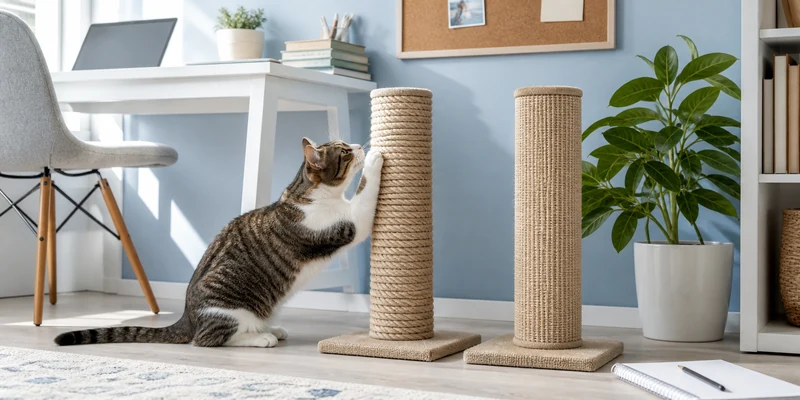
Two products can both be sold as a sisal cat scratching post and behave like completely different things. One is a solid column with tightly wound natural rope running end to end over a heavy base. The other is a cardboard tube in a thin sleeve, glued at the seams, on a plate of pressed board that skates across the floor the first time a cat leans into it. The listings look alike, and the difference only shows up months later, when one post is broken in and the other is in the trash.
What separates them is not really the fiber. It is the form the sisal takes, how tightly and how far it is wrapped, and whether the surface can be renewed when it wears. This guide works through those three things in order, then applies them to standalone posts you can actually buy. If you are still deciding what kind of scratcher your cat needs, the hub guide to the cat scratching post category compares vertical posts, horizontal pads, and inclined scratchers first.
This article contains affiliate links. If you buy through them, we may earn a commission at no extra cost to you. Learn more.
Quick Answer
Which sisal scratching post is worth buying?
- Sisal rope gives a coarser, grabbier pull; woven sisal fabric sheds far less and wears more evenly. Both work, and both beat jute or carpet on a post.
- Wrap quality decides lifespan: coils packed tight with no visible gaps, running the full height of the post, with the ends anchored rather than glued on top.
- A post you can rewrap or re-sleeve outlasts several disposable ones, so check whether the surface can be renewed before you buy.
Sisal Rope vs Sisal Fabric on a Standalone Post
Both surfaces come from the same plant, the agave sisalana, and both are genuine sisal. What changes is whether the fiber is twisted into rope and wound around a column or woven flat into a stiff cloth and stretched over one. On a tall standalone post, that choice affects almost everything about how the scratcher behaves.
| Criterion | Natural sisal rope | Woven sisal fabric |
|---|---|---|
| What it is | Twisted cord wound in continuous coils up the post | Flat woven cloth wrapped and fastened around the post |
| Feel under the claw | Coarse and ridged; the coils sit across the drag of the claw, so the nail catches and releases | Smoother and more uniform; the pull is steadier with less of a snag |
| Mess it makes | Sheds loose strands, heaviest in the first weeks, then settles down | Sheds very little, which matters in small apartments and tidy rooms |
| How it wears | Frays coil by coil and keeps working long after it looks scruffy | Thins evenly across the whole surface; a split seam is the usual failure point |
| Renewing it | Straightforward to rewrap with fresh rope at home | Harder to repair, but some posts take a replacement sleeve or can be flipped |
| Where it fits | Cats that scratch hard and deep; owners who do not mind fiber on the floor | Low-mess households, modern rooms, cats that prefer a smoother surface |
Neither one is a mistake. Rope is the more forgiving choice for an enthusiastic scratcher because a worn section is easy to fix, while fabric is the calmer choice for a home where a small pile of shed fiber every week would be a problem. What both share is that they hold a texture cats keep coming back to, which is the part carpet and jute give up within months. Our companion guide to the sisal cat tree covers the same materials in the context of a full tower, where plush platforms sit alongside the scratching columns.
Wrap Quality: The Detail That Decides Lifespan
Two posts wrapped in identical rope can last wildly different lengths of time, and the reason is workmanship. Wrap quality is invisible in a thumbnail, but it shows clearly once you zoom into the product photos and know what you are looking at.
Coil density. Look along the length of the post for pale lines of core showing between the coils. Tight winding means adjacent coils press against each other with nothing visible in between. Gaps are not just cosmetic: a claw that slips between loose coils drags them sideways, and once one coil migrates the wrap starts to loosen along the whole section.
Coverage from base to top. The economy trick on posts is the same as on towers, which is wrapping the visible middle and leaving the last stretch near the top bare or carpeted. Cats scratch highest when they can stretch fully, so a bare top section wastes the part of the post that gets the most enthusiastic use. Follow the rope in the photos from the base plate to the cap and check that it does not stop early.
How the ends are secured. The start and finish of a wrap are where failures begin. A rope end tucked under the following coils, tacked beneath the cap, or fixed into a groove stays put. An end simply glued to the outside of the wrap gives a cat something to pick at, and a determined cat will unwind a surprising amount of rope from a single loose tail.
Adhesive that stays out of the way. Some glue is normal in construction, but visible beads of dried adhesive across the scratching surface are not, because a hardened patch changes the texture under the paw and cats tend to avoid that section. Reviews mentioning a chemical smell out of the box often point at heavy adhesive use too.
What is under the rope. A solid wood or dense composite column keeps its shape while a cat hauls down on it; a hollow cardboard tube compresses and eventually goes soft, and no amount of good rope fixes a core that flexes. Shipping weight is a rough proxy, since posts with real timber cores and heavy bases weigh noticeably more than the lightweight versions.
One more thing that rarely appears in a listing: sisal rope is sold treated or untreated. Treated rope is coated in oil during manufacture to keep it supple, which is useful in a workshop and unhelpful on cat furniture, since it can smell and leave residue on paws. Untreated rope, often sold as unoiled or specifically for cat furniture, is the right choice, and it is the only kind to buy if you plan to rewrap a post yourself.
Refillable, Re-Sleeved, or Disposable
Every scratching surface wears out, which means the real question is what happens next. Posts fall into three groups, and knowing which one you are buying changes the value calculation completely.
Disposable posts are built as a single sealed unit. When the sisal goes soft, the post goes out. These are usually the lightest and cheapest models, and there is nothing wrong with buying one for a kitten or a second scratcher in a spare room, as long as you expect to replace it rather than maintain it.
Re-sleeved posts are sold with a replaceable scratching section, most often a fabric sleeve or a screw-off column that the manufacturer also sells separately. Some designs are reversible instead: the column unbolts and turns over so the fresh side faces out, which effectively doubles the life of the surface for free. Availability of the refill part is the catch, and refills for discontinued models disappear quickly, so treat this feature as a bonus rather than a guarantee.
Rewrappable posts are the ones you can renew yourself. If the column is a straight cylinder and the rope ends are accessible, stripping the old wrap and winding on new untreated sisal rope takes an evening and a roll of rope. Wind from the bottom up, keep constant tension so the coils stay packed, and anchor both ends under the cap and base plate. The same skill scales up to the columns on a tower, which is part of what our DIY cat tree guide covers.
There is one habit that makes any of these last longer, and it is simply leaving the post alone for longer than looks comfortable. A well used sisal surface looks worn out long before it stops working, and owners report that cats often prefer a broken-in post to a pristine one. Replace or rewrap when the rope has gone soft and lost its bite underhand, not when it first looks untidy.
Our Top Picks at a Glance
How we chose: we compared widely available standalone posts on the type of sisal used, how tightly and how far it is wrapped, the height of the uninterrupted scratching section, the core material, base weight and footprint, and whether the surface can be renewed, using manufacturer specifications and the themes that come up repeatedly in owner reviews rather than any hands-on assessment of our own.
Two things worth knowing before you order. Colorways and model codes in this category change often, so check the current listing photos against the wrap points above rather than trusting a familiar product name. And a rope-wrapped post sheds noticeably for its first few weeks, which is normal and slows down a lot after that.
🏆 Best Overall
A tall, heavy post wrapped in woven sisal fabric on a wide weighted base, tall enough for a full adult stretch and stable enough that a hard pull does not move it. The low-mess surface and the height together make it the sensible default for most homes.

💛 Best Value
A straightforward rope-wrapped post at an entry level price. Check the photos for coils packed tight with no core showing through and rope that runs the full height, since that is where inexpensive posts usually cut corners.

⭐ Upgrade Pick
A design-led floor post with a solid wood base and a natural sisal column, made to sit in a living room rather than be hidden behind a door. Choose this one if styling matters as much as the surface does.

If styling is the main reason you are here, our roundup of the modern cat scratching post compares the design-first options across the category, and modern cat furniture covers the wider look.
Big Cats, Small Apartments, and Sofa Scratchers
Three situations change what you should buy, and each has a clear answer.
Large or long-bodied cats need height before anything else. A post shorter than your cat can reach with front paws overhead never allows the full stretch, and a cat that cannot stretch on the post goes back to the doorframe. Measure your cat against a door, from the floor to the tips of the front paws while stretched, and treat that as the floor for post height. Weight in the base matters just as much, because a big cat pulling down on a light post tips it. Our guide to the tall cat scratching post works through height and stability together.
Small apartments and rentals push in the opposite direction, toward a narrow footprint and less mess. Woven sisal fabric earns its place here, and so does a post that sits flush against a wall rather than needing clearance around it. Renters have extra constraints, since anything that mounts to a wall usually is not an option; cat furniture for renters covers the workarounds.
Cats already scratching the sofa need placement more than product. A post parked in a back bedroom competes with a couch arm in the middle of household traffic and loses every time. Put the new post directly beside the furniture being scratched, then move it gradually once the habit transfers. Our guide to stopping a cat from scratching furniture handles the full redirection routine.
🐾 Best for Large Cats
An extra tall rope-wrapped post on a broad, heavy base, sized so a big adult can reach up and pull down through a full stretch without running out of sisal near the top.
🏠 Best for Small Spaces
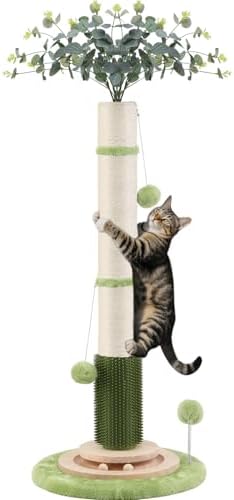
A compact post with a small footprint and a neatly wrapped sisal surface, for apartments where a full tower would take over the room and every square foot has to earn its place.

👍 Also Great
A roll of untreated natural sisal rope for rewrapping a post whose surface has gone soft. The cheapest way to bring a structurally sound post back into service, and handy to keep on hand once you own one.

Placement, Assembly, and Keeping the Sisal in Shape
Set the post where the household already is. Scratching is partly territorial signaling, so cats mark along routes and near the places they sleep and greet you, which is why a post beside the sofa gets used and the same post in a spare room does not. Doorways and the route between the bed and the kitchen are reliable spots. Our guide to where to place a cat tree applies the same room logic to bigger pieces.
Assembly is short but worth doing carefully. Bolt the column to the base fully, then check the bolts again after a day, since posts settle and a slightly loose column reads as wobble under a hard pull. Lean on the post at the height your cat would reach: if it rocks, it needs a heavier or wider base, not a rug underneath. Tall posts near shelving are worth strapping to the wall, which our guide to cat furniture safety explains in full.
Upkeep is mostly restraint. Trim frayed strands flush with scissors rather than pulling them, because pulling unwinds the coil underneath and turns a cosmetic problem into a structural one. Vacuum shed fiber off the base with an upholstery attachment, and rewrap or re-sleeve only once the surface has genuinely gone soft. If your cat ignores the post entirely, that is a training question rather than a product one, and the routine in how to get a cat to use a scratching post usually sorts it out.
Common Mistakes to Avoid
- Buying on height alone. A tall post on a light base tips under a real pull, and a post that moves once often never gets used again.
- Missing the gap between the coils. Visible core between the wraps means loose winding, and loose winding migrates under claws.
- Taking a sisal-sounding listing at face value. Jute looks similar in photos, costs less, and fuzzes out within weeks of regular use.
- Ignoring the core. Good rope over a hollow cardboard tube still compresses and goes soft.
- Replacing too early. A scruffy sisal surface usually has plenty of life left, and cats generally prefer a broken-in post.
- Hiding it. A post in a back room competes with the sofa arm in the middle of the house, and the sofa wins.
Where to Go From Here
For a closer look at the model that shows up in almost every shortlist here, our SmartCat Ultimate Scratching Post review goes through its height, base weight, and sisal fabric surface in detail. If height is your deciding factor, tall cat scratching posts is the next stop, and why cats scratch explains what the post is actually for. When one post starts to feel like too little furniture for the number of cats in the house, the hub guide to cat trees covers towers that combine scratching with climbing and sleeping, while the hub guide to the cat scratching post category remains the place to start if you are still comparing formats.
Frequently Asked Questions
Is sisal rope or sisal fabric better on a scratching post? They suit different households. Rope is coarser, grabbier, and easy to rewrap at home, while fabric sheds far less and wears more evenly. Hard scratchers tend to do well on rope, and low-mess homes tend to prefer fabric.
How can I tell if a post is wrapped well before buying? Zoom into the listing photos and look for coils pressed tightly together with no core showing between them, rope that runs from the base plate to the cap without a bare section, and ends tucked in rather than glued on the surface.
How tall should a sisal scratching post be? Tall enough that your cat can reach up with front paws overhead and pull down through a full stretch. Measure your cat stretched against a door frame and use that as the minimum for the uninterrupted scratching section.
Can I rewrap a worn sisal post myself? Yes, and it is a common repair. Strip the old rope, wind untreated natural sisal rope tightly from the bottom up with no gaps between coils, and anchor both ends under the cap and base. It costs a roll of rope and an evening.
Is sisal safe if my cat chews the fibers? Loose strands are usually spat out rather than swallowed, though not by every cat. Trim frayed pieces flush, keep long loose lengths off the post, and speak to your veterinarian if your cat regularly eats fiber or fabric.
The Bottom Line
A sisal cat scratching post earns its keep through three things: the form of the sisal, the quality of the wrap, and whether the surface can be renewed. Pick rope for grip and easy repair or woven fabric for a tidier home, insist on tight coils running the full height over a solid core and a base heavy enough to stay put, and favor a post you can rewrap or re-sleeve. Get that right and one post outlasts several of the disposable kind.