Last updated: August 8, 2026
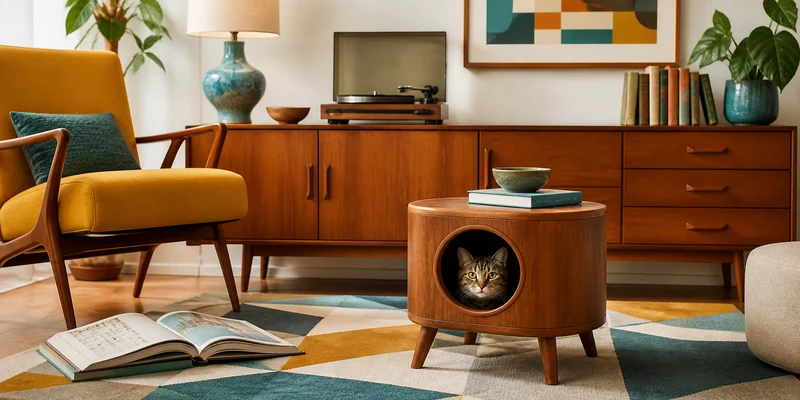
Mid century modern cat furniture is what a lot of owners go looking for after unboxing one more beige carpeted tower and realizing it does not belong in a room with a walnut credenza and a low-slung sofa. The look is specific: warm wood tones, clean geometry, and slim tapered legs that lift a piece off the floor instead of planting it there. The cat-product world has caught up, and you can now furnish a climbing spot, a nap spot, and a litter area without breaking the room.
This guide explains which design details actually read as mid-century, which ones are just marketing copy on a plywood box, and how to keep the style without giving up what cats care about: height, stability, and a scratching surface they will use. Picks below cover four categories, a cat tree, a condo, a bed, and litter box furniture.
This article contains affiliate links. If you buy through them, we may earn a commission at no extra cost to you. Learn more.
Quick Answer
What makes cat furniture mid century modern?
- Three signals do most of the work: a warm walnut, teak, or oak-look wood finish, tapered legs set at a slight angle, and simple geometric shapes with no ornament.
- Legs raise the piece off the floor, which is the single detail that separates a mid-century look from a generic wood cat tower.
- Style should not cost you stability. On any legged piece, check the footprint, the leg attachment, and whether wall anchoring is possible before you buy.
Mid-Century Signals by Piece Type
Use this as a reference while you shop: what to look for in each category, and where the style tends to collide with what your cat needs.
| Piece | Mid-century signals to look for | Watch out for |
|---|---|---|
| Cat tree or tower | Wood-veneer platforms, natural sisal posts, exposed angled legs, muted felt or bouclé perches | Tall towers on narrow legged bases can feel tippy; look for a wide footprint or an anchor strap |
| Cat condo | Closed cabinet body, round or arched entry hole, walnut or teak-look panels, hairpin or tapered legs | Entry holes sized for an average cat can be tight for a large or long-haired cat |
| Cat bed | Molded bowl or low pod on three or four wooden legs, neutral wool or sherpa liner | Elevated pods suit cats who like to perch, less so cats who prefer to burrow |
| Litter box furniture | Credenza or nightstand proportions, flush doors, brass or wood pulls, slim splayed legs | Interior width matters more than exterior style; measure your box first |
| Wall shelves | Floating wood planks, geometric brackets, wood-and-felt combinations | Stud placement dictates layout more than design does |
If you want the broader view of the category before you commit to one style, our guide to modern cat furniture covers the wider design landscape, including Scandinavian and minimalist directions.
What Actually Reads as Mid-Century
Mid-century modern furniture came out of a period that prized function, honest materials, and shapes that could be produced cleanly. Translated to cat gear, that means a few concrete details rather than a vibe.
- Tapered or splayed legs. Straight cylindrical dowels look contemporary. Legs that narrow toward the floor and splay outward a few degrees are the signature detail, and the fastest way to tell an authentic-looking piece from a rebranded box.
- Warm wood tones. Walnut is the classic, with teak and warm oak close behind. Cool gray or stark white pulls a piece toward contemporary or Scandinavian instead.
- Simple geometry. Circles, rounded rectangles, and gentle arcs. No routed trim, no faux shaker panels, no barn-door hardware.
- Honest textures. Natural sisal, wool felt, and bouclé sit comfortably in the style. Cream shag carpet does not, even though it appears on plenty of listings that use the phrase.
Two shortcuts are worth knowing. Veneer over engineered wood is normal at this level and perfectly fine; solid walnut cat furniture is rare and usually made to order. And “mid-century inspired” in a product title often just means the legs are angled, so look at the photos rather than the copy.
Style Versus Stability: The Trade-Off to Manage
Raising furniture on legs is what makes the style work visually, and it is also what makes some pieces less forgiving for cats. A tower that sits flat on the floor spreads its load across a wide base. Put the same tower on four slim legs and the effective footprint shrinks, so a hard landing produces more sway.
That does not mean legged pieces are unsafe, it means you should check three things: the ratio of height to base width, since a tall and narrow silhouette is the riskiest combination; how the legs attach, since threaded inserts set into the panel hold up better than screws driven straight into particleboard; and whether an anti-tip strap is included, which is worth using even when a piece feels solid. Our overview of cat furniture safety goes deeper on tip-over risk and anchoring.
One more practical point: sisal still matters. Cats want a tall, rigid surface they can pull against at full stretch, and a handsome piece with a token scratch patch will not redirect them away from your sofa arm. If your chosen piece is light on scratching surface, pair it with a modern scratching post in the same palette.
Our Top Picks at a Glance
How we chose: we compared widely available mid-century-styled pieces on stability, materials, scratching surface, and how convincingly the design details land in a real living room. Selections lean on manufacturer specifications and the patterns that come up repeatedly in owner reviews.
Two things worth saying up front. Design-forward cat furniture generally costs more than carpeted equivalents, so the picks below try to serve the room and the cat rather than just one of them. And for a large or long-bodied cat, size and entry dimensions should outrank looks every time.
🏆 Best Overall
A wood-panel cat tower with real climbing height and a finish that suits a living room rather than a spare bedroom. A strong starting point if you want one piece to carry the look.

💛 Best Value
Walnut-look panels, natural sisal posts, and a far friendlier price. The most accessible way to move away from carpeted towers.

⭐ Best for Open-Plan Rooms
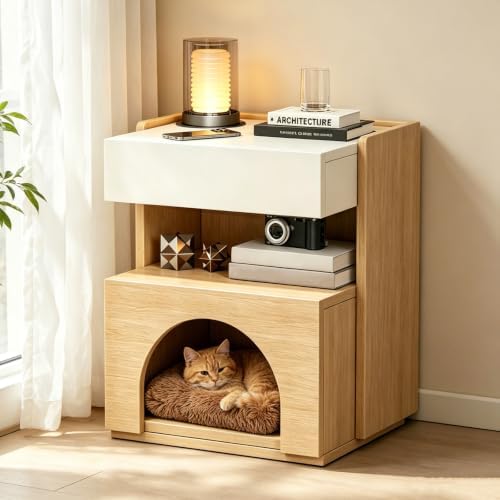
A closed condo that doubles as a wooden end table, reading as furniture first and cat gear second. Suits open-plan rooms where a tower would dominate.
Small Apartments, Rentals, and Open-Plan Rooms
Mid-century pieces do well in small spaces for a reason that has nothing to do with taste: legs create visible floor underneath, and visible floor makes a room read as larger. A legged condo in a studio apartment takes up the same square footage as a solid box but feels lighter.
If you rent, the constraint is usually anchoring. If your lease rules out anchor screws, favor pieces with a wide base and lower overall height rather than tall towers you cannot secure, and set wall-mounted systems aside unless you are prepared to patch holes later. We cover the workarounds in our guide to cat furniture for renters.
For genuinely tight rooms, a single condo often beats a multi-level tower: one enclosed hiding spot, one elevated surface, and a footprint you can slot beside a sofa. Our roundup of mid-century modern cat condos compares the enclosed options in depth, including entry sizes for larger cats.
Multi-Cat Homes and Larger Breeds
Design-led pieces are usually built to an average cat, and that assumption breaks down quickly with a Maine Coon or a household of three. Two adjustments help. Spread vertical territory across several smaller pieces instead of one tall tower, which reduces standoffs at the single good perch. And check platform dimensions rather than trusting photos, since a perch that looks generous in a styled product shot can be tight for a cat who likes to sprawl.
Weight limits are the other thing to verify, particularly on shelves and floating platforms. If height is the priority for your cats, a purpose-built modern cat tree will usually give you more usable levels than a condo will.
Completing the Setup: Beds and Litter Storage
A tower or condo covers climbing and hiding. The two pieces that most often spoil an otherwise coordinated room are the bed and the litter box, and both have decent mid-century options now.
🛏️ Best for Living Rooms
A molded pod bed raised on slim legs, with a removable liner. The legged silhouette is the detail that lets it sit in a main room instead of a corner.

🚪 Best for Hiding the Litter Box
A cabinet-style enclosure with credenza proportions and a side entry, so the box disappears into the room. Measure your existing box against the interior dimensions before ordering.

On beds, temperament decides more than style: elevated pods suit cats who like to survey a room, while burrowers prefer a covered or bolstered bed at floor level. Our roundups of modern cat beds and luxury cat beds sort the options by sleeping style. On the litter side, interior clearance matters far more than the finish, and litter box furniture covers the ventilation and odor questions a cabinet does not solve on its own.
Placement, Assembly, and Keeping the Finish Nice
Placement first. Cats use elevated furniture most when it overlooks something interesting, so a tower near a window will get used far more than the same tower in a hallway. Keep at least one piece in the room where your household actually spends time.
Assembly is where legged pieces are won or lost. Tighten fasteners in stages rather than fully seating each one in turn, which keeps panels square and prevents the small racking that leads to wobble. Check the leg bolts again after a week or two, then once a season. If felt floor pads are included, use them; they stop the legs from walking across hard floors when a cat jumps off.
Maintenance is simple. Wipe wood veneer with a barely damp cloth and dry it immediately, since standing moisture is what lifts veneer edges. Vacuum sisal with an upholstery attachment and trim loose fibers rather than pulling them. Wool and bouclé liners usually come out for washing.
Common Mistakes to Avoid
- Buying on the product title. Plenty of listings use the phrase without a single mid-century detail. Look for tapered legs and a warm wood tone in the photos, then read the specifications.
- Ignoring the scratching surface. A design piece with almost no sisal will not stop couch scratching. Budget for a proper post alongside it.
- Skipping the anchor strap. Especially on tall, narrow pieces, or in any home with kittens or a heavy cat.
- Measuring the room but not the cat. Entry holes, platform depth, and litter cabinet interiors are the three dimensions people regret not checking.
- Choosing white or gray to be safe. Neutral is easy, but it usually lands as contemporary. Wood tone is what carries the style.
Where to Go From Here
Still deciding between a climbing structure and a furniture-style cabinet? Start with our mid-century modern cat condo roundup, since that is the piece that most often has to sit in a main living space. To see which companies actually design for this look, our overview of designer cat furniture brands maps the premium and mid-tier makers, and solid wood cat trees covers the construction differences that matter over years of use.
Frequently Asked Questions
Is mid-century modern cat furniture actually good for cats? It can be, as long as it delivers height, a stable base, and a real scratching surface. The style itself is neutral; the risk is choosing a piece for its looks and ending up with too little of what your cat needs.
What wood finish should I choose? Walnut is the most reliably mid-century choice, with teak and warm oak as close alternatives. Cool gray and painted white finishes tend to read contemporary instead.
Are legged cat trees less stable? They can be, because legs reduce the effective footprint. Favor a wide base relative to the height, check how the legs attach, and use an anti-tip strap where one is provided. See cat furniture safety for the full checklist.
Can I get this look on a budget? Yes, though the material quality drops. Wood-veneer towers with sisal posts from mainstream brands get you most of the way there, and a neutral bed on wooden legs finishes the look inexpensively.
Does litter box furniture in this style control odor? A cabinet hides the box but does not manage odor by itself; ventilation, litter choice, and cleaning frequency do. Our litter box furniture guide covers what to look for.
The Bottom Line
Mid-century modern cat furniture comes down to three details: a warm wood tone, tapered legs, and simple geometry. Just do not let styling override the basics, since height, a stable base, and a proper sisal surface decide whether your cat uses the piece at all. Start with one anchor piece, a tower or a condo, then add a bed and litter storage in the same finish.