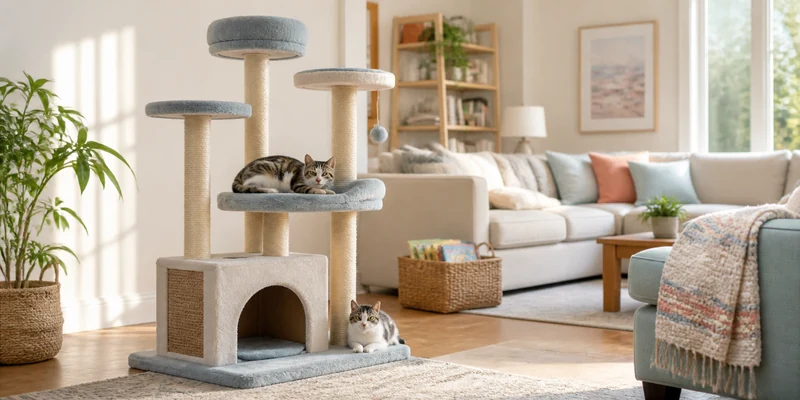
Last updated: August 8, 2026
Looking for the best large cat tree usually means you have already outgrown the starter tower. Maybe two cats keep claiming the same top perch, maybe the 32-inch model in the corner gets ignored because the windowsill is higher, or maybe you have a room with space to give and you want that space to work. A large tree, roughly 60 inches and up, changes what the piece does in a home: it stops being a scratching post with a shelf on top and becomes vertical territory your cats actually live on.
This guide is about size and layout, not about heavy cats. It covers how tall is tall enough, how much floor space a big tower needs, what separates a stable large tree from a swaying one, and which configurations suit multi-cat homes. If your question is about carrying capacity for a chunky or long-bodied cat instead, head to our guide to cat trees for large cats, which covers platform sizes, weight limits, and build strength.
This article contains affiliate links. If you buy through them, we may earn a commission at no extra cost to you. Learn more.
Quick Answer
What counts as a large cat tree, and how big should yours be?
- Most towers labeled large sit between 60 and 70 inches. Past about 70 inches you are into extra large territory, where ceiling height and anchoring start to matter.
- Base footprint matters as much as height. A tall tower on a small base sways, and cats stop using perches that move under them.
- Count perches, not levels. Two cats want two comfortable spots at similar heights, not one prized summit and a stack of small steps.
Cat Tree Sizes at a Glance
Manufacturer size labels are inconsistent, so it helps to think in height bands. Use this to work out which band you are actually shopping in before comparing individual towers.
| Height band | What you get | Works best for | Space to plan for |
|---|---|---|---|
| Under 40 in | A post, one or two perches, sometimes a small cubby | Kittens, seniors, a second tree in a bedroom | Fits beside furniture, no anchoring needed |
| 40 to 55 in | Three or four levels, one condo, a hammock or top bowl | One cat, apartments, reaching a standard windowsill | About two feet square of clear floor |
| 55 to 70 in (large) | Five or more levels, multiple posts, a top perch above eye level | Two cats, active climbers, replacing a smaller tree | Two and a half feet square, plus landing room |
| 70 to 80 in (extra large) | Branching layouts, several perches at similar heights, full-height posts | Three or more cats, high ceilings | Three feet square or a wide rectangular base |
| 80 in and up | Floor-to-ceiling or tension-mounted systems | Dedicated cat rooms, catio-style setups | Requires ceiling contact or wall anchoring |
Two clarifications save a lot of returned boxes. First, large refers to the tree, not the cat: a 68-inch tower can still have perches too small for a Maine Coon. Second, if your goal is purely elevation rather than a big multi-level structure, a slim tall cat tree gives you height on a much smaller footprint. Our main cat tree buying guide compares the categories side by side if you are still deciding.
Why Height Changes Cat Behavior
Cats use vertical space to manage two things: safety and information. A perch above human head height gives a clear view of doorways and a position nothing can approach from above, which is why the top level of a tall tower is usually the contested spot in a multi-cat home. Shelter and behavior guidance has pointed at vertical territory for years as a way to reduce friction between cats sharing a floor plan. A 65-inch tower clears a sofa back and most windowsills, so your cat can survey a room from a spot you have not surrendered.
Height does have a ceiling of usefulness, and your room sets it. With standard eight-foot ceilings, a 72-inch tree leaves roughly a foot of headroom, comfortable for a cat sitting up on the top perch but tight for one who likes to stand and stretch. If your ceilings are low, spending on a wider base and better perches beats chasing the last few inches.
Stability: The Thing That Decides Everything Else
The most common complaint about large cat trees is wobble, and it is usually geometry rather than a defect. As a tower gets taller, the same base has to resist a longer lever. Owners report the same pattern repeatedly: the tree feels fine when assembled, then starts to shift once a cat begins launching off the top perch instead of climbing down.
- Base width versus height. As a rough guide, look for a base at least a third as wide as the tree is tall. A 66-inch tower on a base under 20 inches square is asking for movement.
- Base thickness and weight. Heavier is better. A thin particleboard base saves shipping cost and gives you nothing to work with.
- An anti-tip strap. Most reputable large trees include one, and on any tower past about 60 inches it is the cheapest safety upgrade available.
- Post construction. Full-length posts running through several levels stiffen the whole structure. Short posts stacked between platforms create a hinge at every joint.
Flooring plays a part too: thick carpet lets a base rock slightly and hard floors let it slide, and a thin rubber mat underneath fixes both. Our overview of cat furniture safety goes further into tip-over risk and anchoring hardware.
Our Top Picks at a Glance
How we chose: we compared widely available large towers on base footprint relative to height, number and size of usable perches, post construction, and whether the layout suits more than one cat. Selections are based on manufacturer specifications and patterns that come up repeatedly in owner reviews, not on hands-on assessment.
Two notes first. Large trees ship as heavy flat-pack boxes and take real assembly time, usually an hour or more. And carpeted towers still dominate this size class; wood-look construction at this height means fewer options and a step up in price, which our solid wood cat tree guide covers separately.
🏆 Best Overall
A multi-level tower in the mid-60-inch range with a wide plush base, several sisal posts, and a mix of condos, perches, and a top basket. A sensible default if you want one piece to cover climbing, hiding, and napping.

💛 Best Value
A large multi-level tower around the 60-inch mark at a friendlier price, with the usual condo plus hammock layout. Good value if you want size without paying for a premium finish.

⭐ Upgrade Pick
A 72-inch tower for homes with the ceiling height to use it, with perches spread across the structure rather than stacked in a single column.

Planning the Space: Footprint, Landing Room, and Ceilings
People measure the corner and forget the air around it. A large tree needs three kinds of space, and only one is on the product page. Footprint is the base plus any overhanging perches, which on branching designs stick out further than the base. Landing room is the clear floor a cat needs jumping down, ideally a couple of feet on the approach side. Headroom is the gap between top perch and ceiling.
Measure your windowsill height before you commit, because matching or slightly exceeding it turns the tree into a window seat and roughly doubles how much it gets used. Our guide to where to place a cat tree covers the rooms and sightlines that work.
If the measurements come back tight, drop a height band rather than forcing a 70-inch tower into a corner it does not fit. Our small cat tree roundup covers compact towers that still deliver usable height.
Large Trees for Multi-Cat and Multi-Perch Homes
Once you have more than one cat, layout matters more than height. A tall column with a single premium top perch creates competition, since there is exactly one prime spot and someone has to lose it. A branching design with two or three perches at similar heights spreads the value out and tends to produce fewer standoffs.
Look for wide platforms rather than small round pads, at least two covered spots if you have shy cats, and routes that do not force one cat to squeeze past another. Sisal should run the full height of the main posts so an adult cat can stretch out to scratch.
🐾 Best for Multi-Cat Homes
A wide-base multi-level tower with perches spread across several vertical lines instead of one stacked column, so two or three cats can settle at similar heights without negotiating.

👍 Also Great
A 72-inch tall tower with six sisal scratching posts and a plain, neutral finish. A solid alternative if the picks above are out of stock or you want a simpler look.

If your household is about numbers rather than size, our roundup of cat trees for multiple cats ranks layouts by how well they distribute perches. And if one of your cats is a large breed, check platform dimensions against the cat first; the Maine Coon cat tree guide explains which perch sizes work for long-bodied cats.
Assembly, Placement, and Keeping It Solid
Large trees arrive in one or two heavy boxes and go together with a hex key and a lot of bolts. Lay out all the parts and check them against the manual first, since a missing dowel discovered halfway up is a bad time. Build in the room where the tree will live, because a finished 70-inch tower is awkward to carry through a doorway. Tighten bolts in stages rather than fully seating each one before moving on, which keeps panels square and prevents the slight racking that turns into wobble later. Fit the anti-tip strap while you still have easy access to the top.
Give it a fortnight, then re-tighten everything: fabric compresses under the fasteners in the first weeks of use and bolts loosen as a result. Repeat every few months on a tree that gets heavy use.
Maintenance is straightforward. Vacuum plush surfaces with an upholstery attachment, and trim frayed sisal strands flush instead of unwinding them. When a main post wears through, many trees allow you to rewrap it with sisal rope, which is far cheaper than replacing the tower. Our guide to sisal cat trees covers rope type and thickness if you plan to do that.
Common Mistakes to Avoid
- Buying on height alone. A tall tower with a small base and thin perches gets used less than a shorter one built properly. Base width and perch size predict use better than total height does.
- Confusing a large tree with a tree for large cats. Different problems. One is about the room, the other about weight limits and platform dimensions.
- Skipping the anti-tip strap. Especially with kittens learning to launch, or when the tree sits near a walkway.
- Putting it in the quiet room. Cats want to watch the household, not hide from it. A large tree in a spare bedroom is expensive furniture nobody uses.
- Forgetting landing room. The jump down needs clear floor. Glass tables, floor lamps, and litter boxes beside a tall tower are all worth relocating.
Where to Go From Here
If the floor space is there but the ceiling is not, a tall cat tree with a narrow profile may serve you better. If your motivation is a specific cat rather than a specific room, start with cat trees for large cats and work back from weight limits and perch dimensions. Still weighing formats? The hub guide to cat trees lays out the whole category.
Frequently Asked Questions
How tall is a large cat tree? Most towers marketed as large fall between 60 and 70 inches. Above that, manufacturers usually switch to extra large, giant, or XXL, and below about 55 inches you are in medium territory regardless of the label.
Is a large cat tree the same as a cat tree for large cats? No. Large refers to the structure and the room it needs; a cat tree for large cats is about weight capacity and perch dimensions. Our guide to cat trees for large cats covers that question in detail.
Do large cat trees tip over? They can if the base is narrow relative to the height, if the floor is uneven, or if the anti-tip strap is left in the box. A wide heavy base plus a wall anchor makes tipping unlikely in normal use.
Is one large tree better than two medium ones? It depends on your floor plan. One large tree gives more height and a stronger focal point; two medium trees in different rooms give more cats access to elevation at once.
Will my cat use all the levels? Usually not equally. Most cats settle on one or two favorite perches, typically the highest and one with a view. That is normal, and it is why perch quality matters more than the level count on the box.
The Bottom Line
A large cat tree earns its space when the base is wide enough to stay still, the perches are big enough to lie on, and the top sits at or above windowsill height in a room your household actually uses. Match the height band to your ceiling rather than buying the tallest tower you can find, and anchor anything past about 60 inches. If your question is really about a big cat rather than a big tree, size the perches to the cat first.