Last updated: August 8, 2026
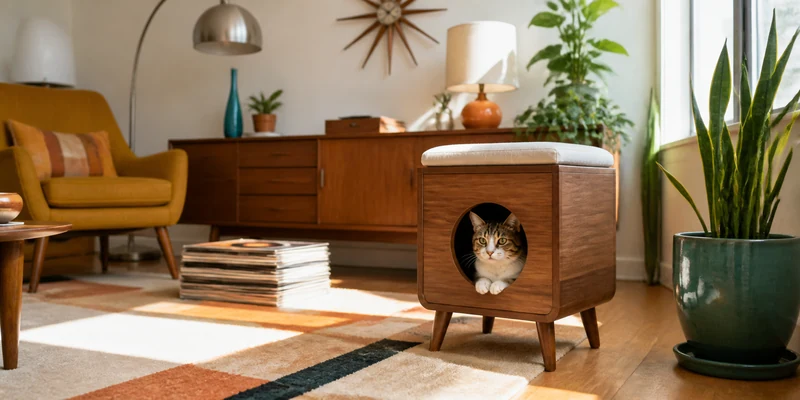
Shopping for a mid century modern cat condo usually starts the same way: you want an enclosed hiding spot for your cat, you look at what is available, and everything is either beige carpet or a plastic cube. What you are picturing instead is a small cabinet in warm walnut or teak, sitting on legs that taper toward the floor, with a round entry hole cut into a clean flat panel. That piece exists, but there are fewer honest examples than the search results suggest.
This guide is about condos specifically, meaning enclosed furniture-style units with a covered interior, not open climbing towers. It covers which design details actually deliver the look, where the style quietly works against your cat, and which widely available options come closest. If you want the same treatment for cat trees, beds, and litter storage, our wider guide to mid century modern cat furniture covers those categories.
This article contains affiliate links. If you buy through them, we may earn a commission at no extra cost to you. Learn more.
Quick Answer
What makes a cat condo mid century modern?
- Three details: a warm walnut or teak-tone finish, a simple boxy or gently arched body with no ornament, and legs that taper and splay slightly outward.
- Genuinely tapered legs are rare in cat condos. Plenty of good options get most of the look from wood tone and geometry alone, and some flat-bottom cabinets accept aftermarket tapered legs.
- Check the entry opening and interior width before you fall for the finish. A condo your cat has to squeeze into will sit empty no matter how well it suits the room.
Mid-Century Condo Silhouettes at a Glance
Enclosed condos come in a handful of recognizable shapes. Knowing which silhouette you are after narrows the search faster than scrolling through listings, because each one suits a different room and a different cat.
| Silhouette | Mid-century signals | Suits |
|---|---|---|
| Cabinet on tapered legs | Walnut or mahogany-tone panels, splayed legs, round or arched entry, flush surfaces | Living rooms and any space where the piece is on show |
| Box condo on a plinth | Warm wood-look panels, cube geometry, an inset sisal panel, no visible hardware | Apartments and corners where a small footprint matters |
| Credenza-style unit | Low horizontal body, flush doors, wood or brass pulls, slim angled legs | Doubling as storage or a console along a wall |
| Wood-frame condo with fabric pods | Exposed wood posts, muted felt or bouclé, geometric openings | Cats who want cover and height in one piece |
| Arched-entry wooden house | Rounded doorway, dowel legs, honest plywood edges, natural finish | Shy cats and ground-level dens |
If you have not settled on a condo versus an open climbing structure yet, that decision comes first, and our cat condo versus cat tree comparison lays out the behavior question behind it. The broader picks across all condo types sit in our cat condo guide.
The Legs Are the Whole Trick
Take any plain wooden cat box, raise it on four legs that narrow toward the floor and splay outward a few degrees, and it reads as mid-century immediately. Leave the same box sitting flat and it reads as a storage crate. That one detail carries more of the style than the wood tone does, which is why so many listings use the phrase while showing a piece with no legs at all.
Three leg types show up in this category. Tapered wooden legs are the classic and the most convincing. Hairpin legs in black or brass steel are a related period look and are common on cat furniture because they are cheap to source. Straight cylindrical dowels are the weakest option visually, since they push a piece toward contemporary Scandinavian instead.
Legs come with a trade-off worth taking seriously. A condo that sits flat spreads its load across the full base. Raise it and the effective footprint shrinks to four small contact points, so a cat launching off the top produces noticeably more sway. Check how the legs attach, since threaded metal inserts set into the panel hold far better than screws driven straight into particleboard, and re-tighten them after the first couple of weeks. Taller units are worth strapping to the wall, and our overview of cat furniture safety covers anchoring and tip-over risk in detail.
One practical workaround: several flat-bottom wooden condos have a solid base panel that accepts standard furniture legs with a mounting plate. If you are comfortable drilling pilot holes, a set of walnut-stained tapered legs turns a generic wooden cat house into something much closer to what you were picturing. Keep the added height modest, since a taller center of gravity works against stability.
Walnut, Teak, and What You Are Actually Buying
Almost everything in this category is engineered wood with a veneer or a printed wood-grain laminate, and that is fine. Solid walnut cat furniture barely exists outside of made-to-order workshops, and even in human furniture the mid-century pieces people admire were often veneer over a stable core.
What separates a convincing finish from a cheap one is usually the edges and the tone. Look at how panel edges are treated in the photos, since a matching edge band reads as furniture while a raw or mismatched edge reads as flat pack. On tone, warm walnut is the safest choice, with teak and a warm mid oak close behind. Cool gray, whitewash, and stark white all pull a piece toward contemporary, which may be what your room needs but is not the same look.
Two more things to weigh before the finish decides for you. Wood panels are easy to wipe but offer nothing to scratch, so a condo alone will not redirect a cat away from your sofa arm. If your pick has only a token sisal patch, plan on pairing it with a modern scratching post in a matching palette. And a closed wooden box holds warmth and smell more than an open tower does, so ventilation openings and a removable, washable cushion matter more here than they would on a cat tree.
Our Top Picks at a Glance
How we chose: we compared widely available enclosed condos on silhouette and finish, entry size, stability, and how convincingly each one holds up in a room people actually sit in. Selections lean on manufacturer specifications and the patterns that come up repeatedly in owner reviews.
Two things worth saying before the list. Design-led condos generally cost more than carpeted equivalents, so two of the picks below stay firmly in mass-market territory to keep the look reachable. And if your cat is large, long-bodied, or heavily coated, entry dimensions should outrank the finish every time.
🏆 Best Overall
A walnut-look box condo with clean cube geometry, an inset scratch panel, and a removable cushion. It gets the wood tone and the shape right at a price that does not feel like a design purchase.

💛 Best Value
A wooden cat house with warm natural panels and a simple cave entry, the most affordable route to the silhouette. The easiest candidate for adding aftermarket tapered legs later.

⭐ Upgrade Pick
A furniture-grade enclosed condo that reads as an end table first and cat gear second. The closest thing in this category to a genuine furniture silhouette.

Entry Openings, Interiors, and Bigger Cats
Design-led condos are built to an average cat, and that assumption falls apart quickly with a Maine Coon, a Ragdoll, or any cat who fills a shoebox. The measurement that matters is not the cabinet footprint but the entry opening, since a cat approaching at speed needs the hole to clear their shoulders without a pause. Cats will use a tight opening, but they use it less, and a condo they hesitate to enter is a piece of furniture rather than a cat space.
Interior height is the second thing people regret not checking. A cat should be able to turn around, sit upright, and stretch out along one wall. Measure your cat curled up and then stretched out, and compare both numbers against the interior dimensions in the listing rather than the outside dimensions in the title.
A third point on layout: enclosed boxes with a single opening can become a corner during a squabble, so a second exit or a top opening is worth looking for in a multi-cat home. If you are shopping for a genuinely large cat, our roundup of cat condos for Maine Coons works through the sizing question in more depth.
Small Apartments and Rentals
Mid-century pieces do well in small rooms for a reason that has nothing to do with taste. Legs leave visible floor underneath, and visible floor makes a room read as larger. A legged condo occupies the same square footage as a solid box but feels lighter in a studio apartment, which is exactly why the style keeps resurfacing in small-space design.
Renters run into a different constraint. If your lease rules out anchor screws, avoid tall narrow units you cannot secure and favor a low, wide silhouette with a generous base. Credenza-proportioned condos are the natural fit here, since they are stable by shape rather than by anchoring. Our guide to cat furniture for renters covers the rest of the workarounds, including how to add vertical space without touching the walls.
In very tight rooms, a single condo often serves better than a multi-level tower: one covered hiding spot, one elevated surface on top, and a footprint you can slot beside a sofa. If the litter box is the other thing spoiling the room, the same cabinet logic applies to litter box furniture, and matching the two finishes is a cheap way to make a small space look deliberate.
Two More Condos Worth a Look
These two cover the situations the picks above handle less well: a larger cat who needs a wider opening, and a room where a lighter Scandinavian-leaning wood tone works better than walnut.
🐈 Best for Large Cats
An oversized two-tier wooden condo with two access holes and a taller interior, so a big cat can turn and stretch inside rather than reversing back out. Check the interior dimensions against your cat before ordering.

🌿 Also Great
A light wood-tone piece with a solid wooden frame and a muted fabric condo, closer to Scandinavian than to walnut mid-century but a clean fit for brighter rooms.
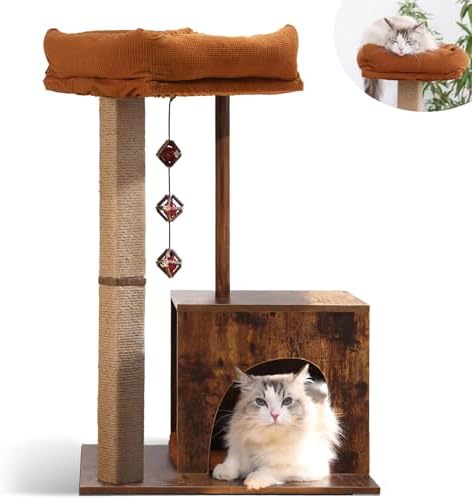
Both sit in the mid-market rather than the premium tier. If you want to see who is designing seriously for this look before committing, our overview of designer cat furniture brands maps the makers, and our Refined Feline review goes into the brand behind the upgrade pick above.
Placement, Assembly, and Keeping the Finish Nice
Placement decides use more than any specification does. Cats settle into an enclosed space when it sits somewhere they already feel safe, which usually means a room with people in it, against a wall, with a sightline to the door rather than facing it head on. A condo in a spare bedroom gets used at a fraction of the rate of the same condo beside the sofa. Our notes on where to place a cat tree apply almost unchanged to condos.
On assembly, tighten every fastener partway first and only fully seat them once the whole cabinet is square. Doing it panel by panel is what produces the racking that leads to a wobble nobody can trace later. Use the felt pads if they are included, since legs on hard floors will otherwise walk a few inches every time a cat jumps down.
Maintenance is straightforward. Wipe veneer or laminate with a barely damp cloth and dry it right away, because standing moisture is what lifts veneer edges over time. Vacuum sisal with an upholstery attachment and trim loose fibers instead of pulling them. Take the cushion out and wash it on a schedule rather than waiting for it to look dirty, since a closed box concentrates smell far more than an open perch does.
Give a new condo time before you judge it. Many cats ignore a new enclosed space for a week or two. Leaving a familiar blanket inside and dropping a few treats near the opening usually moves things along faster than picking your cat up and placing them in it.
Common Mistakes to Avoid
- Buying on the product title. A lot of listings use the phrase with no period detail present. Look at the photos for tapered legs, a warm wood tone, and flush unornamented panels, then read the specifications.
- Measuring the room but not the cat. Entry opening, interior height, and interior depth are the three numbers people wish they had checked.
- Assuming the finish is solid wood. Nearly all of it is veneer or laminate over engineered board, which is normal at this level but changes how you clean it and how much weight the panels take.
- Skipping the scratching surface. A closed cabinet gives a cat nothing to pull against. Budget for a proper post alongside it.
- Ignoring ventilation. A sealed box with one small hole and a plush cushion gets warm and holds odor. Look for a second opening or vent cutouts.
- Choosing white or gray to play it safe. Neutral is easy, but wood tone is what actually carries this style.
Where to Go From Here
If a condo turns out to be the wrong shape for your cat, the honest comparison in cat condo versus cat tree is the place to check before spending. If it is the right shape and you now want the rest of the room to match, our mid century modern cat furniture guide covers trees, beds, and litter storage in the same palette, while modern cat furniture maps the wider design landscape including minimalist and Scandinavian directions. For the nap side of the setup, modern cat beds pairs well with a legged condo.
Frequently Asked Questions
Is a mid-century condo worth it over a plain cat house? Only if the room matters to you. Cats respond to cover, stability, and placement, not to leg profiles, so the premium buys you a piece you are happy to keep in a main living space.
Are condos on legs stable enough? They can be, but legs shrink the effective footprint. Favor a wide base relative to the height, check that legs mount into threaded inserts rather than bare particleboard, and anchor taller units. See cat furniture safety for the full checklist.
Can I add tapered legs to a flat-bottom cat condo? Often yes, if the base is a solid panel that will take a mounting plate. Keep the added height modest and re-check the fasteners after a few weeks of use.
Will my cat actually use an enclosed condo? Cats who already hide in boxes, closets, or under beds usually take to one quickly. Cats who prefer to survey the room from above tend to get more out of an open tower, which our cat condo guide discusses alongside the enclosed options.
Do these condos smell over time? A closed box holds odor more than an open perch, so a washable cushion and some airflow matter. If your cat starts avoiding a space they used to like, or grooming changes, mention it to your veterinarian rather than assuming it is the furniture.
The Bottom Line
A mid century modern cat condo comes down to warm wood tone, simple geometry, and legs that taper toward the floor, with the legs doing most of the visual work. Buy for the entry opening and interior first and the finish second, since a condo your cat avoids is just a cabinet. One well-placed piece beside the sofa beats a handsome one in a spare room.